





While archaeologists thought they had explored all the secrets of the Peruvian desert, an artificial intelligence has just achieved the impossible: detecting hundreds of 2000 year old drawings which were until now invisible to the human eye.
It is a technological feat that sweeps away decades of uncertainty. While experts explored every centimeter of this arid territory for 80 years, artificial intelligence revealed hundreds of colossal secrets, invisible to the naked eye, which are shaking up our vision of History. And this, in just 6 months.
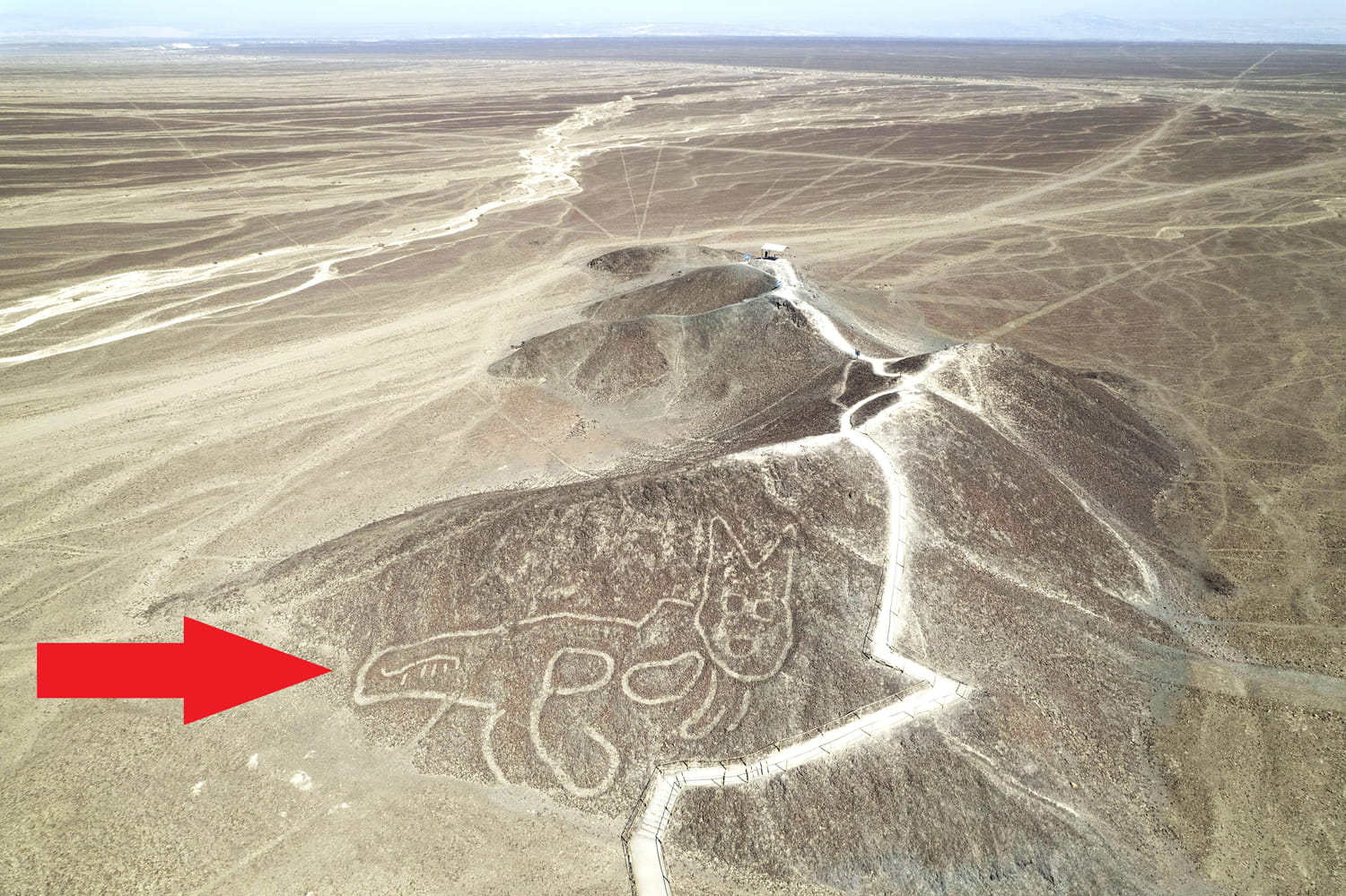
You have to imagine a desert of dust and stones, burned by the sun and polished by the wind. It is here, on one of the most hostile soils on the planet, that men engraved hundreds of monumental messages two millennia ago. But time and erosion have done their work: these traces have become so subtle and discreet that even the most experienced archaeologists, who fly over the area by plane or analyze satellite images, pass by without seeing anything. For 80 years, the number of discoveries stagnated and archaeologists thought they had covered the issue. But that was without counting on the computing power of IBM and researchers from Yamagata University who made it possible to identify 303 new archaeological treasures (see photos below).
These treasures are the famous lines of the Nazca Desert, Peru. These are huge geoglyphs – giant drawings made on the ground – which represent animals, plants and strange humanoid creatures, the most famous of which are the monkey, the hummingbird or the spider. The AI detected others: smaller drawings, located along ancient pilgrimage paths, which had remained hidden in the desert landscape since 200 BC. Concretely, it spotted figures resembling human beings wearing masks, or silhouettes with disproportionate heads. Some almost look like modern cartoon characters, which adds to the mystery.
She also identified depictions of human sacrifice. For example, we see figures holding severed heads. This confirms that these lines were not just “beautiful”, but linked to deep and sometimes violent religious rites. More surprisingly, she detected exotic animals whose presence was unknown in the Nazca culture. But also shapes representing tools or objects, such as fishing nets, which show the importance of maritime resources for these desert people.
This discovery changes everything about the role of these giant drawings. Until now, archaeologists thought that they served as an astronomical calendar or that they were messages intended for the gods. Thanks to the mass of data collected by AI, they now have a fascinating new lead: these drawings are actually ritual signposts. The ancient inhabitants would have engraved them to communicate with travelers and guide them to Cahuachi, the great city of pyramids, during sacred ceremonies. Through these drawings, the Nazcas “spoke” to the pilgrims: each figure (an orc, a severed head, a lama) acted as a ritual symbol, preparing the traveler’s mind as he approached the sacred temples.
The human eye had missed them because the big difference with the “historic” lines (like the Hummingbird which is 96 meters long) is that these new figures are smaller (often between 5 and 15 meters) and located near the trails. At ground level, they look like simple piles of stones. The AI had to analyze the contrast of the pixels on thousands of aerial photos to understand that they were intentional drawings.