




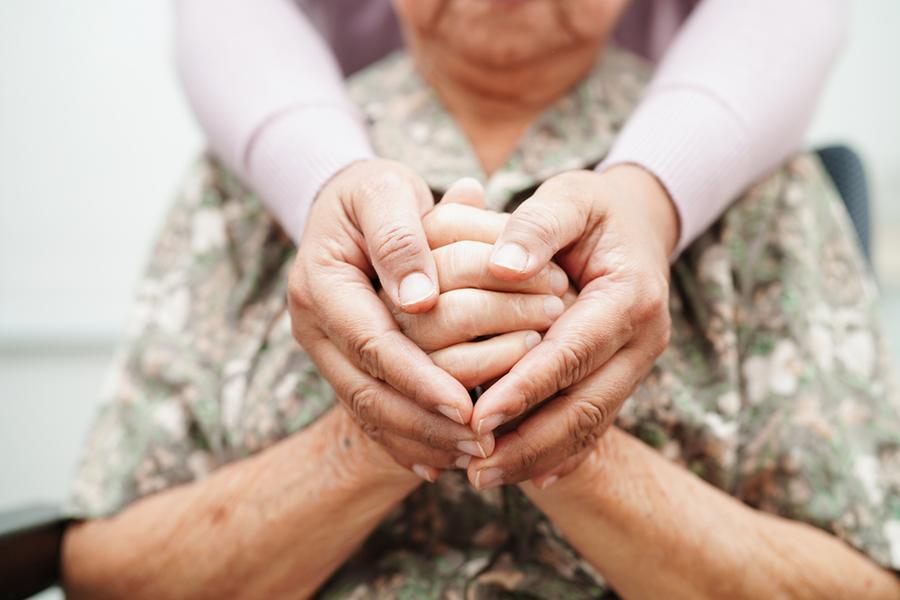
On Monday 12 January the Council of Ministers approved a long-awaited regulation, which recognizes and defines more precisely the figure of the “caregiver” (literally: the one who provides care), also identifying an economic support plan, which for 2027 provides a budget of 257 million euros. Being a government bill, the text will have to be approved by both houses of parliament to come into force. And this could already be a problem….
Minister Alessandra Locatelli rightly claims this result, for several reasons: first of all, in the last ten years as many as 30 laws had been presented in Parliament, without successbut today we have reached a definitive text, capable of putting public economic resources and services into motion. Furthermore, we have finally reached a formalized definition of the role, one of the stumbling blocks on which many regulatory proposals had run agroundwith a “reasonable” solution: measuring the time of care and cohabitation, expanding the caregiving function also to “non-relatives” figures, and also to people “not co-resident” with the non-self-sufficient person. It was then decided to explain gradual monetary support (up to a maximum of 400 euros per month)but other lines of support are foreseen, not all of which are perfectly outlined (facilitating the caregiver in working contexts, guaranteeing greater flexibility, ensuring more voice and listening in the relationship with services).
Yet the reactions of many family and caregiver associations were not enthusiastic: beyond an inevitable (and somewhat formal) recognition of the goodness of the result achieved (finally a law!), criticism was raised on numerous points: first of all the idea that the entire process can only start from 1 January 2027 (2026 essentially serves to build the INOPS platform and define the system, with a budget of just over one million euros). As if to say: For those who have a non-self-sufficient person at home, waiting any longer is tough! The model for selecting recipients of financial support is also judged to be too restrictive; an ISEE that is too low, and over 90 hours of cohabitation/care per week: too many situations remain left out. Moreover, the most reliable estimates at national level (Istat and Cnel) speak clearly: there are 3 million 800 thousand non-self-sufficient people in Italy, there should be around 7 million caregivers: it is impossible to support everyone financially, and it therefore becomes essential to find “fair” criteria to reduce the recipients. With 400 euros per month (4,800 euros per year), the 257 million in 2027 would go to just over 53,000 people. Other objections concern the weak role envisaged for caregivers in interacting with services – and family members know well how important their voice is in discussions with doctors, family assistants, nurses, etc., at home and in clinics, hospitals, etc. Some associations have also complained about poor listening during the construction of the law – and this too constitutes a significant issue.
However, in a nutshell, the approval of this law, between lights and shadows, rather than solving, reveals a gigantic problem for the entire community welfare system of the future, to which this law obviously cannot provide an answer: the prospect of exponential growth in the demand for assistance for the non-self-sufficient, with relative growth in healthcare spending, and the absolute centrality, especially at the level of home care, of the proximity caregiving system – especially family care. In other words, if we intend, as it seems, to move the support and care of non-self-sufficient people to their homes as much as possible, this means recovering and supporting the help from families, also with significant economic aid. So a law that at least begins to define and support family and community caregiving functions is good: but the Ministry of Health, the Ministry of Economy (who holds the purse strings for public spending…), and of course the Head of Government will also have to deal directly with this issue. This is not an issue for a few, but concerns the overall balance of the entire country.