





Between sudden overdose and ineffective treatment, here is why this simple visual feature is often misleading and how to tell the difference to take your medication safely.
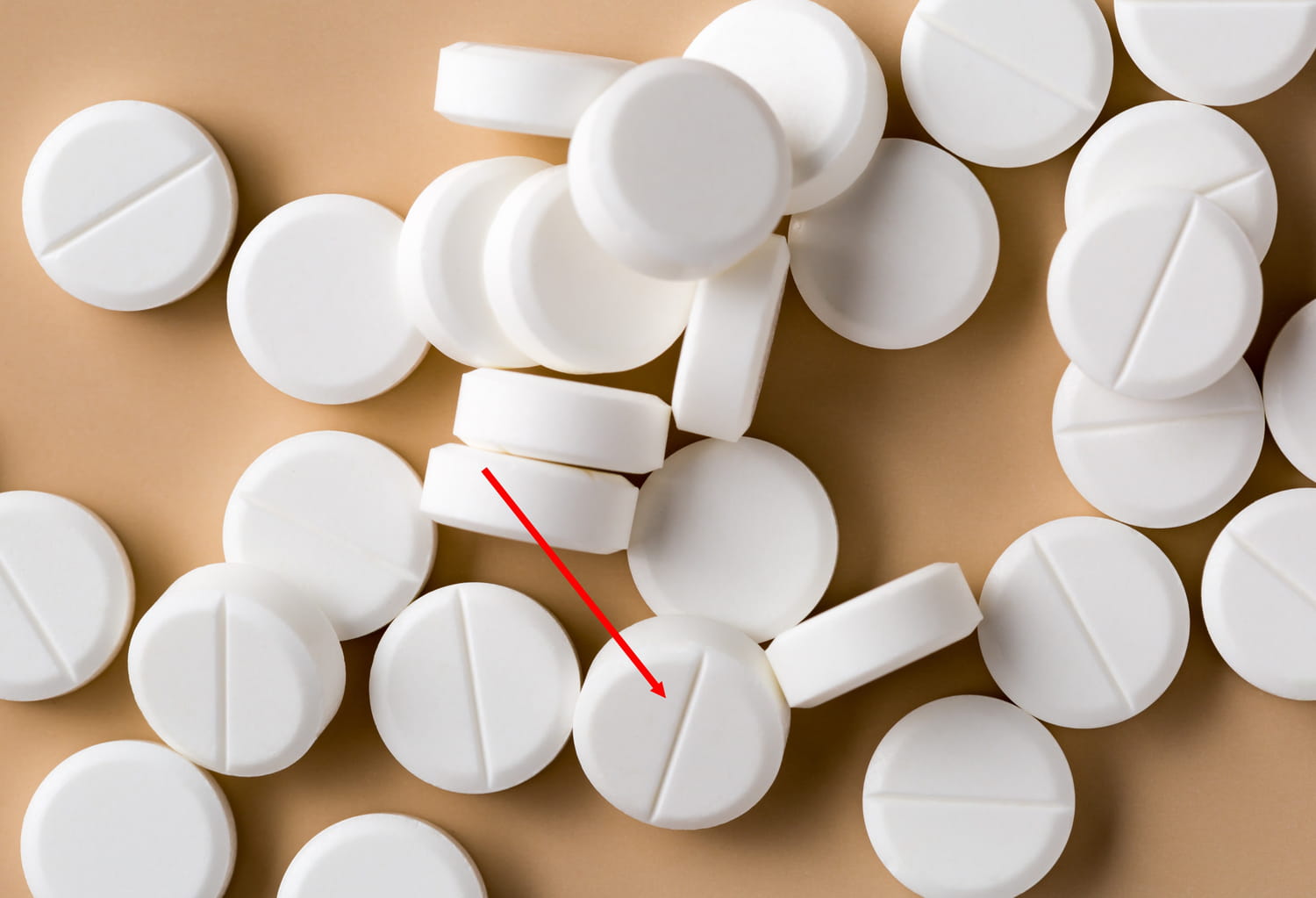
To adjust a drug treatment, it is sometimes necessary to divide the dose: this is the role of so-called “scored” tablets. These medications have a central groove (or cross) specifically designed to cut them into equal parts. The best-known example is Lexomil® (anxiolytic), whose bar form is officially “quadrisable”. For these products, the laboratory guarantees that the active ingredient is distributed evenly throughout the tablet. By cutting it, you can be sure of absorbing exactly the desired fraction of the dose. But be careful, because a groove on a medicine does not necessarily mean that it is breakable.
Many tablets display a similar line that is just a “score line”, a common visual trap. As the pharmacist @Topiramatee warns on X: “There are two types of lines: the break bar and the break bar”. If the first allows for dosing, the second only serves to reduce the size of the tablet to help people who have difficulty swallowing, but the entire pieces must be ingested. Confusion is risky because “the distribution of the active ingredient (…) is not necessarily homogeneous, therefore swallowing half of a tablet exposes the patient to a risk of overdose or underdose” warns the Pharmacies Monitor.
This error of judgment can prove dangerous, “not to mention that certain medications should not be cut”insists @Topiramatee. This is the critical case of Prolonged Release (LP) treatments, such as painkillers such as Tramadol LP. If you cut these technical drugs, “you will destroy its structure”warns the pharmacist. The physiological consequences are serious: “The active ingredient which was to be released gradually over 12 hours will be released suddenly”. This phenomenon exposes the patient to immediate toxicity by overdose, followed by therapeutic ineffectiveness for the rest of the day.
What about medications that don’t have any grooves and you’re tempted to cut them yourself? “It’s the same problem as with the breakout bar: you have no guarantee that you will have strictly equal shares in terms of active ingredient content”explains @Topiramatee. In addition, some tablets are coated to protect the mucous membranes; breaking them can cause burns or ulcers, as OMEDIT points out in its recommendations for good use. This is particularly the case for certain medications against osteoporosis or gastro-resistant drugs whose film coating must never be broken.
To avoid any accident, vigilance is required. “Only tablets whose packaging or instructions specify that they are “scored tablets” can be cut to make half doses”recalls the Moniteur des Pharmacies. It is therefore essential to check this notice on the box or the instructions. If you have lost the packaging, the information is available free online at the Public Medicines Database. Finally, if in doubt, ask for confirmation at the pharmacy.