


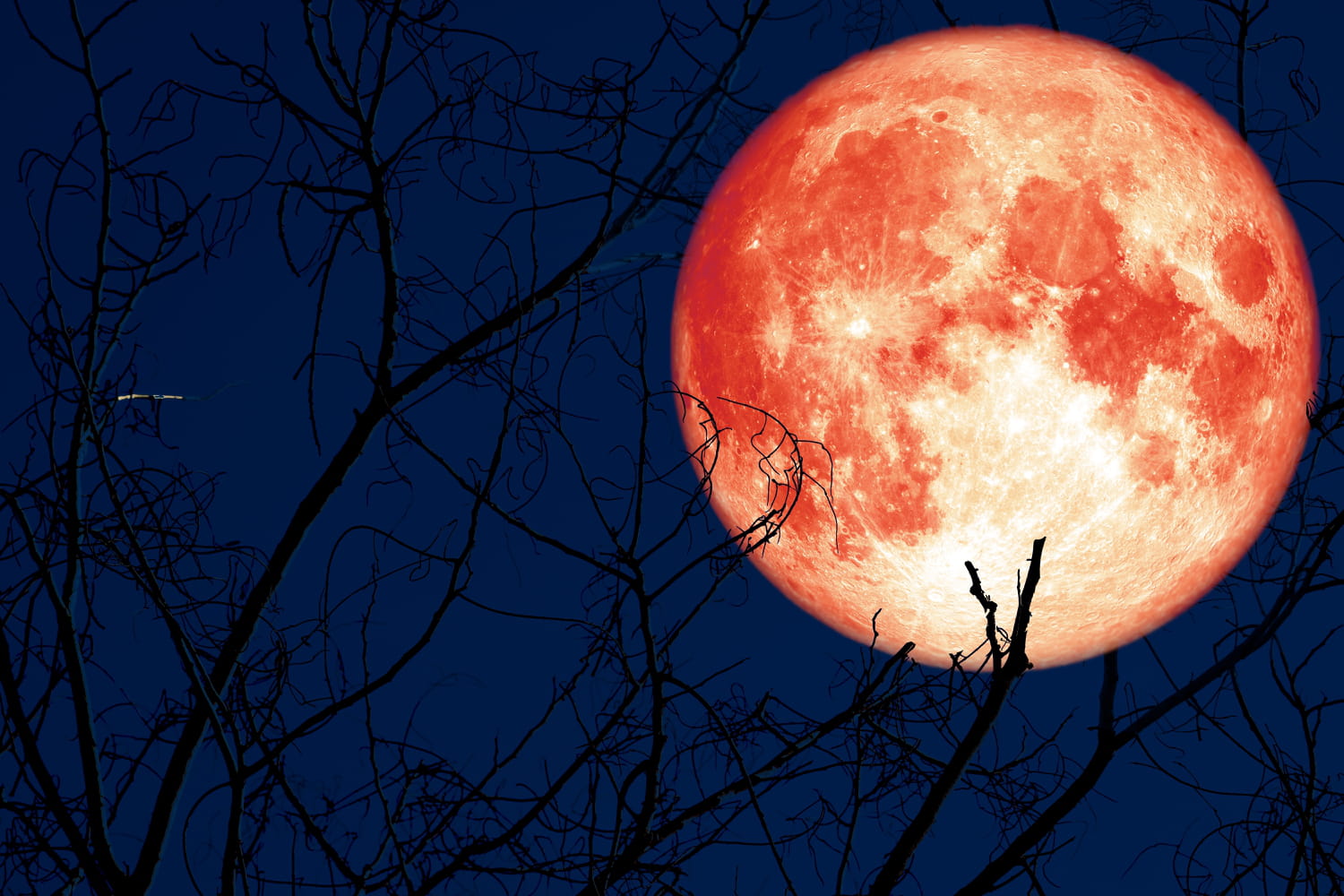



In astronomy, we call this phenomenon “Blood Moon”, a poetic name given to a total lunar eclipse.
Usually pure and dazzling white, the Moon sometimes abandons its usual color to drape itself in a copper robe, offering an almost unreal spectacle. This is what astronomers call the “Blood Moon”, a poetic name given to a total lunar eclipse. Such an event had not benefited from such favorable conditions in the French sky for years, making this eclipse a truly historic event not to be missed.
Contrary to what one might believe, the Moon does not turn black when it is in the Earth’s shadow. It takes on this very particular coppery or reddish hue. This phenomenon is due to the earth’s atmosphere: our atmosphere acts like a prism. It deflects the sun’s red rays into the Earth’s shadow (a phenomenon called Rayleigh scattering). These red rays end up gently illuminating the Moon, giving it this “ember” or “blood” appearance. Concretely, instead of becoming invisible, the dark part begins to take on the glow of a brick red, copper or sometimes dark pink color. You will see this huge red sphere floating just above roofs, trees or mountains. It’s the perfect time for a nice photo with your phone.
Lunar eclipses are not rare but they are often partial, therefore less impressive, and often invisible from Europe, or spoiled by a Moon too close to the horizon. This year 2026, the totality phase is particularly well placed to be admired before the Moon sets. This event will take place precisely on Tuesday March 3, 2026: the show will be at its peak just before dawn, between 6:30 a.m. and 7:30 a.m. It is at this precise moment that the Moon, very low on the western horizon, will begin to enter the Earth’s shadow and change color. The times and technical data for this phenomenon are provided by the IMCCE/Paris Observatory. For the more curious, NASA also offers detailed trajectory maps to simulate the Earth’s shadow on the lunar surface for each minute of the event.
Unlike its cousin, the solar eclipse, which requires special glasses to avoid serious burns to the retina, the lunar eclipse is completely harmless and can therefore be observed with the naked eye, without protection. We look at the Moon, which only reflects very weakened and filtered sunlight. It’s as easy on the eyes as a classic sunset. It takes about 10 minutes for our eyes to adjust to the darkness. This is where shades of red really get popping. You also don’t need an expensive telescope or binoculars (even if a pair of binoculars allows you to admire the details of the red-tinted craters) to see it well. You can observe it from your garden, your balcony, or even behind an open window if it faces West.
If excitement is building among astronomy enthusiasts, it is because we had to be patient. The last time we were able to observe a total lunar eclipse in similar conditions was in May 2022. Since that date, we have only been treated to partial eclipses (where only a small part of the Moon is nibbled away) or penumbral eclipses, which are much less spectacular. In 2026, the situation changes.