





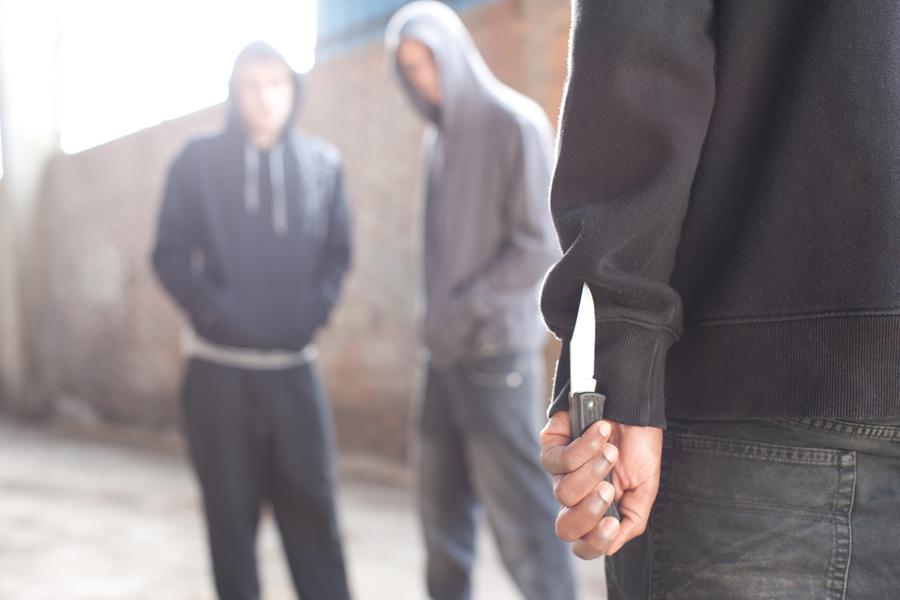
More and more often there are reports of young people being attacked on the streets: beatings, knives, vehicles. Robberies for modest loot, often. Other times gratuitous violence, for a yes or no to a cigarette, used as a pretext. The statistics of the Ministry of the Interior say that half of the approximately 300 voluntary homicides (a number in itself not high in relation to the population and not increasing) ascertained in 2023/2024 occurred as a result of a degenerate argument and this fact, yes, is on the increase: it starts with the words, we get to the facts. Lives are ruined, one’s own and that of others, without even a clear reason why.
Many of the minors who end up in the criminal circuit have to deal with knives and substances, they justify themselves by saying that they carry the knife to defend themselves, fearing an attack. The suspicion of the magistrates who deal with it is that most of the time the defense is an excuse.
But then it is enough to enter a semi-central provincial high school, to discuss the use of force in a democracy between self-defense and holding the square, to understand that feeling safer with a knife in your pocket (perhaps without knowing that it is a crime to carry it, and not calculating the risks to one’s own safety and that of others that comes with it emotionally) is an imaginary that is widespread even among very ordinary students: normally calm boys and girls.
In investigating this topic, on which an extensive report appeared in issue 49/25 of Famiglia Cristiana, we collected the testimony of Giovanni, a university student who experienced a gratuitous attack on the street.
«It was January 2024, it was around 10.30 pm, I was with a friend in a central square in Turin», says Giovanni A., a first year university student, «I was 17 years old. Three of them approached me, looking bigger than me, one asked me for a cigarette, which I didn’t have, then suddenly he put his arm around my neck. In the meantime my friend had left.”
How did he react?
«The experience of judo, practiced for 13 years since I was three, gave me the clarity not to panic: I held his wrist, but in the meantime someone else pulled me to the ground by my legs. I remained down, because judo taught me to watch my hands: I sensed a glow in the hand of the person holding me, I feared a knife, I gave in so as not to aggravate the situation, I got a kick in the eye while I was on the ground, but it went well, they were very drunk and gave up. I tried to remain contained in my reactions, I couldn’t resist, the automatisms of judo helped me, I managed not to lose my calm, perhaps someone else out of adrenaline or pride would have tried to assert themselves or let anger prevail, worsening the risk.”
Is it difficult to overcome afterwards?
«It’s a trauma, help could be needed: for a while I happened to be cautious, even having the instinct to attack first if I sensed a danger that perhaps wasn’t there, luckily my friends were attentive to my reactions. At first you’re even embarrassed to go back to school with a bandaged eye.”
Some are thinking of starting to carry a knife to defend themselves, have you thought about it?
«For the feeling I felt, despite having mastered it I think also thanks to judo in which I had a good teacher who always put those who were braggarts in line, I can imagine what mechanism goes into the minds of those who think this but, apart from the fact that you can hurt yourself with a blade, in one against three the knife is of little use, indeed, if they disarm you you risk more. I carried, but never used, pepper spray for a while, then stopped. It may only make sense to neutralize an attacker in an isolated context, but among people it is very dangerous. In Turin, in 2017, in front of the giant screen for the Champions League final, in Piazza San Carlo, due to pepper spray used as an improper weapon for robbery, two people died in the crowd and thousands were injured, some seriously, crushed by the reaction of collective panic. From a distance, I can say that the experience, elaborated, has taught me when I see faces around that I don’t like to change my path.”
Would you recommend enrolling a child in judo?
«Yes, but not with the idea of teaching him to defend himself by taking to the streets, but because he learns to control his emotions and his opponent: his movements, his hands, the details around him. If there is a step and you move away, it’s better to go to the opposite side so as not to risk dying by hitting your head on it.”