




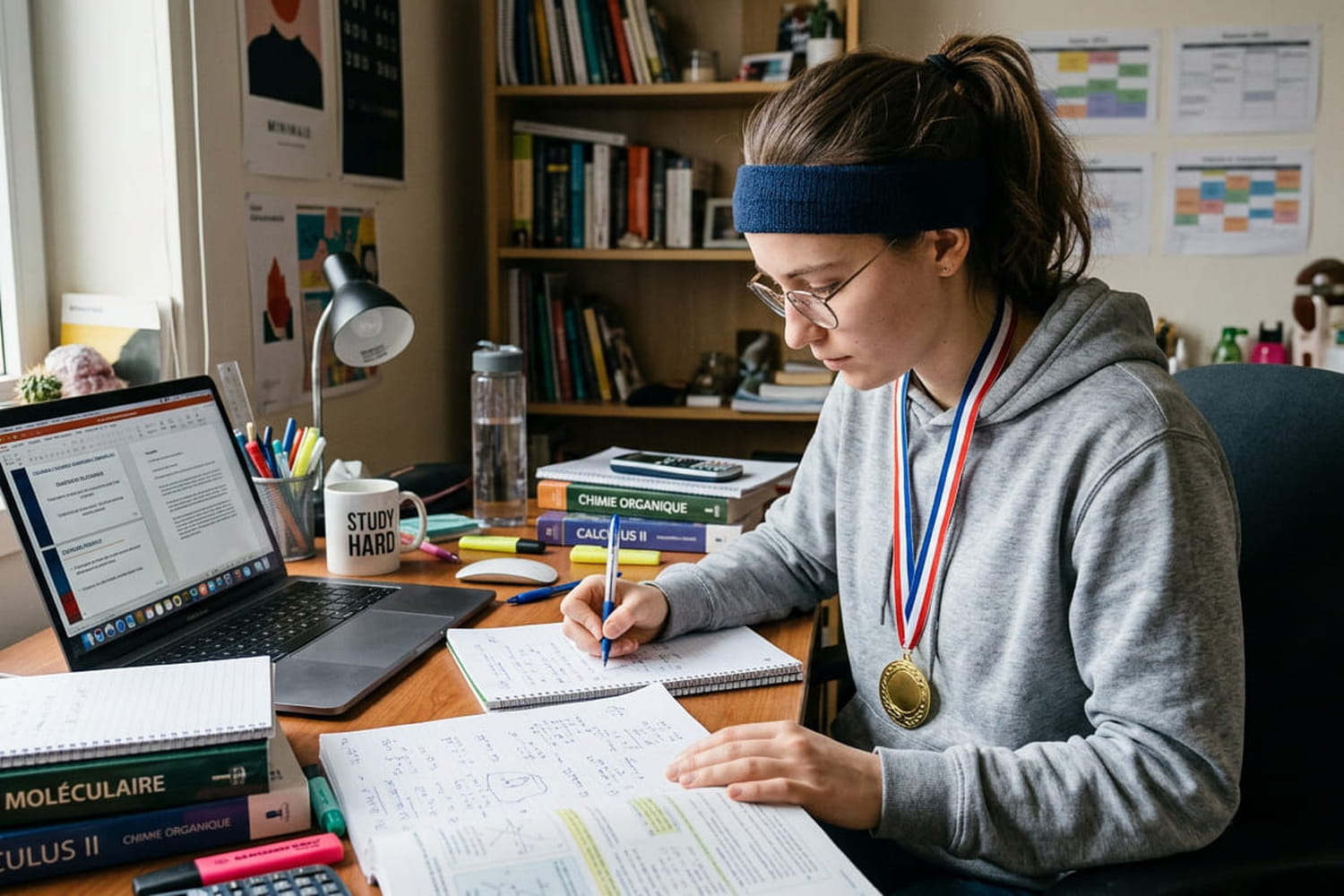
What if the secret to passing the baccalaureate was to study like an Olympic athlete trains? This is what a psychologist specializing in high-level athletes advises. But don’t panic, his method is less demanding than you might think.
Brevet, baccalaureate, competitive exams, partial exams… From class 3thit is an inevitable passage that most students dread: school exams. And, even worse, the weeks of revision that precede them. As the end-of-year exams approach for middle and high school students, everyone is going their own way to prepare as best they can. Some revise a little every day, while others prefer a big session of several hours on the weekend; some copy everything onto colored cards or reread everything to better remember, while others prefer to draw inspiration from educational videos or even ask for help from artificial intelligence to understand the lessons… But what is the best technique to pass your exams?
If the choice is subjective, some advice is still good to take. And besides, these recommendations sometimes come from where we least expected them. From the British newspaper Independenthe is a sports psychologist who gives his tips for preparing for the baccalaureate or any other school exam… by adopting the philosophy of a high-level athlete. “You can think of an exam as a performance situation, and that’s what we do in sport: we try to achieve optimal performance at the appropriate time.”explains Dr Geoff Lovell, who has been supporting athletes in the Olympic and Paralympic Games for 30 years. And in the same way that an athlete prepares for a competition, a student must learn to establish a revision schedule, but also to manage their emotions on the big day, and adopt a consistent routine during the weeks preceding.
The method is less strict than one might think. “Most people can’t revise extensively for 12 hours straight, so it’s best to do it in small, very focused sessions, with a clear idea of what you’re trying to achieve.”explains the psychologist. He thus uses the metaphor of the marathon: a runner is not going to do 42 kilometers in each training session, at the risk of losing motivation and becoming exhausted before the fateful day. He will therefore divide his sessions into several shorter stages. To revise a school exam, Geoff Lovell recommends “to work in concentrated periods of 45 minutes, approximately six per day” (for days when there is no school Of course)interspersed with short breaks” about 15 minutes. This is equivalent to 4 and a half hours of revision over a weekend day for example, which will be much more effective than if done in one go.
But above all, “one of the traps” against which the psychologist warns, it is to “make a list of tasks to accomplish without specifying when we will actually accomplish them”. As an athlete establishes his training plan, a student must “for each day, have a precise schedule and a detailed program” what he plans to study. We know that concentration is reduced when we stay on the same task for too long, which is why it is better to set smaller goals, more “manageable” as pass a quiz, write a sheet or even do an exercise.
As for daily habits, again contrary to what one might think, Geoff Lovell does not recommend going to bed earlier than usual the day before the exam, nor stopping going out with friends the days before: “Don’t do more or less than before, stick to your usual routine. (…) It is always important to keep in touch with your friends to maintain a positive emotional state.“In short, there is no need to put terrible pressure on your shoulders, the key is to maintain a pace that suits everyone and to anticipate without exhausting yourself.