






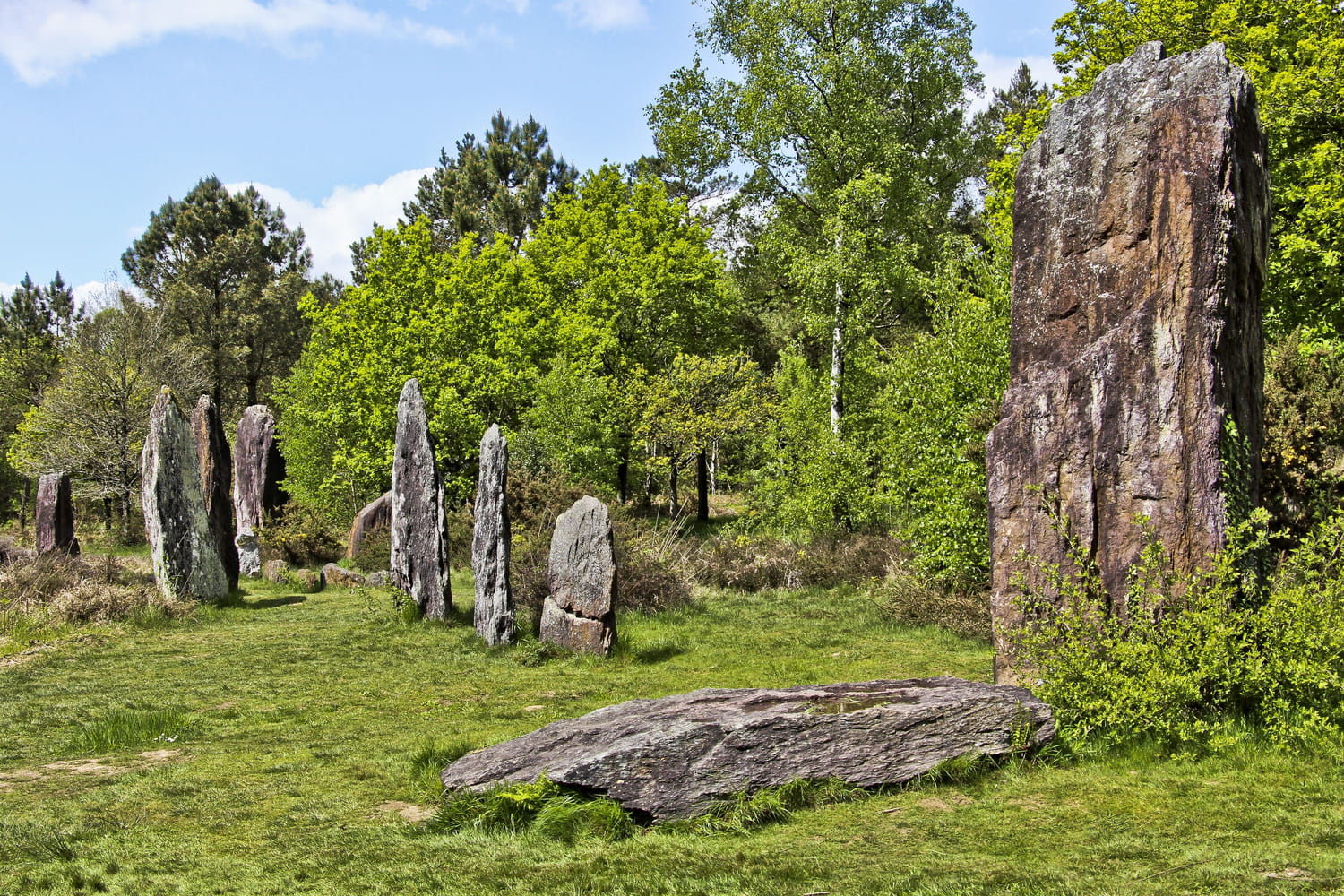
We imagined a magical forest populated by fairies and druids; archaeologists have discovered an archaeological secret there. Thanks to laser technology and the recent deployment of artificial intelligence, science has just unlocked Brittany’s best kept secret.
The archaeological finds never end. After the discovery of hundreds of dinosaur eggs and even giant drawings in the Nazca desert in Peru, it is up to the Brocéliande forest to reveal many secrets. For the general public, the Paimpont forest in Brittany is the fascinating setting for the legends of Brocéliande and the Knights of the Round Table. For scientists, this 10,000 hectare massif is above all an incredible “time freezer”. Because the trees have grown there for centuries, the soil has never been turned over by tractors or destroyed by modern construction. Everything seems to have remained intact, frozen under the leaves. But what’s underneath?
To unlock the secrets of the Brocéliande forest, researchers from Rennes 2 University and Inrap used LiDAR. It’s a giant scanner installed under an airplane that bombards the ground with millions of laser flashes. By calculating the time it takes for light to bounce back, the computers “erase” the vegetation, resulting in an ultra-precise 3D map of the bare ground. And there, surprise: the “wild” forest contained many secrets.
The first shock for archaeologists was to discover the borders of ancient fields and paths from Gallic and Roman times. Concretely, at the end of the Iron Age (more than 2,000 years ago), this forest almost did not exist. The landscape was completely open, cleared and cultivated. Scientists have spotted traces of large quadrangular enclosures: these were the ditches which protected the farms of the time, with their wooden houses, their vegetable gardens and their animals. The current forest simply took over much later, growing over the ruins of these forgotten countrysides.
The other great discovery concerns the wealth of the subsoil of Brocéliande: iron ore. Long before the creation of the famous Paimpont Forges in the 18th century, the Gauls, then the men of the Middle Ages, exploited this resource on an industrial scale. Flying over the area, the laser spotted hundreds of miniature hills formed by the accumulation of black rock waste discarded after iron was smelted in large clay furnaces.
Brocéliande was ultimately one of the largest economic lungs of the region. Metal was produced there in industrial quantities, far beyond the needs of the local inhabitants. This iron then traveled tens of kilometers to supply all of Brittany and the rest of Gaul.