

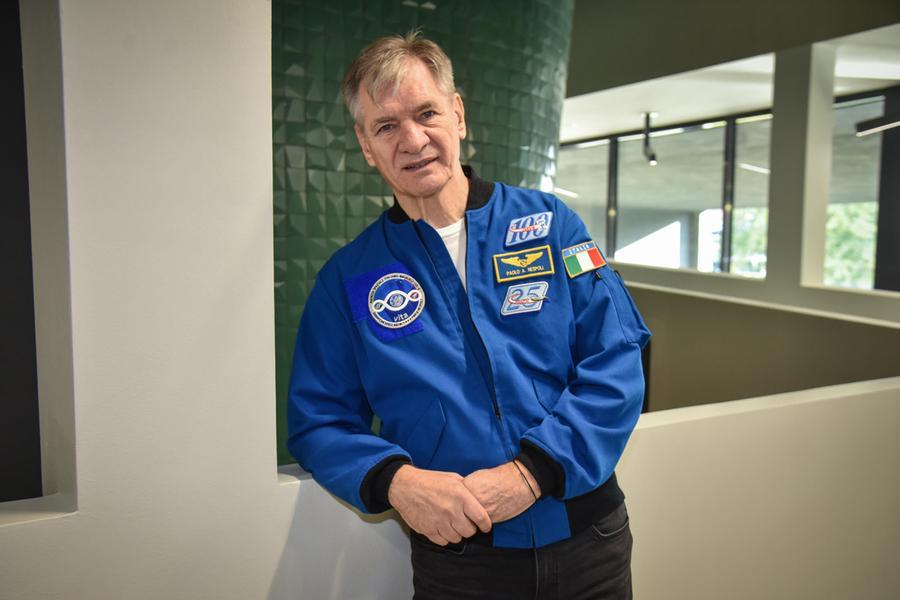



The memory of the world connects the memory of the first man on the Moon to Neil Armstrong’s phrase: one small step for man, one giant leap for humanity. Artemia II, today’s mission to the Moon, leads us to measure today’s pace. Paolo Nespoli, retired astronaut from ESA (European Space Agency) and ASI (Italian Space Agency), with 313 days spent in orbit, he is one of the Europeans with the most experience in space, among the guests of the Innovation Week Festival on 11 April in Pavia in the great hall of the Ghislieri College (places already sold out) he deals with the theme: Why did man return to the Moon today? Answering this question is a way of taking measures at a distance from the past, but also from the future, and from Mars, today considered a non-impossible mission.
Taking it almost on the fly between one trip and another on very busy days, we asked Nespoli to help us understand what the Artemis II mission represents in man’s journey in space.
Engineer Nespoli, we have already been to the Moon, even if some doubt it while others doubt the roundness of the earth, why are we going back there now?
«This is an American project, useful for reviving the glories of NASA and American culture. The idea I have is that this mission has a political, technological and image value: when, at the time of Trump’s first presidency, the new administration asked NASA what it would want to relaunch NASA that went to the moon, the answer was to go to Mars. When politicians realized that aiming for Mars would have meant investing in a long-term prospect worth 500 billion dollars, which would have taken away funds from research and universities, they slowed down, especially since Mars would have required a long-term project, at least 15 years, which was of little use to the administration at the time. It is true that NASA has also done international cooperation, because several countries including Italy build components of the Orion spacecraft, but control of the mission is entirely American.”
So was the moon a fallback?
«If the main objective of the expedition is to show how good Americans are, for ordinary people it doesn’t make too much difference whether an American flag is planted on Mars or on the Moon. It works a bit like when you see an advert on TV showing a beautiful beach: the beauty of the image hooks the viewer and is real, but the real objective is not to show him that beautiful place, even if it really shows it to him, but rather to convince him to drink the associated brand of mineral water. NASA, however, still gave the political request an important scientific content.”
How would you explain this to the ordinary citizen you mentioned earlier?
«NASA used this mission, a bit reductive in itself, to do really useful things for a future mission to Mars: they tested a vehicle and astronauts, in a spacecraft that is much smaller than the international space station on which the experience of the last thirty years is based. They tried to understand what happens when a spacecraft goes into radio silence, which not only means that astronauts cannot talk to the control center, but also means that the spacecraft cannot send data to Earth and that it cannot be controlled from Earth: the consequence is that during the period in which there is no connection the spacecraft must be completely autonomous. Around the Moon in the Artemis II mission there was silence for 45 minutes, if one were to ever go to Mars the radio connection would never be there. Let’s start experimenting in a small way. And then obviously there are the beautiful things that unleash the popular imagination: we continually take images of the Earth from the International Space Station but we are unable to have a complete vision like our Artemis II colleagues had and it is natural that this captures the imagination, the fantasy, the attention”.
All ancient cultures deal with man’s instinct for exploration. Prometheus, Icarus, Adam, Dante’s Ulysses are punished, but explore the unknown. What do they tell us about us?
«They prove the fact that this need which I would call knowledge rather than exploration is even more than an instinct and a desire but an obligation inherent in the human being who knows he is risking to climb an 8000 meter peak where ultimately he will find snow but goes anyway. We need to know, because through knowledge we progress. It is the aspect that, I believe, most distinguishes us from animals and which has led our species, our civilization, to prevail on Earth: it is undeniable that we must explore. We will have to continue to use low Earth orbit, because in addition to all things of a logistical, strategic and commercial nature, it allows us to understand more what happens from a physical and engineering point of view in the absence of gravity. We will have to progress with science, technology, technique. But the need we were talking about also leads us to look further.”
How much further?
«We can’t know now because we don’t know the future. When I go to speak in schools I show how far away the closest star to our Sun is: we are talking about billions and billions of kilometres, therefore 150 thousand years of travel if we thought of going to Proxima Centauri with a modern spacecraft. But a century ago it would have been unthinkable to leave Earth and now we can do it. I ask the children in the classes I meet: “Will we arrive on Proxima centauri?”. It’s a provocation, with today’s means it’s a dream, but I tell them: “Get busy because dreams sometimes come true in the future”.
Has the Moon brought us closer to Mars these days?
«Paradoxically, using so many resources to return to the Moon risks taking us further away from Mars. If it had been up to me to decide, I would have aimed for Mars later: it’s a bit like imagining planning a journey on foot from Milan to Naples, using as a test a walking route from Milan’s central station to the peripheral station of Rogoredo. If I get there using most of my resources, I’ll never get there in Naples».
What did he understand about us by looking at us from space?
«That we are not in a very good place as a human species, because we are divided, shattered, each in our own microcosm that we call a nation: each thinks for himself. But when we do a deep exploration of the universe we should go there not as France, Italy, Germany, the United States, Canada, but as a human race and plant only the flag of humanity on the Moon or Mars: from space you see that the Earth is a single thing and you lose for a moment your belonging to your nation. As astronauts from countries that are not exactly friends on Earth together on the International Space Station we feel like representatives of humanity. I learned that the earth is beautiful and you feel from up there that it is your home, we should all work together to improve the future of humanity and the planet. But I’m afraid it’s a chimera.”