





It’s the first instinct when you lose your dog or cat: share a missing person notice, in the street or on social networks. But your ad could backfire.
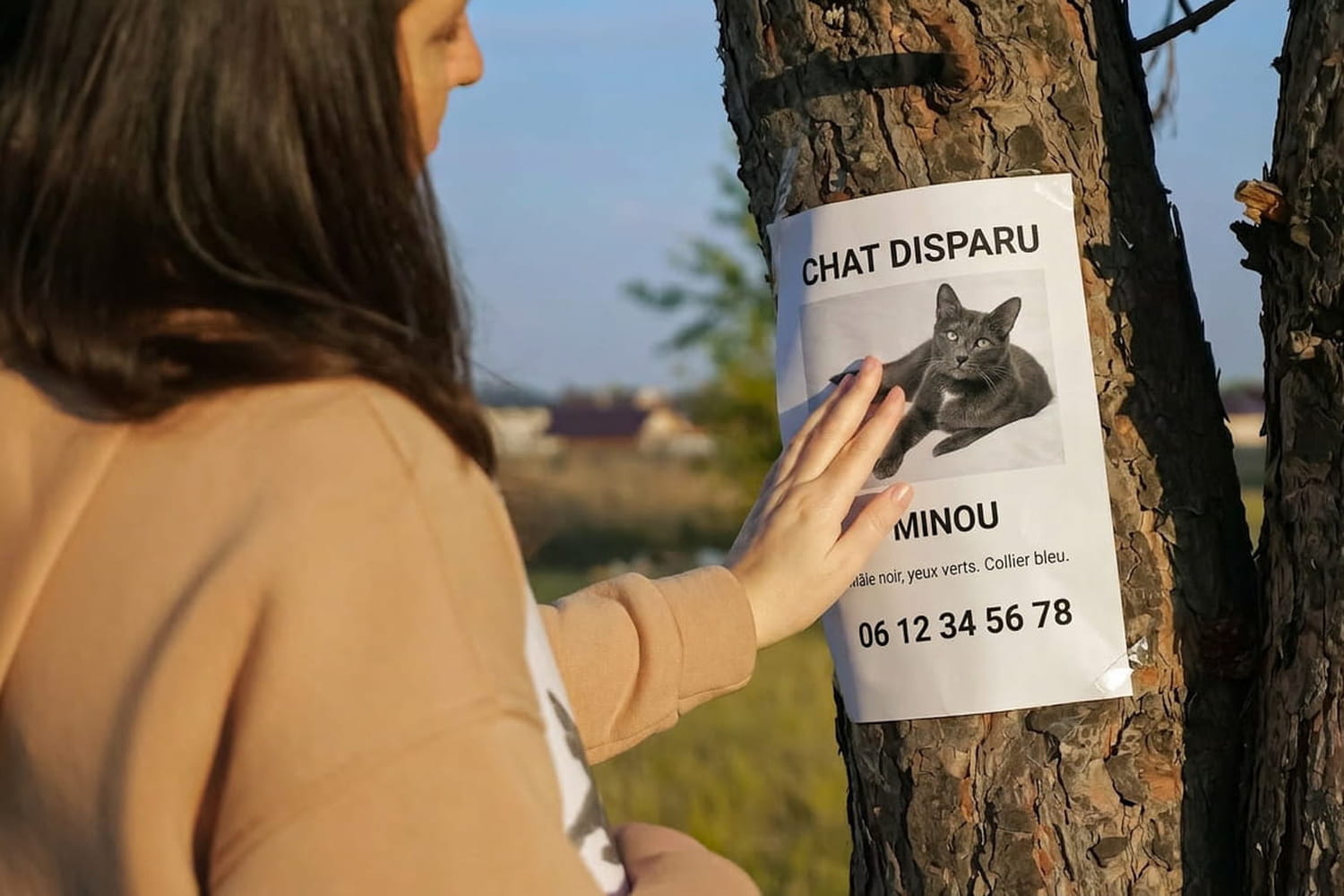
It’s the fear of all pet owners. A dog that runs away, a cat that doesn’t come home after its daily walk… and it’s panic. Because our four-legged friends are much more than just companions, they are truly part of the family. An Ipsos survey from 2025 confirms this: 69% of French people consider their little ball of fur to be a full member of the household. So obviously, seeing his disappearance is a devastating moment. We imagine all kinds of things, and our search becomes a race against time. We distribute “Missing Cat (or Dog)” posters in the neighborhood, but now also on social networks, where the reach is much greater.
Because yes, it must be recognized, the internet has this advantage: more people will be likely to see the wanted notice and relay it – especially if the animal in question has moved away from the neighborhood where the posters were posted – and the chances of finding their precious doggie or cat will therefore increase considerably. But this massive distribution also carries risks, and it is therefore better to be wary when reporting the disappearance of your beloved animal. Scammers, who unscrupulously roam the web looking for vulnerable victims, can take advantage of this.
On a wanted poster, we do not only share the photo and first name of the animal. Often, owners add their contact details to be easily contacted, but also sometimes the identification chip number of their cat or dog. And above all, they all specify the urgent nature of the situation. So many elements that are a gold mine for scammers, who use them to send precise and targeted messages to these desperate victims. The scenario is well-crafted: they pretend to be a veterinarian, a volunteer or employee in an association, or quite simply a well-intentioned person who found the animal. Thanks to the physical details and other particularities indicated in the wanted poster, the explanations seem entirely credible. Some even send photos for proof.
Then, the trap closes by playing on the fear of the owners: their animal would have been discovered injured, or taken in by a shelter demanding immediate fees. As you will have understood, even the most cautious risk paying, blinded by the hope of finding their precious companion as quickly as possible. Of course, you should never trust people who seem to want to rush you to pay. The pound or the SPA may indeed charge you fees, but never before you come to collect the animal in person. Moreover, with artificial intelligence, the photos can be false and have been generated using the one retrieved in the ad.
In other words, you absolutely must be wary and ask the right questions to be sure that the person on the other end of the phone has indeed found your animal. In addition, if it is unavoidable to provide your telephone number, it is better to avoid giving the full number of the chip or tattoo in the search notice: part of it may be enough to identify it. Also favor closed support groups, which verify the identity of members more than public groups open to all, to publish your ad.