


Agatha Christie said that a clue is a clue, two clues are a coincidence, but three clues make a proof. Let’s talk about the Prima della Scala which since 2016 Rai has broadcast live and exclusively. Not on Rai 5, where it was confined until 2015, but on Rai 1.
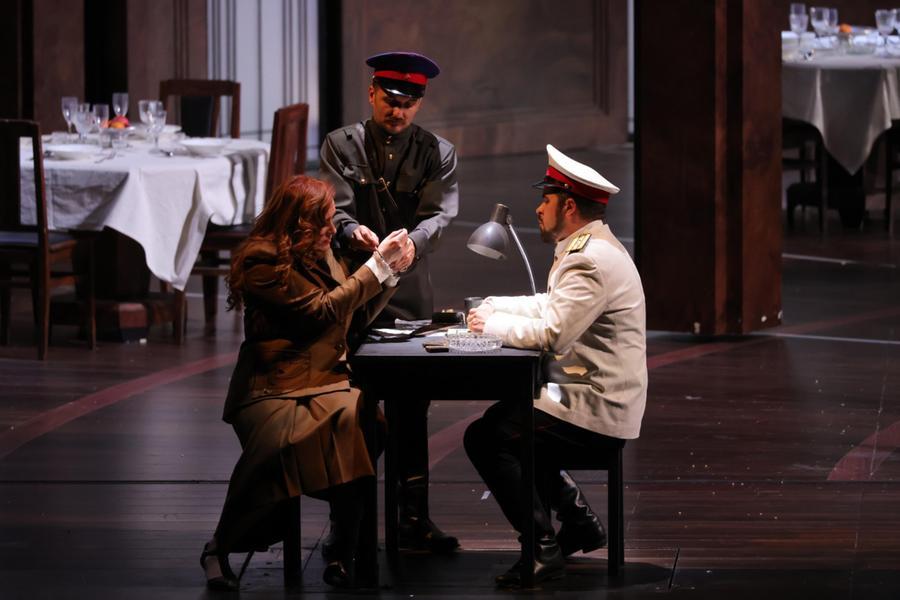
This year it’s on stage A Lady Macbeth from the Mcensk district by Dmitrij Shostakovich, chosen by the master Riccardo Chailly and directed by Vasily Barkhatova tribute to the composer on the fiftieth anniversary of his death. It is a dark and powerful work, censored by Stalinwhich tells the story of Katerina Izmaylovaa woman who rebels against a suffocating society, with a production that wants to restore artistic freedom to the masterpiece.
In terms of television ratings, the change of network in 2016 marked a clear turning point. In 2016 Madame Butterfly in fact it obtained an audience of 2,645,000 spectators (13.43%), inaugurating a new phase of great television attention. The following years remained at high values: Andrea Chénier by Umberto Giordano in 2017 recorded 2,083,000 spectators (11.08%), followed by Attila in 2018 with 1,945,000 (10.77%). The peak of the last decade was reached in 2019 with Tosca by Puccini, which totaled 2,873,000 spectators (15.01%), a result that still represents the highest today. Also the 2020 special edition, To see the stars againbroadcast in 2020 in the midst of the pandemic and without an audience, obtained a very high figure: 2,608,000 viewers (14.7%).
It should also be emphasized that a gradual decline has been observed since 2021. Macbeth that year it gathered 2,064,000 spectators (10.5%), while Boris Godunov in 2022 dropped to 1,495,000 (9.1%). The lowest figure since the return to Rai 1 is that of 2023 with Don Carlostuck at around 1,404,000 spectators (8.27%). Last year there was a slight recovery: The force of destiny by Verdi totaled 1,603,000 spectators (around 10.2%), marking a turnaround after two years of decline. In summary, the ratings of Before the Staircase in recent years they have shown very variable interest: very strong between 2016 and 2020, weaker between 2021 and 2023, with a return to growth in 2024.
It must be said that the viewing figures refer only to the television broadcast on Rai 1, to which must be added the radio ratings on Radio 3on the online platform Rai Play (where it can be seen for 14 days after the premiere) and above all the results of broadcasts abroad: Attilafor example, in 2018 it was broadcast live on ARTE (France, Germany and related linguistic territories), on Ceska Televize in the Czech Republic, on MTVA in Hungary and on RSI in Switzerland, and deferred on NHK in Japan, on Il Media in South Korea and on RTP in Portugal and on 17 international radio stations hosted on the Euroradio platform, from Russia to Australia.
Therefore, a program that wins cannot be changed. And this year too (fortunately) opera returns to the Rai flagship network for the most famous premiere in the world: the Milanese one of Saint Ambroeus.

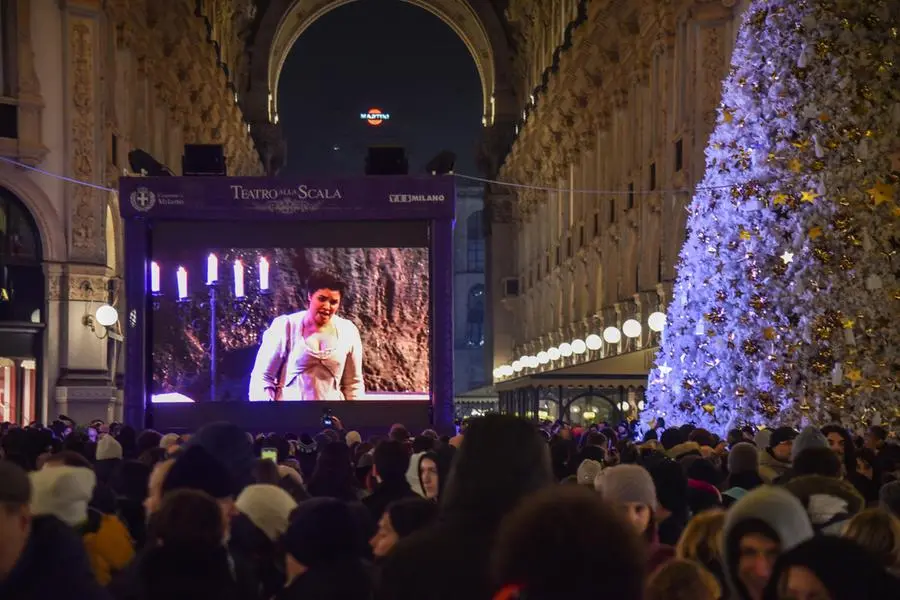
The giant screen set up in the Galleria Vittorio Emanuele for Verdi’s “La Forza del Destino” at the 2024 La Scala premiere
(HANDLE)
Italy has done more in opera theaters than one might think
So why be surprised at the excellent television ratings and the fact that in Milan, every year, the places where it is broadcast multiply? From the San Vittore prison to the theatres, from the airports to the museums, from the squares to the Gallery, from the theaters in the center to those in the suburbs. In all, between the city and the hinterland, 37 places where you can get excited and listen to opera.
Net of the event effect, we always forget when we talk about the work that melodrama was and is true Italian popular music, the soundtrack of Italianness, its authentic musical tradition. For its effective genre of narration (“drama entirely sung with instrumental accompaniment”), for the themes it deals with: love and betrayal, passion and revenge of popular heroes close to us that the public feels credible, authentic, true in the tangle of affections and miseries, feelings and meanness.
Nothing but elite music. Italy, perennially unfinished, has achieved more in opera theaters than one might think. There is Verdi, who together with a few other great compatriots (Machiavelli, Leopardi, Fellini) was able to describe Italians not as they believe they are, but as they really are: «The first scene of Rigoletto it seems to take place during one of the elegant dinners in Arcore”, he wrote Alberto Mattioli in the delightful pamphlet Less grey, more green (Garzanti), «the protagonist of A masquerade ball he is the archetype of the provincial big boy, ready to appear in the Vitelloni; Radamès is the boy from a good family who falls in love with the immigrant housemaid Aida instead of a socially compatible mezzo-soprano.”
From the toast of Traviata to Violetta who shouts her love for Alfredo
And we want to talk about the mockery of the betrayed, an authentic national sport well summed up in that “what’s in your head, Mr. di Ceprano?” (Rigoletto). Not to mention the «Let’s free ourselves from the happy glasses» (Traviata), the most famous toast in the history of melodrama which has become synonymous with (ephemeral) lightheartedness. And that «peace my God / Fatality! Fatality! Fatality! / There’s a separate crime down here!” (The force of destiny) often performed at weddings and funerals for its powerful reflection on evil and fate. There’s Gilda who in Rigoletto he again intones «dear name of yours I will be» for a promise made «every evening at the temple», to be repeated by the Duke of Mantua that “this or that is equal to me” because “a woman is as mobile as a feather in the wind”. Eleonora who in Troubadour she longs for Manrico who only warms up if he feels the heat of battle and runs to put out “the horrible fire of that pyre” only to then discover that so much pathos and desire for protection is dedicated, like every self-respecting Italian male, to his “abject gypsy” mother Azucena.

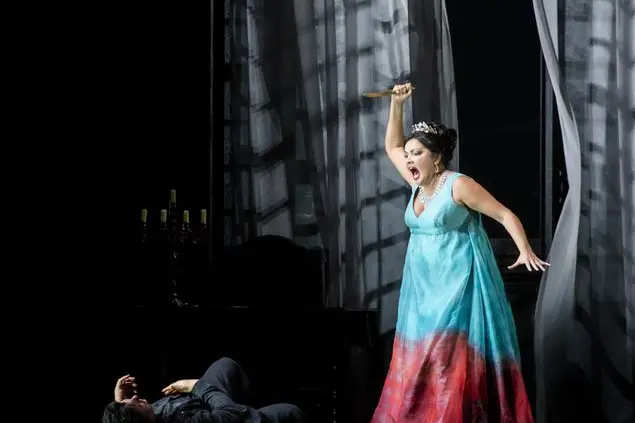
A scene from Tosca performed at La Scala in 2019
Unlucky heroines, rejected or betrayed lovers, like Violetta who in the Traviata he shouts «Love me Alfredo» to hear the ungrateful man reply «I have that paid woman». Or poetics Chaste Diva (only the hard of heart are not moved by the performance of Maria Callas) in Norm by Vincenzo Bellini to whom the faithless Pollione sacrifices himself as he wants to save his lover Adalgisa: «you take my life, but pity her». The choir of Nabucco, that Think about it used by the pre-Salvini Northern League supporters and that someone would like as a national anthem without knowing that the protagonists are the Jews fleeing from Egypt. We could go on and on. But it deserves a note The pirate by Vincenzo Bellini, a work perhaps less mainstream than the others, with Imogene who witnesses, in the trance of a dream, the decapitation of her beloved lover with a splatter scene that not even a Quentin Tarantino film could find: «there you see the fatal stage (…) As I look, the barbaric ax hides from me… But the blood is already dripping; but everything floods me…”.
That melodrama that reunified Italy in the nineteenth century
Then there’s the music, of course. The marches performed by the bands of the patronal festivals, especially widespread in the South, are an anthology of the most famous arias of melodrama. Many have listened to them, assimilated them, without even knowing their origins. In short, the media and pop success of the work is not so surprising because, before political unity, in the nineteenth century there was “melodramatic” unity which unified the country by incorporating Neapolitan melodies, the Roman stornello, the Po Valley soundswith choirs out of tune and songs whistled even at village fairs.
Today opera is no longer nationally popular, at least not in its diffusion, because going to opera houses costs money, and not everyone can afford it. But melodrama remained our most authentic pop soundtrack. Luckily Rai is there, every year, to bring it into our living room.