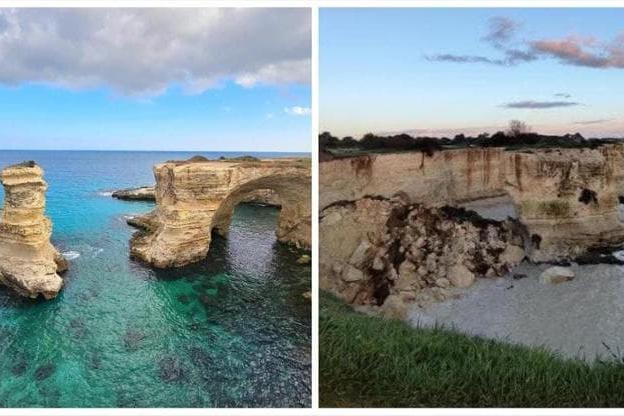




A bitter Valentine’s Day for Salento. On the symbolic day of love, the sea erased one of the most romantic and photographed places on the Apulian Adriatic coast: the Lovers’ Arch in Torre di Sant’Andrea, Melendugno marina (Lecce). A violent storm, accompanied by heavy rainfall and violent winds, caused the collapse of the famous natural arch, leaving in its place a pile of crumbling rock.
The first “before and after” images were published by the local portal Melendugno.net, which documented the disappearance of the arch on February 14th. For decades that light stone structure, set among the white stacks overlooking the Adriatic, has been the setting for promises of love, photographs at sunset, kayak and canoe excursions.
A symbol of Salento that no longer exists
The Arch of Sant’Andrea represented a true “natural picture” overlooking the sea. It was the most iconic attraction on the cliff, used in covers, tourism promotion campaigns and travel stories. In summer, hundreds of visitors crossed the arch by sea, helping to make it one of the identifying symbols of the local community.
Precisely on Valentine’s Day, the municipal administration had drawn attention to the orange alert issued by the Civil Protection of the Puglia Region. But no one could have imagined that bad weather would have such devastating effects on a rock formation that seemed immutable.
When the sea redesigns the coast
In reality, what happened is part of the natural processes that shape coasts. As he remembers the Higher Institute for Environmental Protection and Research (Ispra), Marine erosion affects large stretches of the Italian coast and can accelerate during extreme meteorological events. Intense storm surges exert pressure capable of amplifying fractures already present in the rocks, causing sudden collapses.
Also the National Research Council (Cnr) underlines how natural arches and stacks are the result of a fragile balance between the resistance of the rock and the erosive force of the waves. The water penetrates the cracks, widens them over time, digs cavities that become suspension bridges over the sea. But when the vault no longer holds, the arch collapses, often allowing new isolated stacks to emerge.
Pain and awareness
Among the many comments posted on social media, that of a citizen, Stefano Lefons, is striking: «The arch has given way to another stack and will do so for centuries. We were direct witnesses of how the sea dug and shaped our beautiful cliff.” Words that invite us to read the event not only as a loss, but as a lesson in humility.
The landscape is not a still photograph. It is a living reality, in continuous transformation. The disappearance of the Lovers’ Arch reminds us that even the rocks, which we perceive as eternal, are subject to time and the force of nature.