




“It’s not funny anymore.” “He’s out of ideas.” «Better than the cinepanettoni of the past». Quite a few critical reviews panned it Good Caminolatest work by Checco Zalone. The public is not of this opinion and is flocking to the theater en masse – just as happened with the cinepanettoni – to see the film.
What is the reason for this attitude? Why is there no laughter or vulgarity is (almost) absent? Or because the characters have a positive evolution and some values are highlighted?
What kind of movie is it Good Camino?
To weigh up the judgment we need to understand: which category do you want to include this film in? Remaining in the metaphor of holiday desserts, there are both artisanal and industrially made panettone: both have their reason for being. Well, the latest work of the Apulian actor is a good industrial panettone, and of its kind it is of quality.
A popular comedy that speaks to everyone
It is a comedy capable of speaking successfully, takings in hand, to the general public, with irony and lightness and, at the same time, of asking profound questions about fathers and sons, about the meaning of life and the style with which it is conducted.
An industrial cinema (and that’s not a flaw)
An industrial cinematographic product, with an impressive budget (28 million) largely at business risk, set in Sardinia and Spain, three months of filming, intense and multi-channel promotion. “Industrial” is not an adjective with negative connotations: these characteristics are rare in the Italian panorama, an exception if we also add the box office numbers.
The plot, father and daughter on the Camino de Santiago
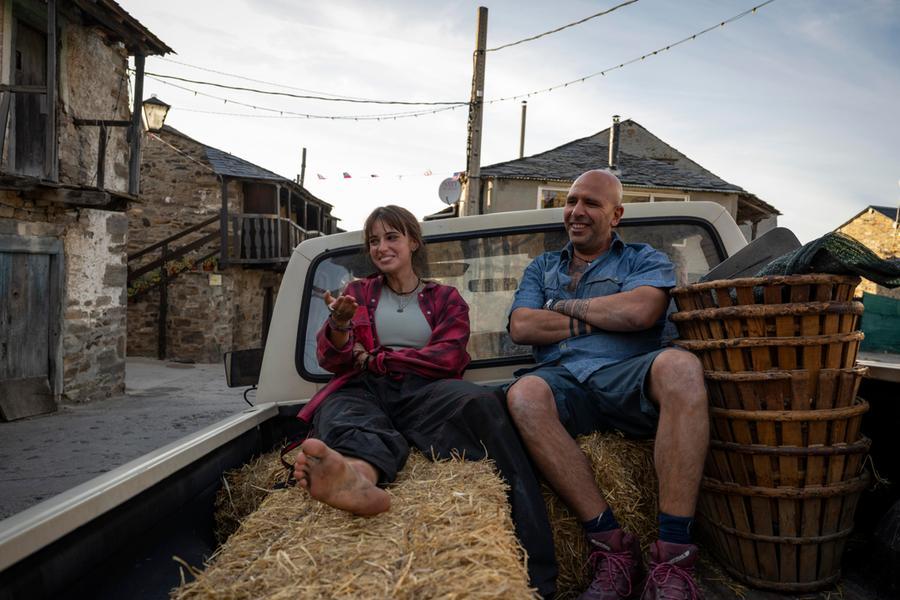
Good Camino, directed by Gennaro Nunziante, brings together once again the creative couple that has marked Italian comedy in recent years, with Checco Zalone as the protagonist. The narrative expedient that moves the film is simple: a very rich father who does nothing, immersed in tacky luxury and unbridled worldliness, out of a surge of pride sets out against his will in search of his teenage daughter, Cristal (“like champagne”), whose traces have been lost. Secretly the girl decided to undertake the Camino de Santiago, in search of a deeper meaning to her existence, fleeing both from her unpresentable parent and from a former model mother in search of new artistic ambitions, once again married to a pedantic “busy” director, almost a mockery of the learned cinema who judges Zalone’s latest work from up to down. Having tracked down his daughter, Checco reluctantly begins the “Cammino” aboard one of his six Ferraris to convince her to return home soon. But she doesn’t give up and, stage after stage, the journey becomes the mirror in which the protagonist himself is forced to look at himself, to deal with his life and above all with Cristal’s existence: because fathers are not born but made.
Direction, pace and construction of the film
From a production and technical point of view, Good Camino it is a well-packaged film, with a calibrated rhythm, a multiplicity of locations, an original soundtrack supported by songs that aim to entertain and which act as a landing point for the publicity stunts that preceded the release of the film. The plot proceeds through images and situations, through gags, rather than through an articulated and coherent narrative line. The film is based on the symbolic image of the Camino de Santiago, with its climbs, dirt roads, hostels, fellow travelers and landscapes.
The Camino de Santiago as a metaphor for life
It’s the great (and simplistic) metaphor of life: walking means accepting fatigue, listening to your interiority, putting aside the desire to live in a selfish and utilitarian way, the belief that you can buy everything, to instead let yourself be transformed by this adventure and the ability to love.
Spirituality and Christian references in the film
In a time in which the spiritual dimension in public space is reduced to the exotic or to a generic personal search, the film chooses to talk about it in a calm, concrete, accessible way, with direct references to the Christian experience. It is a journey that father and daughter undertake in company, with the help of guides and reference points. There are many consecrated figures who appear in the film, presented according to their own specifics, not just to have “character actors” on stage.
The characters: Zalone, his daughter and the guiding figures
Checco Zalone goes beyond his usual character, the less than average Italian, engaging in a process of transformation and positive growth through experience. The debuting (and surprising) actress Letizia Arnò, in the role of the daughter, she brings authenticity and emotional depth, embodying a generation in search of deeper values than those transmitted by adults. Beatriz Arjona, Alma, the mysterious pilgrim and precious guide, introduces an authentically maternal gaze and spiritual depth; embodies the possibility that we all would like of a meeting capable of generating change.
Credible however unrecognizable, Martina Colombari – in some respects in the role of herself – she plays the fugitive’s mother: a former model in search of family balance and a more qualifying artistic life.
This group of performers, not always adequately explored on a psychological level, works well in the context of the film and contributes to giving voice to non-trivial themes.
Irony, excess and respect for the spiritual dimension
While Checco Zalone’s politically incorrect (sometimes forced) jokes uncensored mock even the most solid taboos (concentration camps, body shaming including trichological ones, 11 September, Gaza…) and some excessive insistence on urological problems – for the age of the audience, what do we expect? – seems to be stolen from a medical column, the spiritual dimension of Good Camino it is preserved and treated with discretion. There is no preaching but experience: sharing the road, silence and daily fatigue become an opportunity to listen and be open to change. The reconciliation between father and daughter does not come through sensational and definitive gestures, but – as happens in reality – through the renewed presence of a parent willing to allow himself to be changed in the relationship.


Cinema, spirituality and box office
Speaking of spirituality: just as body and soul cannot be separated in a person, neither can the artistic aspect be separated from the economic one in a film. Although art must retain its gratuitousness, cinema cannot ignore the box office in order to survive in theaters.
This commercial success will be remembered by producers and above all by exhibitors as the event capable of saving the budgets of the entire season.
Preserve cinemas, especially single-screen ones, cannot be just a question of public funding and the courage of the managers: we also need a product like this, together with the popular arthouse offerings and films of high artistic quality but – alas us – often of low economic return.
Box office receipts and success
Good Camino has been able to conquer the public since the first days of programming, dominating the box office of the holidays. The film as of December 31st has already exceeded 30 million and, if this trend continues, it is destined to beat the 50 million takings in Italy of the previous one (and not perfectly successful) Tolo Tolo. A success that demonstrates how Italian cinema can still produce films capable of attracting the public without giving up the ambition of proposing a positive message, elements that are rarely found together today in the Italian cinematographic panorama.


A final judgment: popular cinema that makes you think
This film is not perfect, it is neither a treatise on pedagogy nor a Gospel, nor is it destined to enter cinema history manuals.
It’s in a different category: it is popular cinema (and here too the adjective is not negative), it speaks to many (sorry?), fills the rooms and suggests a reflection on some values. It is a new route of the extremely celebrated Italian comedy: as happened with those films that we now consider cultural pillars of our common feeling, the judgment on this work also requires the right temporal distance and less fussy superficiality, so that its right value can be appreciated.
Many of the criticisms leveled at Zalone’s film seem to be the same as those directed at directors who were once defined as affected and disengaged but today revered as masters.
The peaks of the seventh art certainly lie elsewhere, but spending 90 pleasant minutes during the days off of the Christmas holidays, developing some good reflections and contributing to the survival of fundamental cultural assets such as cinemas, These are not experiences to throw away in these times.