




Sometimes, while chatting with friends, you ask or hear someone ask you: what would you take with you if you ran away to a desert island? We mean the objects we care about most in the case of a voluntary escape from the stress that grips us. However, we leave to more remote hypotheses the possibility of being forced to get rid of what is dearest to us, that is, memories, emblems of the time we have lived through, for other reasons, much less are we interested in fearing hypotheses that could see us as protagonists of dramatic scenarios. The desert island remains the most fascinating possibility of all.
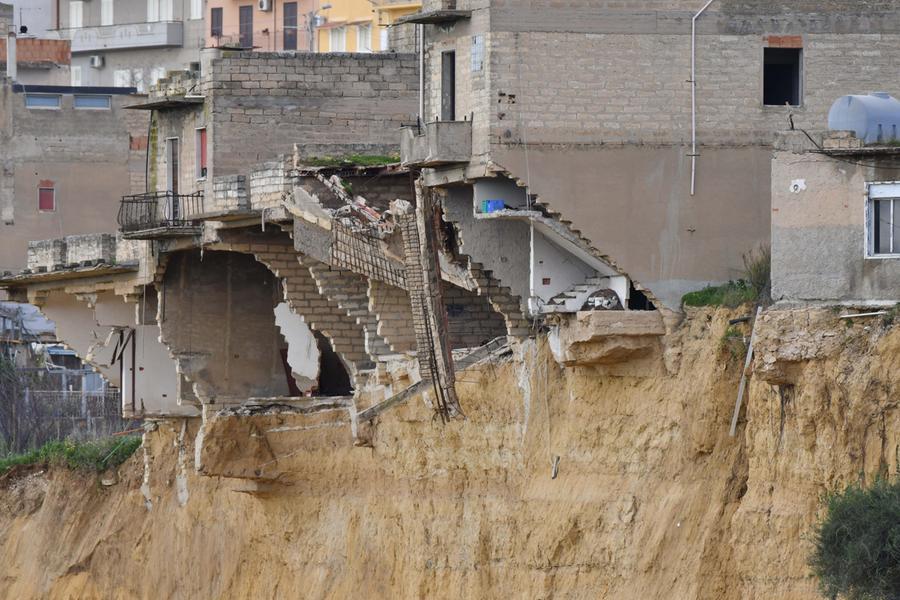
But now let’s move to Niscemi and think that all this is reality. Most of the people who lived in the area affected by the landslide had to actually save – and with imaginable desperation – the collected objects they cared about, and quickly prepare a bundle to say goodbye to everything else. In just a few days, the lives of one thousand five hundred people from Nisceme have undergone a traumatic change and, an even more disturbing detail, none of them knows and will know, at least in the short term, what will become of their future. No matter how hard you try to put yourself in their shoes, it will never be the same as suffering such a misfortune. In the cold, who among us could say how we would react in a similar situation? In the meantime, however, there is life pressing with everyday problems. Despite the analyzes and conjectures to trace the faults of what happened, there is the need to wash, get dressed, refresh oneself, meet the demands of the children, disguise the tears, think about work, protect oneself from the cold of winter and why not, live a dignified life. How, where, when will it be possible to aspire to this? All seasoned with the awareness of not even being able to abandon ourselves to the darkest pessimism.
While we watch the images of the landslide on television we should go beyond what we see with the eyes, and it is the ability to read the silent desperation of those who suffer the humiliation of the rebounds of accusations between politicians, passing the buck of responsibility that serve no purpose, if not to produce exhausting expectations in a present that seems to fall from minute to minute. Niscemi has become an emblem of resistance, and this remains the only clear response to date. But as we well know, resistance cannot be the real solution. In such a dramatic context, sooner or later tempers will become exasperated. Responses from the State are urgently needed, concreteness is expected. We are shocked, yes, we all are. In an area that had given very specific signals since 1997, the date of the last landslide – even if the hydrogeological criticalities reach much further back – what has been done to make Niscemi safe?
Italy by its nature is problematic in itself, the hydrogeological risk is a constant from north to south, without exception, however, I invite you to observe the Umbria model and to carry out the rehabilitation work in delicate areas such as Orvieto and Todi. Over the years, a great deal of work has been done in this region, and despite the phenomena of instability, landslides and movements that have been repeated for centuries, with continuous monitoring, drainage and hydraulic adjustments, mass evacuations or catastrophic collapses like Niscemi have never occurred. So let’s stop talking only about illegal practices to cover up other crimes. May those responsible be identified and concrete answers be given to those who are left with a handful of flies in their hands (the bundles of desperation, so to speak) after a life of sacrifices.