
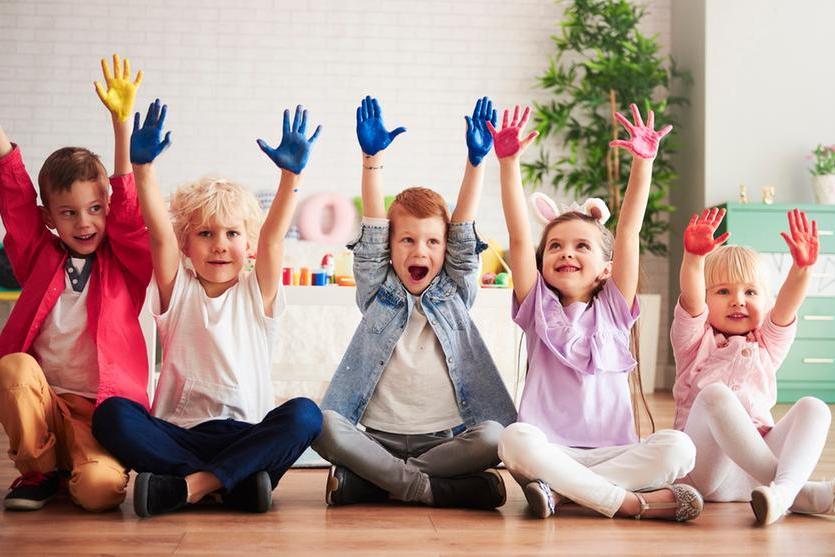




Children first. There are no interpretations to give to the message of the Italian Bishops for the 48th National Day for Life, which is celebrated on Sunday 1st February. Children first says the title because, as Matteo reminds us, “Be careful not to despise any of these little ones; for I tell you that their angels in heaven continually see the face of my Father” (Mt 18:10).
Who continues: «Jesus’ kind and affectionate welcome towards the little ones surprises his contemporaries, including his disciples, who are used to considering children very little. Yet, in Scripture God’s relationship with his people is often compared to that of a loving mother and a caring father towards their children; their attitude, in fact, “reflects the primacy of God’s lovewho always takes the initiative, because children are loved before they have done anything to deserve it” (AL 166)”.
Children who have a lot to teach adults: «Let yourself be loved and served with simplicity, recognize yourself as dependent without embarrassment, attribute primary importance to the laws of the heart, desire the good… these are some of the lessons that children give to adults and which Jesus presents as conditions for welcoming the newness of the Gospel: “Truly I say to you, unless you convert and become like little children, you will not enter the kingdom of heaven” (Mt 18, 3). They, therefore, should never be despised, discarded or subordinated because the Creator has particular care for them.”
A vision of the little ones that goes beyond the evangelical one and shapes the legal culture (“the greater good of the minor”). «Our best legal culture, which highlights the “best interests of the minor”, is also inspired by this evangelical vision of childhood, which has led the whole of humanity to a progressively more respectful consideration of the beginnings of life: in any situation, children are the ones who must be welcomed and protected first and foremosttogether with their family, so that they can grow up as free and happy as possible. Also because, not infrequently, the results of a problematic childhood are at the root of many negative behaviors in adulthood.”
Yet, there are many shadows that loom over the lives of the little ones: «Nevertheless, the lives of children are very often subservient to the interests of adults. Let’s think about the many, too many, children who are “collateral victims” of adults’ wars: killed, mutilated, orphaned, deprived of homes and schools, reduced to starvation, as a result of indiscriminate bombings. Let’s think about child soldiers, kidnapped and used as “cannon fodder” in many conflicts that are fought in various parts of the globe, especially in the “low intensity” ones, which almost no one talks about. Let’s think about the children “manufactured” in the laboratory to satisfy the desires of adults: they are denied ever knowing one of their biological parents or the mother who carried them in their womb. Let’s think about the children who are deprived of the fundamental right to be bornprobably because they are not perfect following some prenatal tests. Let’s think about the children involved in cases of separation and divorce of their parentssometimes used as tools for revenge against the ex-spouse. Let’s think of children made the object of sexual attention or of girls married off earlyoften to men much older than them. Let’s think about child workers, deprived of their childhood because they are classified as low-cost labor by the “corporals” on duty, in contexts of social degradation and school dropout. Let’s think of the children kidnapped or indiscriminately given up for adoption in sad ethnic cleansing operations.
Let’s think about the children involved in domestic violencewhich deprive them of one or both parents and leave a profound mark on them.
Let’s think of the children that human traffickers take away from their families out of vile interestto the point of harvesting their organs for the benefit of those who can afford to pay for them.
Let’s think of the children forced – often alone – to undertake tiring and dangerous migrationswith sometimes fatal outcomes, to escape conflicts, impoverishment and famines often caused by adults.
Let’s think about children indoctrinated by an ideological educationfunctional not to their growth, but to the diffusion of ideas that interest this or that power group.
Let’s think of children mistreated or abandoned to themselves by parents or educators who care little about their true well-being».
Unfortunately «In these and other cases the interest that prevails is that of the adult, that is, the strongest, the richest, the most educated, who can also decide on the lives of others and who is also capable of masking his own selfishness behind “politically correct” and falsely altruistic words».
It is true that «If you look closely, peace, freedom, democracy and solidarity can only start with the little ones. Where a society loses the sense of generativity, using its children instead of serving them and giving them life, the relationships between adults – people and communities – also become exponentially barbarized, giving space to the selfish and violent search for one’s own interests. “Many children are rejected, abandoned, robbed of their childhood and their future from the very beginning. (…) What do we do with solemn declarations of human rights and the rights of the child, if we then punish children for the mistakes of adults?” (AL 166).
We feel the need for greater attention to the little ones also in our Italian society, in which the prevailing individualistic culture is expressed, among other things, with a crisis of generativity which does not only concern fertility, but progressively undermines the ability of adults to put themselves at the service of the little ones. It may happen that they make noise, ask for incessant attention, condition the freedom of adults, but the acceptance of their limits is a paradigm of the acceptance of the other tout court, lacking which any prospect of a supportive community vanishes, to give space to an incessant and destructive conflict. When children are not loved, the weakest elements of the community are also discarded with them, that is, potentially everyone, when fragility or weaknesses are manifested even in “strong” subjects”.
Christian communities are also involved in this. «Christian communities must also grow in their care of children, not only by continuing their commitment to eradicate and prevent the hateful practice of abuse, but by becoming a “welcoming home” for them in liturgical celebrations, in attention to the various forms of poverty that affect them, in the adoption of age-appropriate methods for proclaiming the faith and in opportunities for community life. “Education in the faith is able to adapt to each child, because the tools already learned or the recipes sometimes do not work. Children need symbols, gestures, stories. (…) The spiritual experience is not imposed but is proposed to their freedom” (AL 288). The first words that a child hears from the Church on the day of Baptism – “our community welcomes you” – must be followed by a real dedication of time, space and resources to the needs of the little ones and their families”.
Yet «There are, however, in society and in the Church many people and institutions who actively work to protect children, through actions to protect and welcome difficult mothers and protection in situations of violence, in education, in responding to the many needs and poverty of large families and small children, in the prevention of child exploitation in its various forms, in support for parenting, in the surveillance of areas that put physical, moral and spiritual integrity at risk at an increasingly early age. Everyone’s gratitude and support must go to them, because their service – often free – makes our world better for everyone, not just for the little ones. We must continually draw inspiration from them, to cultivate the sense of an authentic primacy of children’s rights over the interests and ideologies of adults.
The point is this. «It’s about implementing a true “conversion”, in the double sense of “return” and “change”. Return to a culture that rediscovers the value of generativity, of the “desire to transmit life” (SnC 9) and to serve it with joy. Every person who brings children into the world or takes care of little ones – parents, grandparents, teachers, catechists, consecrated people, foster families – should feel the sympathy and esteem of other adults, because service at the onset of life is a guarantee of goodness and a future for all.
Change as abandonment of the bad inclinations of a narcissistic and indifferent society, in which adults are too busy with themselves to really make room for children: fewer and fewer are born and their future will be weighed down by debts, environmental degradation, loneliness and conflicts that adults produce, regardless of the world’s tomorrow”.
May the Day for Life therefore “be an opportunity for a serious examination of conscience, based on the point of view of children in matters that concern them (from being born, to growing up, to being happy…) and supported by the sincere voice of children, who can be asked – for once – how they would like things to go”.