





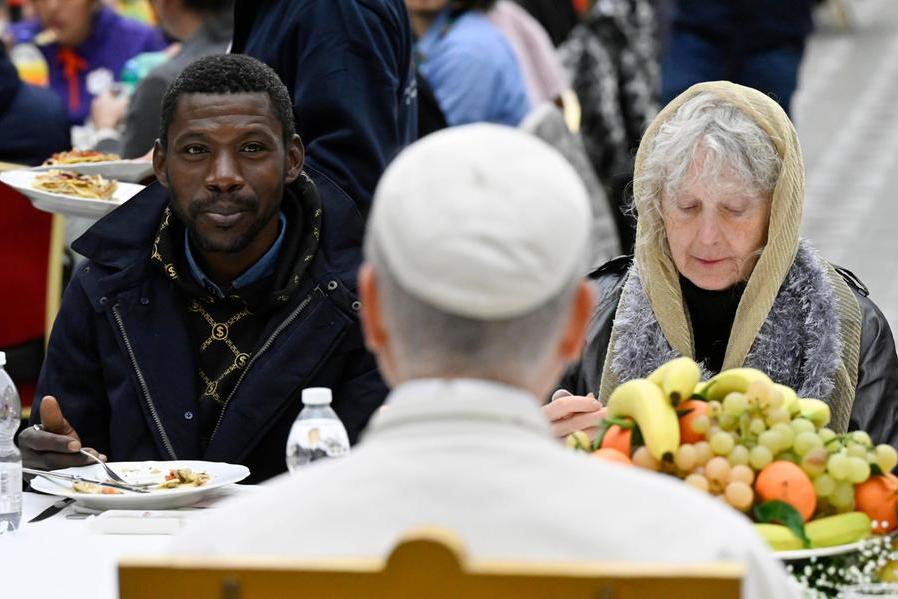
Dear reader friends, we have arrived at Christmas at a rapid pace. From my heart, together with the entire editorial staff of Credere, I wish you a peaceful Christmas of the Lord, in this year 2025 marked by so many events. In this issue we tell you about a “special” Christmas: that of the Christians who live in the land of Jesus, who like him live unknown and in conditions of serious precariousness. A story that can lead us to consider Christmas in a different light from that of sequins, and to see it rather as the celebration of the humble, the poor, those who don’t count. Because, starting from the Incarnation, every man and every woman on earth – however miserable their condition may be – has a special dignity before God. That God who has chosen to be-with-us. An article from a few days ago recounted the Christmas lunch offered by the Vatican Apostolic Charities to the poor under the colonnade of St. Peter’s, last December 7th. No sensational news, it will be said: Pope Francis has made these initiatives a habit. Yet, these poor people invited to party and become “subjects” cannot help but provoke us. I reread a beautiful page by Saint Charles de Foucauld: «Jesus attracts the shepherds to himself with the voice of the angels… Jesus does not reject the rich, he died for them, he calls them all, but he refuses to share their riches and calls the poor first… If You, Lord, had called the rich first, the poor would not have dared to approach You, they would have believed themselves obliged to remain apart because of their poverty… But by calling the shepherds to you first, you called everyone to you.” Yes, it is often the saints who speak to us in a profound way about the “scandal of the incarnation”, such as Francis or Charles de Foucauld. No meditation will ever be able to exhaust the depth of the mystery of a God who makes himself small, thus honoring all the “little”, the humble, the marginal of life. Saint Paul says it in an extraordinary way: “Jesus Christ, although he was rich, became poor for you, so that through his poverty you might become rich” (2 Corinthians 8:9). And the Apostle always reminds us that the first Christian communities were composed mostly of “humble” people (1 Corinthians 1,26-29). Christianity brought a new spirit to ancient Greco-Roman society, where abortion, infanticide and abandonment were considered “acceptable” behaviors. It actually brought a new way of looking at people based on caritas and pietas. The Universal Declaration of Human Rights, celebrated last December 10, is in some ways the “secular” outcome of a value, human dignity, which owes much to two millennia of Christian history. The Letter to Diognetus, after speaking of the incarnation, meditates on charity, almost as a consequence of it: “By loving God, you will become an imitator of his goodness”. Pope Leo reminds us that “Christian love”, that made up of “personal, frequent and heartfelt gestures”, overcomes every barrier… enters the most hidden folds of society” (Dilexi te, n. 120). Replying to a reader, he recommended: “What better gift could there be than opening our homes, during the days of Christmas, to welcome poverty… Let’s invite a poor family to Christmas dinner, or even just a person living in a difficult situation, who is alone.” With this invitation, I renew to everyone my best wishes for a holy Christmas of the Lord.
Credere, the magazine for living the “adventure of faith”
BELIEVE is the magazine that offers you stories, characters and columns every week to inspire faith in everyday life. Already chosen as the “Official Magazine of the Jubilee of Mercy”, it is a newspaper rich in content for the spirit, with many testimonies of famous people and ordinary people and the gestures and words of Pope Francis, closer than ever.
Discover the magazine and subscribe »