




In a few weeks, France will switch to summer time. When exactly? Date and tips to prepare for it and avoid being tired.
In 2026 and like every year, we change time in spring. The time change represents a collective ritual which punctuates the seasons and synchronizes, twice a year, the rhythm of our lives with that of the sun. The principle of time change was introduced in France in 1976 in order to limit artificial lighting in the evening and reduce the country’s energy bill. But the idea goes back further. In 1784, Benjamin Franklin mentioned the concept in a letter to the Journal de Paris. With a bit of spicy humor, he suggested that Parisians get up earlier to save candles. He even proposed ringing church bells at dawn and firing cannons to wake up the lazy ones. Even today, the time change is still relevant…
When will DST change in 2026?
In 2026, the transition to summer time officially takes place on the night of Saturday March 28 to Sunday March 29.
Do we go forward or back an hour?
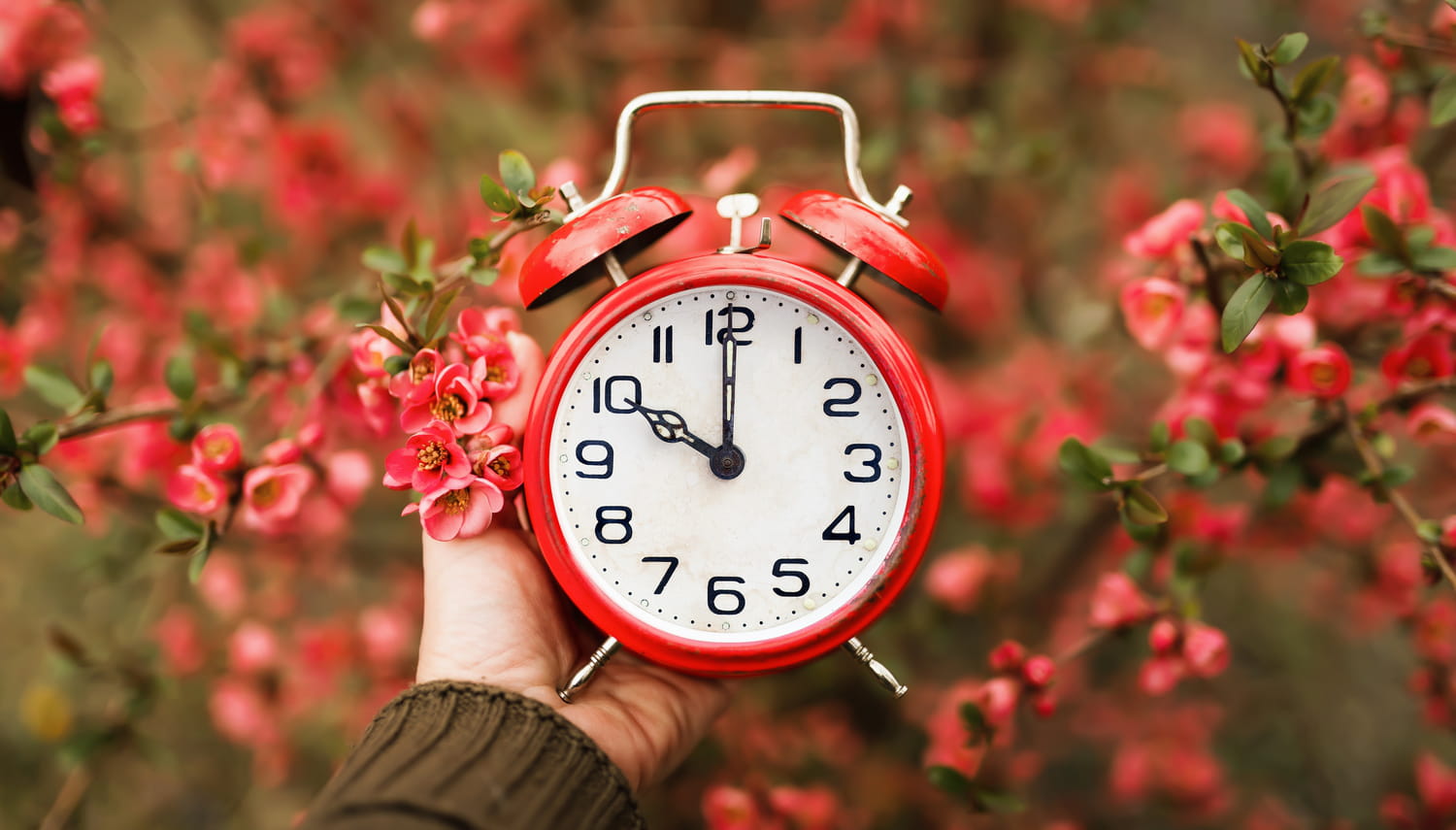
Very precisely, at 2 a.m., we will have to advance the clocks and watches by one hour so that it is directly 3 o’clock. If we advance by an hour (we go from 2 to 3 hours), we therefore “lose” an hour and sleep an hour less. This change, although synonymous with an hour less sleep at the time, allows you to enjoy longer days and late evening sunshine, which symbolically marks the entry into the summer season.
Why does the DST change take place in the spring?
It’s true that there is a gap between the season calendar and the label. In fact, it is called that because it defines the time that will remain in effect throughout the summer period. The change takes place at the end of March to “prepare” for the arrival of sunny days. We leave the time that accompanied us all winter to switch to that which will cover the months of June, July and August. The term “summer time” is much simpler and more evocative for the general public than “spring and summer time”: this makes it possible to clearly mark the contrast with the other time of the year.
Is this the last time change in 2026?
In 2026, the end of the time change is still not on the cards. Although the European Parliament voted to abolish it in 2019, the issue has stalled in the Council of the European Union. Member States cannot agree on the choice of a permanent time zone (summer time or winter time). It must be said that this subject is not a priority: between successive crises (Covid-19, geopolitical context), the subject has been relegated to the background of European political agendas. Therefore, France continues to apply the two time changes in 2026 (March 29 and October 25).
Sleep doctors advise gradually shifting your sleep by 15 minutes from the previous Thursday (March 26). On Sunday morning, it is advisable to immediately expose yourself to natural light to recalibrate your biological clock. This helps the brain reset its sleep-wake cycle and blocks the production of melatonin (sleep hormone). On Sunday afternoon, you should ideally resist the urge to take a nap of more than 20 minutes so as not to delay falling asleep the same evening.
What is special about the change to summer time in 2026?
The 2026 daylight saving time change has some interesting features, particularly on a religious level. It falls precisely on Sunday March 29, which corresponds to Palm Sunday in the Christian calendar. It is the day that marks the start of Holy Week, one week before Easter. For the faithful who go to the first morning masses, you will have to be particularly vigilant: with the hour lost, waking up will be more “prickly” than usual. On the other hand, the month of Ramadan must begin around February 18 and end around March 20. The transition to summer time will therefore take place approximately one week after the end of the fast, which will prevent practitioners from seeing the time of breaking the fast (Iftar) suddenly move back an hour in the middle of the holy month.