


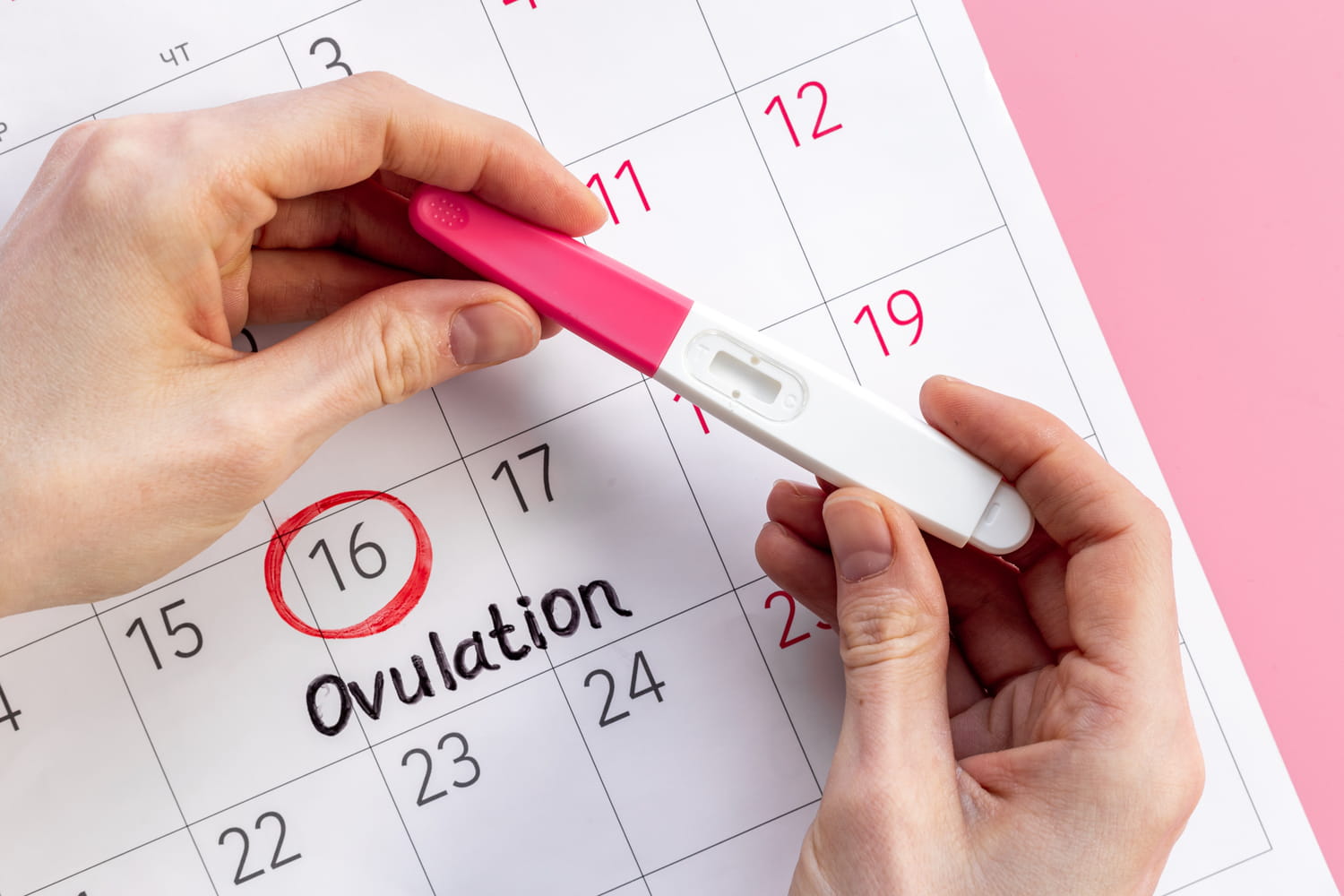



Calculating your ovulation date allows you to know the most fertile period of the menstrual cycle. Women often look for it when they want to get pregnant. Here is our free online calculator.
Ovulation is the time in the menstrual cycle when a woman is most fertile since this is when she expels an oocyte (egg) through the ovary. This egg can be fertilized by a sperm and give rise to an embryo. Ovulation begins at puberty, when a girl gets her period, and ends at menopause, when periods stop. The lifespan of an egg cell is approximately 12 to 24 hours after its expulsion from the ovary. Sperm survive in the cervix and remain fertilizing for 3 to 5 days. At the time of ovulation, the woman may manifest a series of symptoms such as tension in the breasts, abdominal pain occurring on the side of the ovary which releases her oocyte or even an increase in vaginal discharge.
Phase and duration of the menstrual cycle
To understand what ovulation is, you first need to know what a menstrual cycle is in women. THE female cycle begins the first day of menstruation and ends on the first day of the next period. So, if the first day of the period is the 3rd of the month and the 1st day of the next period is the 31st of the month, the cycle is 28 days. Whatever its duration, the menstrual cycle is made up of 3 phases :
- the follicular phase (approximately 14 days, including 5 days of periods),
- ovulation (24 hours on average)
- the luteal phase (approximately 14 days).
Ovulation date in a regular cycle
A normal or “regular” cycle lasts 28 days. Ovulation occurs on the 14th day. This ovulation date will allow you to know the fertile period. Ovulation, which lasts 24 hours, corresponds to the release of the oocyte from the ovary. The best time to conceive a babycalled fertile periodextends between the day before and just after the ovulation phase, i.e. approximately between the fourth day before ovulation and 24 hours after for a 28 day cycle. Please note: it is not because ovulation in a regular cycle (28 days) occurs halfway through it that it always occurs halfway through the cycle (for example on the 16th day of a 32-day cycle, or on the 12th day of a 24-day cycle).


Ovulation date if the cycle is irregular
The expulsion of the egg usually takes place 14 days before the start of menstruation. If you have irregular cycles and can’t predict when your next period will be, it will be more difficult to determine your ovulation date. The use of a temperature curve or ovulation tests may be possible. Drawing up a temperature curve allows you to determine very precisely the most favorable time to optimize your chances of getting pregnant.
The length of the cycle varies depending on the woman. If your cycle is shorter (less than 26 days), the follicular phase is shorter and therefore ovulation is earlier. If you have a cycle lasting for example 21 days: ovulation takes place on the 7th day from the first day of your period. The calculation is carried out by subtracting 14 days, the duration of the luteal phase which does not vary, from the number of days of the cycle: i.e. 21 – 14 = 7. If the cycle has a duration of 22 days: ovulation will take place on the 8th day, i.e. 22 – 14 = 8.
Ovulation date of a long cycle (more than 33 days)
If the cycle is longer than 33 days, the follicular phase is longer and ovulation occurs later (late ovulation) i.e. the 19th day from the first day of menstruation: i.e. 33 days – 14 days = 19 days. If the cycle lasts 34 days: ovulation takes place on the 20th day, i.e. 34 – 14 = 20.
Period of fertility, fertilization, implantation
The fertile period is the same as the ovulation period: it is the time when the egg is expelled and can meet the sperm. Fertilization refers to a fundamental stage of sexual reproduction, during which the male gamete fuses with the female gamete to form the egg, called the zygote. In humans, it is the sperm which plays the role of the male gamete and the egg which is the female gamete. The sperm contained in the semen emitted into the woman’s vaginal cavity will come into contact with the egg, and one of them will penetrate the egg. After penetration, the oocyte will become “hermetic” to the entry of other spermatozoa, which allows the development of a single egg. Fertilization therefore corresponds to the fusion phase between an egg and a sperm, which results in a single cell that becomes the embryo. After fertilization, the egg becomes an embryo and moves down to the uterus. A few days later, it clings to the uterine wall. This stage is called “implantation”. It generally takes place 6 to 10 days after ovulation.
Ovulation test: how reliable?
Clearblue, Biosynex… Ovulation tests are available in pharmacies, drugstores or supermarkets, without a prescription. They are therefore purchased over the counter. These tests detect the surge of the LH (luteinizing) hormone, which increases just before ovulation, in the urine. Some digital models also detect estrone-3-glucuronide (E3G) to report multiple fertile days (up to four or more per cycle). The reliability of ovulation tests is estimated to be around 99% when used correctly. But according to the ANSM, their performance may vary and they do not replace medical advice. Their interpretation should therefore be taken with caution, particularly in the event of irregular cycles.