


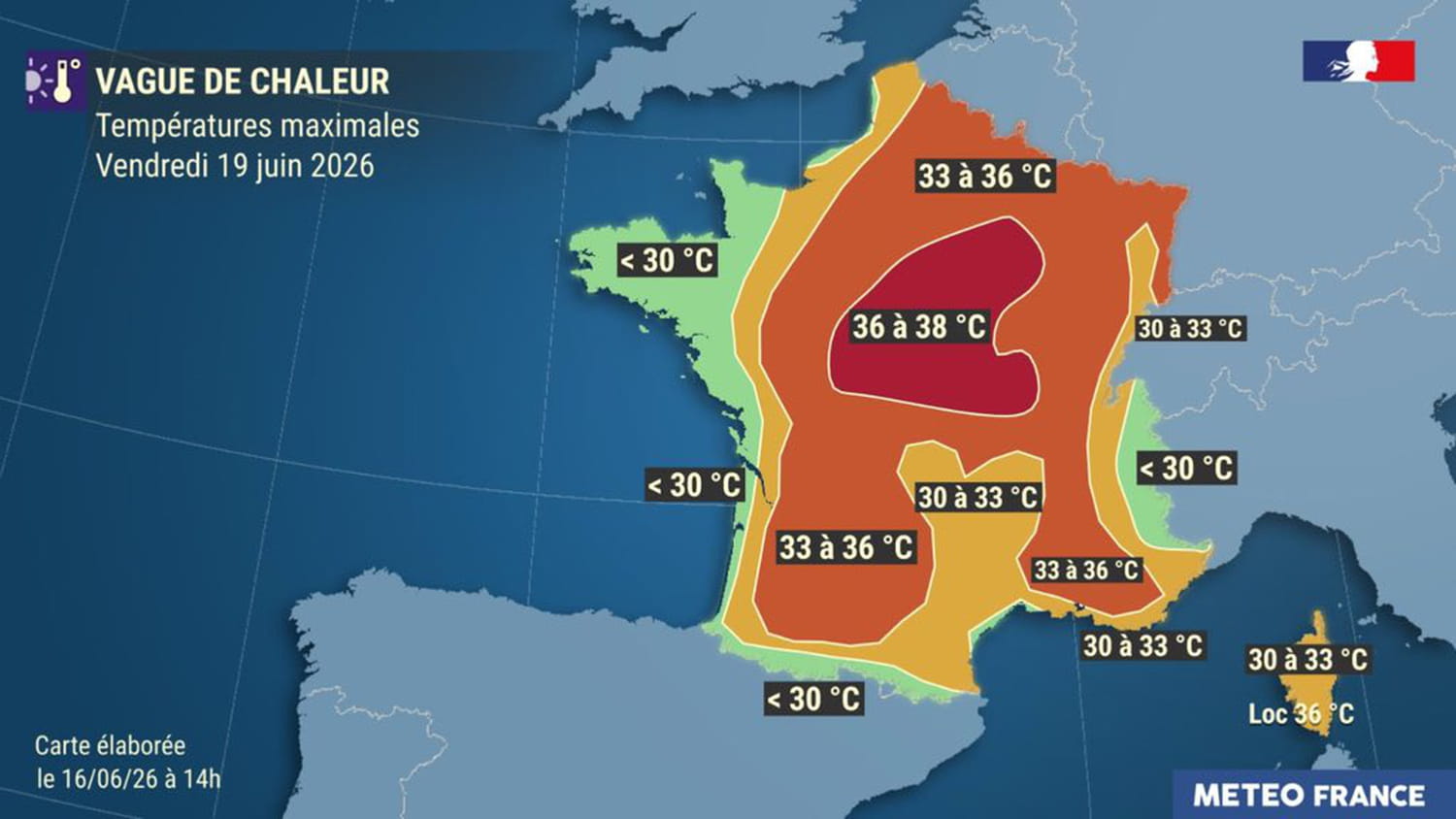
Peaks of 40°C are possible on Sunday. A long heatwave episode is predicted for France in mid-June 2026. Effects on the body, dangers, advice to avoid dehydration: this is how to best endure it.
(Updated Wednesday June 17, 2026 at 8:16 a.m.) Heatwaves are no longer rare in France, and temperatures are rising more every year. From a maximum of 35 degrees a few years ago, thermometers now climb to over 40 degrees. This is also what is announced for June 21 and 22. Meteo-France talks about the “first heat wave of the year 2026”. “On Wednesday, the heat intensifies everywhere. Between Thursday and Sunday, very high heat and hot nights affect a large part of the country, with 34 to 38°C from the South-West to the Center-East and the North-East via Île-de-France. Peaks of 40°C are possible on Sunday.”
A heat wave is setting in this week.
From Tuesday, more than 30 C in many regions, then values of 30 to 38 C.
Thunderstorms may break out in the southern and west/northwest areas at the end of the weekhttps://t.co/tmD15ys43p pic.twitter.com/tKviIvg1JC
— Météo-France (@meteofrance) June 15, 2026
What is the definition of heatwave?
The word “canicule” comes from the Latin “canicula” which means “little female dog”. Canicula is the name given to the star Sirius (which comes from the Greek “seirius”, meaning “burning”, “fiery”). which is located in the constellation Canis Major. Star that rises and sets with the sun from July 22 to August 22, a period characteristic of extreme heat. The heatwave designates a episode of high temperatures during the day and night for a prolonged period, of at least 3 consecutive days. In France, each department has its own threshold temperature from which we speak of a heatwave. Its thresholds vary between the North and the South. According to Météo France, we speak of a heatwave when temperatures at night are 18 to 20 degrees in the North, and 20 to 24 degrees in the South.
What are the recommendations in the event of a heatwave?
- Drink Water and Stay Cool
- Avoid alcohol
- Eat enough
- Close shutters and windows during the day, ventilate at night.
- Get your body wet (warm but not cold shower)
- Give and receive news from loved ones.
What are the dangers of heatwaves for the body?
Prolonged exposure to heat is a significant stress for the body. The human body tries to adapt to it. He sweats more and the blood vessels dilate. If it cannot maintain its temperature around 37°C when it is very hot or if body fluids or salts are not adequately replaced, several problems can arise:
Extreme heat can also aggravate pre-existing illnesses and be responsible for heat-associated illnesses. Taking certain medications can worsen heat-related effects, particularly in people at risk.
► Cramps, nausea, inexplicable fatigue, severe headache, incoherent speech or high fever: Call 15
Yellow, orange or red alertness levels: what does that mean?
Meteorologically, it is the exceptional nature of the high nighttime temperatures which marks the duration of a heatwave episode. Temperature and duration thresholds are defined by Météo France and vary according to the departments. There are three levels of vigilance in case of extreme heat:
► The yellow vigilance level corresponds to:
- a heat peak: short-term exposure (1 or 2 days) to intense heat
- or a persistent episode of heat but which remains below the alert thresholds
► The orange vigilance level corresponds to a heatwave: a period of intense heat for which the averages over 3 consecutive days of night and day temperatures reach or exceed departmental thresholds, and which is likely to constitute a health risk, particularly for fragile or overexposed people.
► The red vigilance level corresponds to an extreme heatwave: exceptional heatwave in terms of its duration, its intensity, its geographical extension, with a strong health impact for all types of population, and which can lead to the appearance of collateral effects, particularly in terms of business continuity.
Heatwaves in France: key dates
We identify 50 heat episodes in France since 1947. Over the last 35 years, they have been 3 times more numerous than in the previous 35 years. The number of days of heat waves has increased by 9: “The frequency and intensity of heat waves are expected to increase in the coming decades. The frequency of events is expected to double by 2050.” Today, THE heatwaves have udid not occur earlier (in June) or later (end of August-beginning of September). Among the main heat waves occurred in Francethose of June 19471976, 20032005, 2006.


► Summer 2023: the last heatwave was recorded in August 2023 with temperatures exceeding 40 degrees in several regions of France. Departments have been placed on red alert, proof of an “extreme” heatwave.
► Summer 2022: the heatwave episode began on June 15, 2022. This episode was unprecedented due to its precocity and intensity. Several temperature records for the month of June and also in absolute terms were recorded. A second heatwave episode affected France between July 12 and 20, then a third between July 31 and August 14.
► Summer 2019: between June 24 and July 7 and July 21 and 27. According to the bulletin published by Santé Publique France in September, 1,435 deaths were observed during this heatwave. The most affected are those over 75 years old.
► June 2005 and 2006 with temperatures often between 35 and 40°C, particularly in the south-east and in the Rhône valley (more than 30°C every day in Lyon in 2006).
► August 2003. Its intensity, duration and geographic extent were exceptional. It had caused 15,000 additional deaths compared to the usual mortality for this time of year in France.
► Other memorable heatwaves: that of July 1983 “longest observed” recalls Météo France, and those of the summer of 1947 and 1976.