



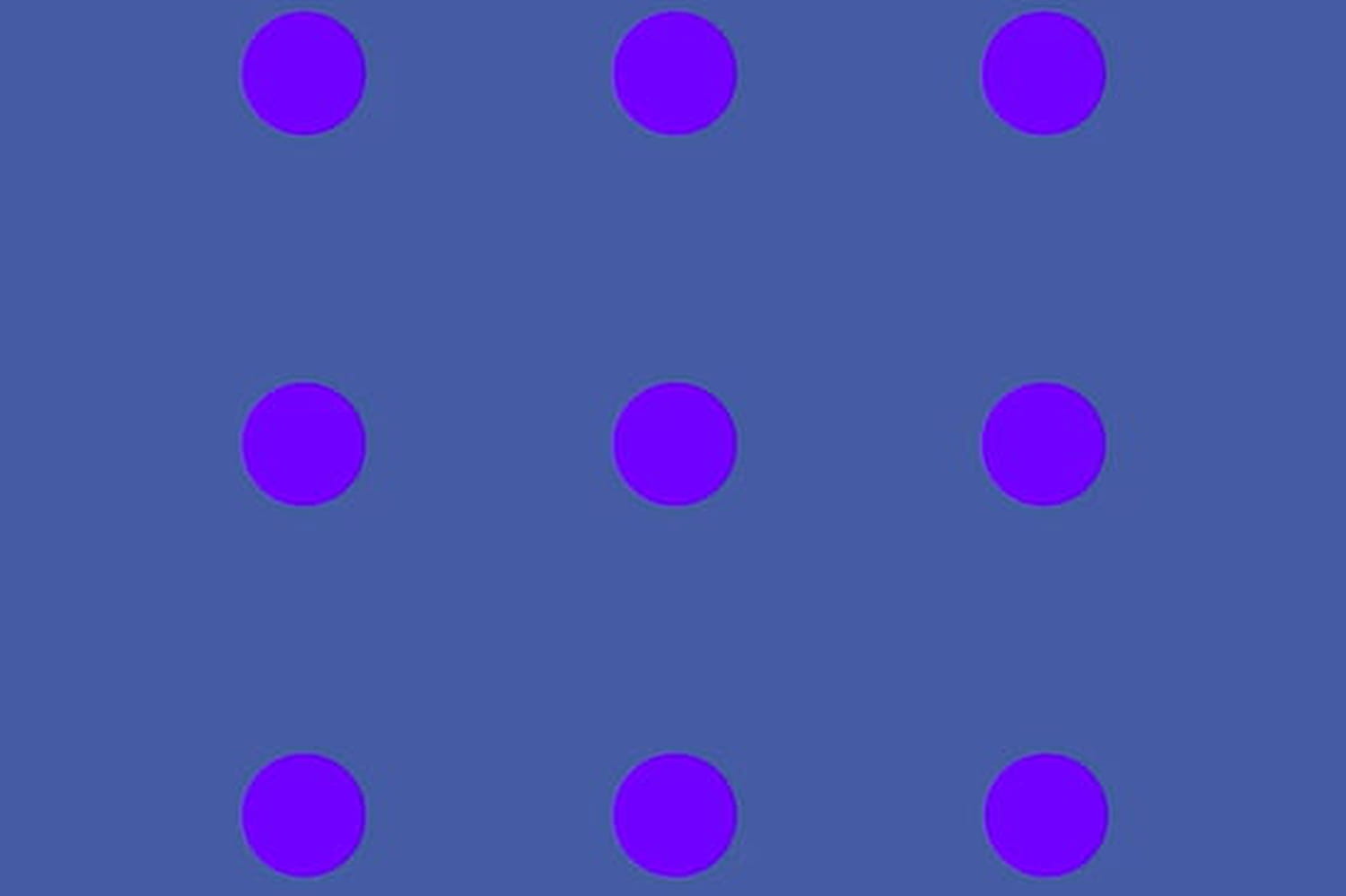


This optical illusion developed by a Harvard researcher reveals why our eyes are not as reliable as we think.
Have you ever noticed, when you stare at a point, that the colors could change before your eyes? Rest assured, you don’t have a vision problem: it’s just your brain playing a trick on you. It’s an optical illusion and reveals how far from reliable our perception of color is. The scientist Hinnerk Schulz-Hildebrandt first explained this illusion.
It all started from a banal observation. One day, this optics researcher at the famous Harvard University (United States) consults a flight map on his phone. As he follows the trajectory of the plane with his gaze, he notices something strange: the line changes color. Violet when he stares at it, it turns blue as soon as he sees it out of the corner of his eye.
Intrigued, the scientist decides to explore this curious phenomenon further and develops an illusion composed of nine purple dots arranged on a blue background. The principle is simple: when you stare at one of the points, it appears clearly purple, while the surrounding points appear blue, even though all of them are strictly the same color, that is to say purple. To experience it yourself, nothing could be simpler: observe the image closely, then gradually move away from your screen. As the viewing distance increases, more dots return to their purple appearance. The scientist demonstrates in the journal Perception that the brain misleads us about the colors we think we see.
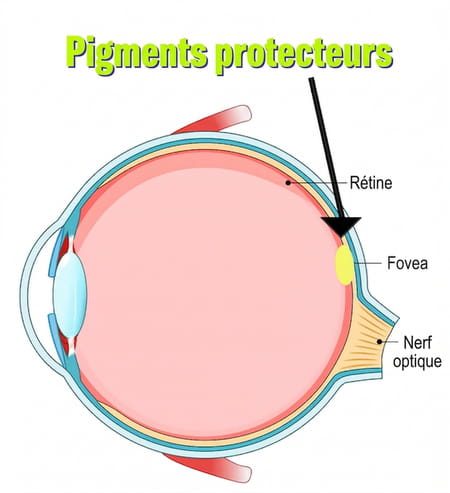
But why is he so wrong? Hinnerk Schulz-Hildebrandt points out that our eyes have three types of color-sensitive cells, called “cones,” which detect wavelengths corresponding to red, green and blue, respectively. However, the cones sensitive to blue are almost absent from the fovea, the central area of our retina, the one which corresponds to the exact place where our gaze is focused. Result: when we fix a point directly on the optical illusion, we perceive less blue, and the point appears more purple.

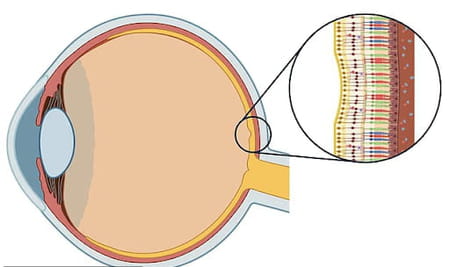
Added to this is a little-known feature: a layer of protective yellow pigments covers the center of our retina. As Scientific American explains in a video, “this layer acts like internal sunglasses” And “absorbs part of the blue and ultraviolet light before it even reaches the cones of our retina. Result: we do not perceive as much blue in the center of our vision as in the periphery”. Finally, the blue background of the image reinforces the illusion thanks to a phenomenon called “simultaneous contrast”: our brain perceives colors according to their environment, and a blue-violet dot placed on a blue background will automatically appear to us “less blue”, therefore more purple.

The most fascinating thing is that these perceptual “errors” go completely unnoticed in everyday life. “We usually don’t notice it because our brains have learned to compensate for this difference” explains neuroscientist Jenny Bosten, a vision specialist with Scientific American. Our brain constantly recalibrates the information transmitted by our eyes to give us a stable and coherent vision of the world.
This fun exercise reminds us that what we “see” is never a faithful photograph of reality, but a permanent reconstruction of our brain. At every moment, it interprets, corrects and adjusts the signals transmitted by our eyes to construct an image of the world which, although convincing, is never completely accurate.