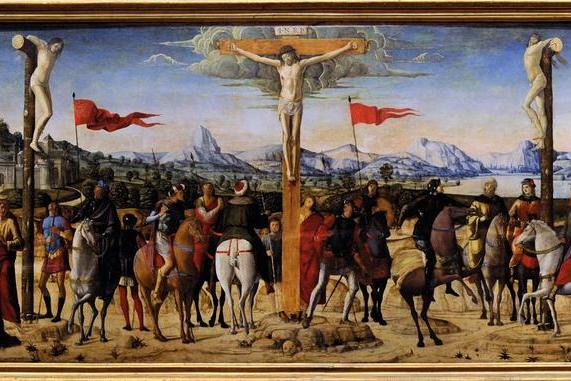




«Jesus will be in agony until the end of the world; one must not sleep during this time.” This phrase from the philosopher came to mind, dear reader friends Blaise Pascal thinking of the thousand tragedies that are taking place in many parts of the world: now all eyes are on Iran and the countries of the Persian Gulf, but there are Gaza, the West Bank, Lebanon (there is talk of 1 million displaced people), the conflict between Pakistan and Afghanistan, the humanitarian catastrophe in Haiti, the drama in Cuba, the crisis in north-east Nigeria (6 million starving people). They are like many Golgothas before our eyes, in which the passion of Christ “relives” in the innocent victims of our days.
It is a powerful light that helps us to look perhaps with a different gaze at the story of Jesus’ passion, on this Palm Sunday and during Holy Week. Christ was the innocent victim of a great deal of human violence. We often forget that we are disciples of a God who reveals himself in a paradoxical way: in the ignominy of the cross, in the abandonment of God and men, even of our closest friends. The victory of the cross also lies in this paradox: having transformed his death into an act of love, his sacrifice into an instrument of eternal salvation.
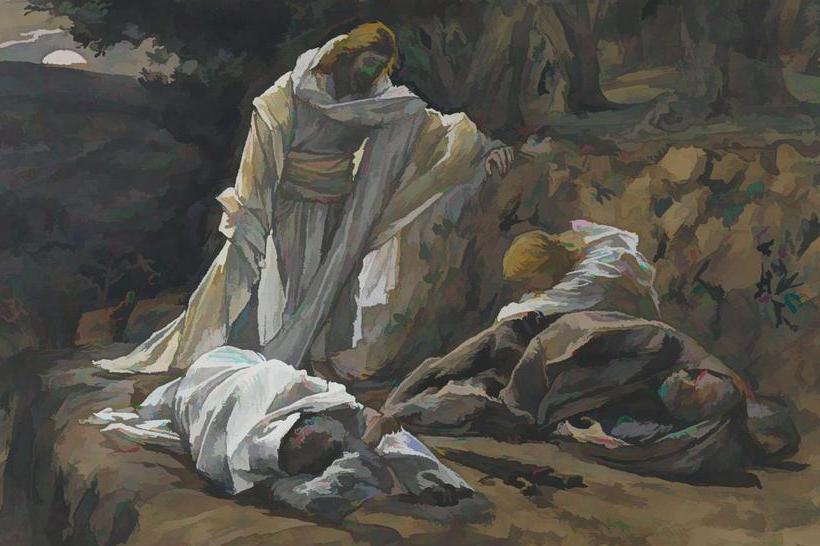
But there are also other actors in the story of the Passion: the disciples, for example, succumbed to sleep during the agony that Jesus experienced in his soul before his body. «Simone, are you sleeping? Weren’t you able to stay awake for a single hour?”. That absence of the disciples, the indifference towards the drama that was taking place, is often ours too.
Pope Leo at the Angelus on Sunday 15 March he urged us to “live Christianity with our eyes open”. And father Ibrahim Faltasof the Custody of the Holy Land, commented: «Eyes closed to good, eyes blinded by power cannot open, cannot see the suffering and pain of others, cannot stop the consequences of a hatred that infects and kills».
A famous poem came to mind, Christians and pagansOf Dietrich Bonhoefferthe Lutheran theologian killed by the Nazis in 1945, who refers precisely to the passion of Christ which continues over time. While some “men” go to God to ask (for help, liberation from evil, etc.), in short for themselves and their own needs (“this is what everyone does, Christians and pagans”); other men “go to God when he is in need / they find him poor, outraged, without bread and home / they see how sin devours him, / weakness and death”.
It is the reverse movement, the one that arises from faith in the Crucifix: we recognize him in the sufferers of history and we are ready to participate, to share, to show solidarity. This path of adult faith is not an obvious one, dear friends.
On Good Friday we will experience the great universal prayer, a reflection of the heart of Christ who gave his life for all. Let us at least carry in our hearts the fate of the world in this week of such intense liturgies. May it help us to open our hearts and hands, to alleviate some suffering, to bring a bit of good and love, where we can, to those who need it. And may it help us to feel, as some Italian theologians wrote in an appeal dated 16 March, “the responsibility to join with all those who reject violence”.
In collaboration with Credere
Credere, the magazine for living the “adventure of faith”
BELIEVE is the magazine that offers you stories, characters and columns every week to inspire faith in everyday life. Already chosen as the “Official Magazine of the Jubilee of Mercy”, it is a newspaper rich in content for the spirit, with many testimonies of famous people and ordinary people and the gestures and words of the Pope, closer than ever.
Discover the magazine and subscribe »