
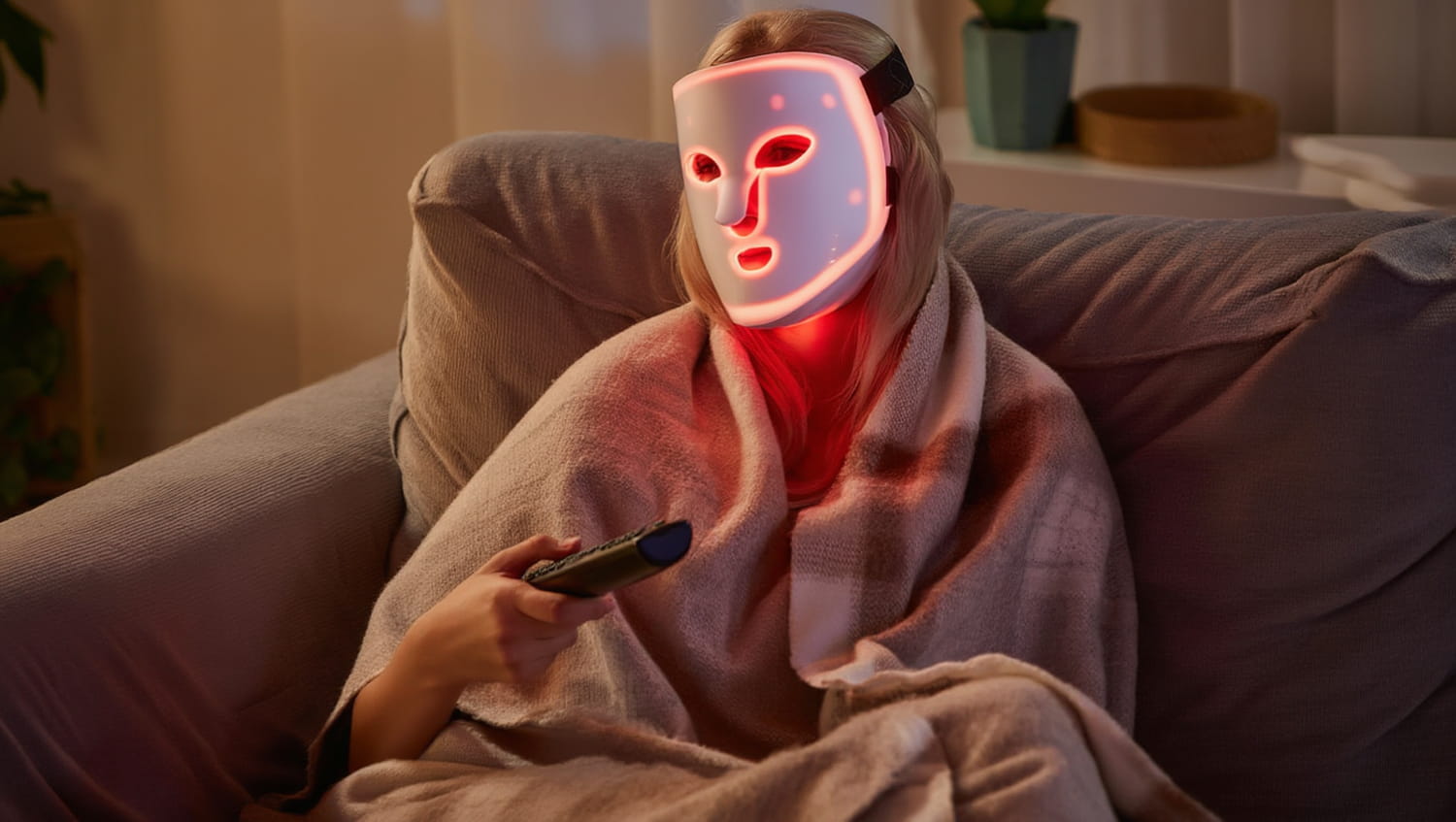




Star of skincare routines, the LED mask promises radiance and anti-aging. But if used incorrectly, it can disrupt the uniformity of the complexion. Explanation.
What if your favorite beauty device doesn’t always give the results you hoped for? Star of home skincare routines, the LED mask has established itself as the essential high-tech facial treatment. Promise of radiance, smoother skin, boosted collagen and anti-aging effect visible in just a few minutes a day: hard to resist. Validated by numerous professionals, it is attractive for its ease of use. But like any treatment integrated into a beauty routine, its effectiveness depends above all on the way in which it is used — and the frequency chosen. What if, by wanting to boost your youthfulness, you were in reality triggering an invisible cellular reaction but devastating for the uniformity of the face? We explain everything to you.
It all started when dermatologist Dima Haidar, known as Docteur_skin on social networks, published a video on her Instagram account. “If you like to take care of your skin, then be careful. You may be making these mistakes without realizing it.“, she begins. And continues: “If you have problems with spots or hyperpigmentation, be careful about using LED masks at home. They can stimulate cells that produce melanin called melanocytes and make dark spots worse.“Before you panic and throw your device in the trash, it’s important to add a touch of nuance.
First of all, most masks do not damage the skin and, on the contrary, are beneficial. Where use can become problematic is because, even though LEDs are “cold lights”, some masks of lower quality or worn for too long can impact the skin. The radiation hits a sensor located on the surface of the melanocyte. For him, intense light is perceived as stress or a potential threat, like a mini-sunburn. In response, the skin activates its unique mode of defense: the production of a melanin shield. It is this protective mechanism which, ironically, darkens and aggravates the pigment spots already present or creates new ones.
For its part, blue light is excellent for killing acne-causing bacteria. However, some studies show that it can induce more intense hyperpigmentation than UV rays in dark to black skin. It generates free radicals which can stimulate the production of melanin as a protective reflex.
Used wisely and without exceeding ten minutes per day, LED masks can truly boost collagen production and calm skin inflammation. The dose simply makes the poison.