





The Government approved in the Council of Ministers the bill on the recognition and protection of family caregivers, a measure awaited for over ten years which for the first time introduces an organic discipline in Italy for those who take care of a non-self-sufficient family member.
A first step after years of attempts
In the last ten years, over thirty legislative proposals on the topic had been presented, without however arriving at definitive legislation. With the new bill, presented by the Minister for Disabilities Alessandra Locatelli, an important step has finally been taken towards the legal recognition of a hitherto largely invisible social figure.


Who are family caregivers and why is it important to regulate them
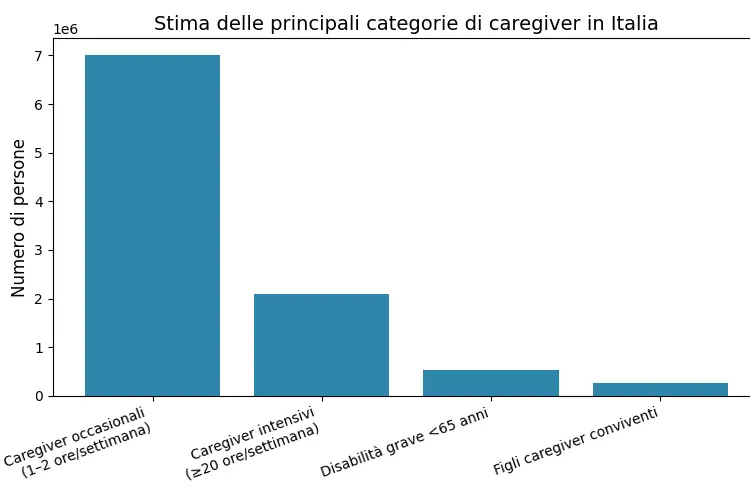
In Italy, family caregivers are people who take care of a relative with a disability or non-self-sufficiency in daily life activities free of charge. Often it is a spouse, a child, a parent or another cohabiting relative who dedicates much of their time to assisting the fragile person. Legally recognizing this figure means giving an account of it not only in symbolic but also concrete terms, paving the way for protections and interventions capable of supporting families who play a decisive role in maintaining national welfare.
The main measures contained in the bill
The approved text introduces a system of protection differentiated based on the intensity of the care commitment, measured in hours per week: live-in caregivers with a care load exceeding 91 hours per week (including night hours); caregiver with a commitment of between 30 and 90 hours per week; caregiver with a commitment between 10 and 29 hours per week; non-cohabiting caregivers who provide care for at least 30 hours per week.
Economic contribution and access criteria
Only for the first category, that of live-in caregivers with the most intense care burdens, is there a tax-free economic contribution of up to 400 euros per month, equal to 1,200 euros per quarter. To access the measure, however, there are stringent economic criteria: the caregiver must not have an income exceeding 3,000 euros per year and the family unit must not exceed an ISEE of 15,000 euros. Requirements that could significantly reduce the effective number of beneficiaries compared to the overall number of family caregivers present in the country.

Resources and implementation times
The Budget Law has allocated a total of 257 million euros per year when fully operational starting from 2027 to finance the new protections. For 2026, around 1.15 million euros are foreseen for the creation of the INPS IT platform, necessary to precisely identify the beneficiaries and manage requests for access to the measures.
Beyond the economic contribution
The bill is not limited to economic support, which is important but still insufficient. It is also foreseen – and this is one of the most important aspects of the Bill – a procedure for formal recognition of the caregiver figure, with registration in a dedicated section of the INPS and inclusion in the “life project” and individualized care plan of the assisted person. These are elements that could form a basis for future social security, employment and training protections. The measures envisaged also include: solidarity work permits, parental leave for caregivers with minor children and forms of flexibility for students and workers engaged in care.
A first goal and a development perspective
While recognizing the importance of the first step taken, many associations of caregivers and people with disabilities underline the limits of the measure: resources still considered insufficient, very restrictive access criteria and the absence of more structured social security and social protections. The bill now passes to Parliament under urgent procedure. The hope is that, during the legislative process, the protections provided will be able to be expanded, the measures made more accessible and the inclusion of a greater number of families who face the complex and delicate task of care every day.