






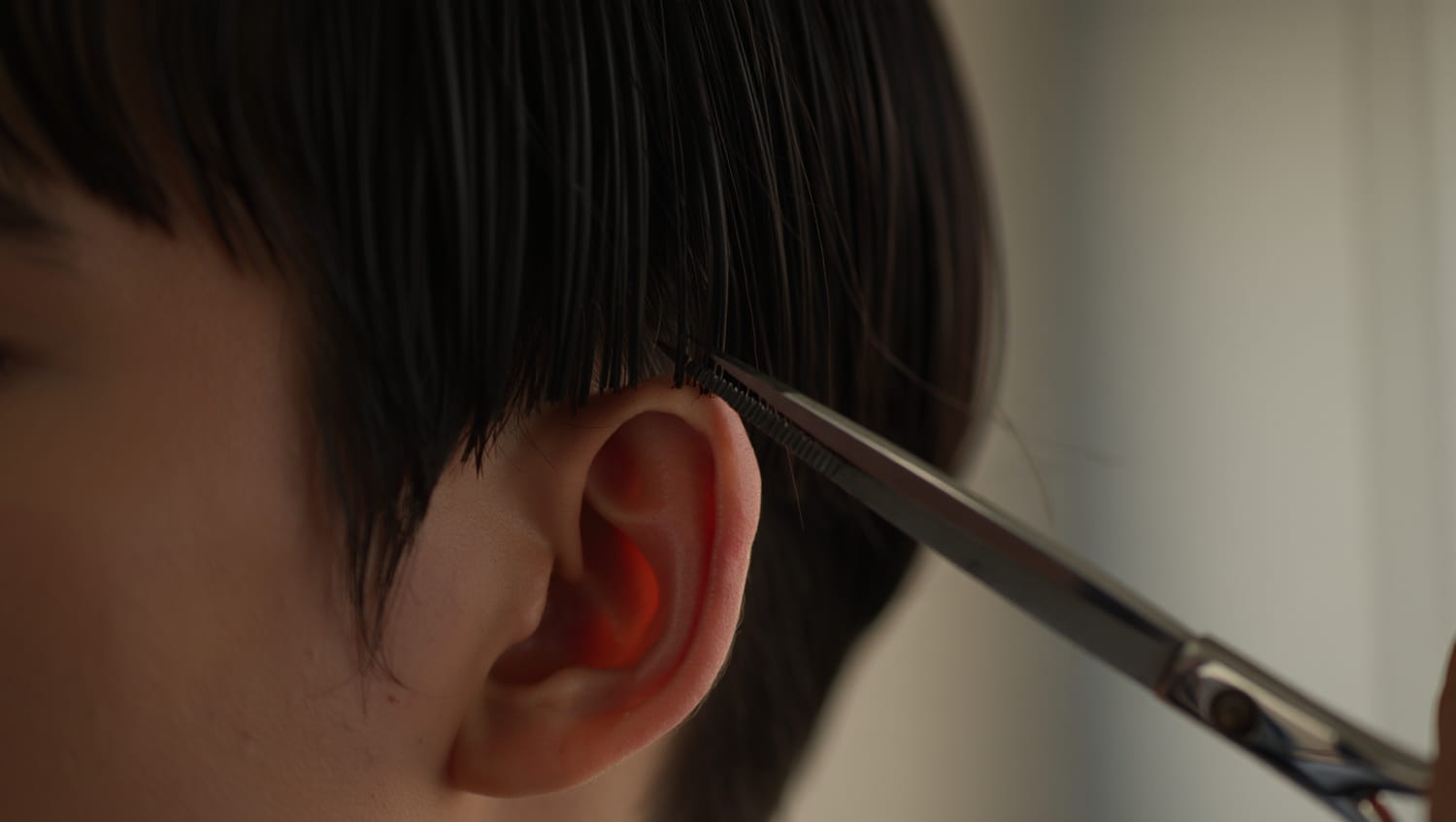
Thought out down to the smallest detail, this short and clean cut is making salons panicky (+71%). Focus on this minimalist phenomenon that redefines summer.
In hair salons, the discourse has changed. Clients arrive with more precise desires, fewer vague ideas and more clear references. The era of wavy lengths and “effortless” hairstyles marks a decline, in favor of structured cuts. What matters now is durability.
In fact, we are now looking to benefit from a controlled cut, without having to multiply the products or technical procedures at home. Hairdressers speak of a return to more rigorous basics. Here, there is no question of masking with styling. The form must be enough. This requires significant precision from the start, because each strand contributes to the overall balance. This type of hairstyle is based on a legible line, assumed symmetry and controlled volume. In short, the final result may seem natural, but it is actually carefully constructed. The data confirms this dynamic. According to Fresha, an online platform dedicated to making appointments in the beauty and well-being sector, searches related to this cut have increased significantly, with an increase of 71% in one year and more than 55,000 requests recorded in a single recent month.
This peak of online interest reflects what is already happening in salons: a clearly increasing demand for graphic cuts, without gradients and with real intention in the form. Clients are no longer simply asking to “refresh” their length, they want a transformation that can be seen.
Another key element of its success: its ability to adapt. Length may vary to suit different face shapes. On some faces, it accentuates the contours, on others, it balances them. The adjustment takes place within a few centimeters, reinforcing the importance of upstream diagnosis. This precision makes cutting more demanding, but also more customizable than it seems. It does not work as a fixed model, but as a base that the hairdresser adjusts according to the texture of the hair and the morphology. His name? The Japanese square.
Moreover, this requirement is also found in the interview. Unlike more flexible cuts which tolerate approximate regrowth, this requires regular monitoring. Professionals recommend touch-ups every six to eight weeks. Naturally straight or slightly wavy hair particularly highlights this type of cut, because it more easily respects the defined line. But with a suitable routine, other textures can also obtain a very similar result.