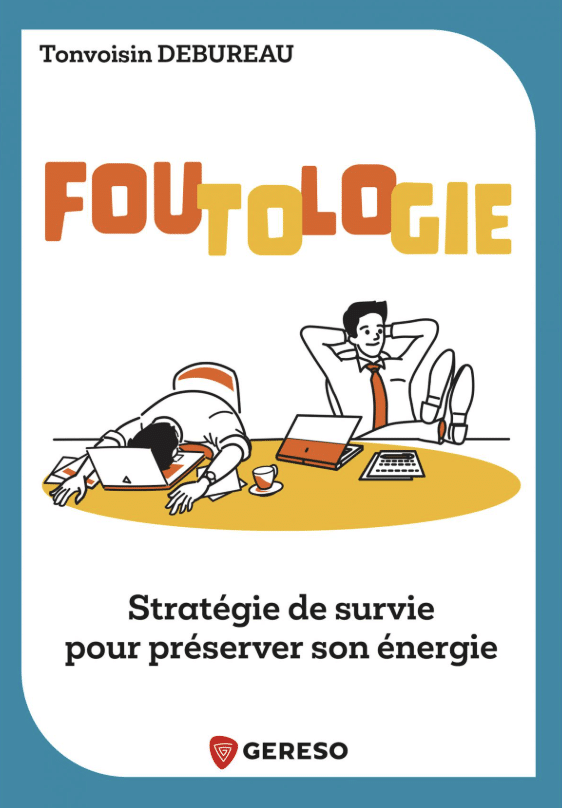
Saying yes out of guilt, exhausting yourself for others, confusing presence and value: Yannick Chatelain alias Tonvoisin DEBUREAU is familiar with this mechanism. In Foutologyhe offers a radical method to regain control of your energy – without losing your kindness. Interview.
“ Foutology », the word makes you smile. But what are we really talking about?
Yannick Chatelain: Let us immediately calm our enthusiasm as Foutologists: Foutology is not the art of not giving a damn about everything! We are far from this magnificent formula attributed to Montesquieu: “ It is an extraordinary thing that the whole of philosophy consists of these three words: “I don’t care.” » On paper, that sounds like a serious crack, but in real life, uh, it’s more complicated.
Foutology is the art of consciously choosing what really deserves our time, our attention, our energy – and of assuming we no longer give it to everything else.
I often summarize the book in one sentence: “ We don’t run out of time. We lack energy. And we spend it far too often on the wrong people, the wrong problems, and the wrong fights. »
In the book, I call it Mordor, in a nod to Lord of the Rings: the place where everything that enters is consumed, never giving us anything back. Sterile controversies, the views of others, comparisons, unnecessary conflicts, certain meetings – and sometimes certain family meals.
The problem isn’t that Mordor exists. The problem is that we continue to send our resources there. And every time we feed Mordor, we mechanically withdraw energy from what really matters: our health, our loved ones, our projects.
Your book starts from a head-on observation: we are not tired of our life, we are tired of saying yes to everything. For many women – mothers, working people, caregivers – saying no seems like a luxury that we do not allow ourselves. What do you answer them?
Yannick Chatelain: My answer: That they have long been made to believe that their value is measured by their availability. To be a “ good mother “, a ” good colleague “, a ” good friend »: it was too often to be the one who never said no. The right one to say “Yes” – I dare say the word, because that’s what it’s all about: a service that we provide, again and again, to the point of forgetting ourselves.
The problem is that by being indispensable to everyone, we end up becoming absent to ourselves. And an exhausted person no longer protects anyone in the long term. Setting limits is therefore not an act of selfishness – it is quite the opposite: an act of responsibility.
A candle that lights everyone up by burning at both ends always ends up going out. Protecting yourself is not desertion. This is the condition to continue to illuminate.
You propose the three circles method to distribute your energy. Where do we start when we are overloaded and we no longer know what really matters?
Yannick Chatelain: We certainly don’t start by doing more. We start by removing. I ask my readers to divide their lives into three circles: what is essential, what needs to be managed, and everything in between. And very often, the discovery is the same: we enormously feed Circle 3 – what I call Mordor – and we starve Circle 1.
Hence this sentence, which I find almost brutal in its simplicity: “ Each token given to Circle 3 is a token stolen from Circle 1. »
From there, a lot of decisions become surprisingly easy to make.
You distinguish the time-consuming parasite from the energy vampire. In a professional environment, which one is the most formidable?
Yannick Chatelain: The energy vampire, without the slightest hesitation. The parasite steals an hour here, an hour there. It’s tiring, but if you look at the glass half full, it’s almost distracting. The vampire steals even your desire to work. He is as exhausting as he is dangerous: he always arrives with the same problems, the same complaints, without ever wanting a solution – for the good reason that his real job consists of creating problems to pretend to solve them. We come away from each exchange with him empty, and a little lost: this is his specialty, the paradoxical injunction.
Many people think they are tired from their workload. In reality, they are especially exhausted by this type of fanatic who, in order to exist, methodically siphons the energy of others.
Your chapter on presenteeism is powerful: in France, being exhausted would almost be proof of seriousness. How to get out of it without being marginalized?

Yannick Chatelain: I believe that we still massively confuse presence and contribution. We admire the person who answers their emails at midnight, who never takes a break, who is always available. Worse: overwork is glorified as proof of professional seriousness.
Yet sustainable performance is never born from exhaustion. Models as crazy as the 996* now sell the idea that we can be efficient by working harder and harder, presented as a modern and desirable way of life. In reality, it’s most often a one-way ticket to burnout. Our energy is not an infinite resource.
The goal is not to work less. It’s about lasting. True performance isn’t about having energy at the end of the week – it’s about still having energy in ten years.
*996 (9 a.m.–9 p.m., 6 days a week, or 72 hours a week) was born in Chinese tech, where it was officially banned by law in 2021 – even if informal practices persist in some companies. The phenomenon is no longer confined to China: several Silicon Valley start-ups, particularly in AI, are now claiming similar paces in the name of global competitiveness, a trend confirmed by concrete data (measurable increase in professional activity on Saturdays in San Francisco). We even sometimes mention a “997” (7 days a week) or, by ironic exaggeration, a “007” (24 hours a day, 7 days a week). Experts agree, however, that these extreme rhythms remain, at this stage, a minority rather than widespread – the 997 being more of a worrying cultural symbol than a truly widespread norm.
The “Foutomètre” helps to decide on a daily basis. Can it also be applied to big decisions: changing jobs, leaving a partnership, breaking up with a toxic client?
Yannick Chatelain: Absolutely. The Foutomètre never decides for you. It simply prevents you from making a big decision too quickly, under the influence of fear, guilt or the eyes of others.
He asks a very simple, and extremely effective, question: does this decision nourish my Circle 1… or does it nourish my Mordor? And very often, the answer appears suddenly, much more clearly than we imagined.
You defend a form of radical authenticity. But in a world where image matters – social media, personal branding, networking – how radical can we really allow ourselves to be?
Yannick Chatelain: Radical authenticity doesn’t mean saying everything you think. It’s stopping playing a character.
You can be diplomatic, preserve your secret garden, communicate intelligently – without spending your life creating a version of yourself that pleases everyone.
By wanting to be loved by everyone, we often end up no longer knowing who we are. And this renunciation has an immense energy cost. Authenticity is not about revealing everything. It’s no longer betraying what really matters to you.
A phrase from Foutology to remember to transform your daily life tomorrow: which one, and why?
Yannick Chatelain: Without hesitation: “ We don’t run out of time. We lack energy, which is a precious resource. And we spend it far too often on: the wrong people, the wrong problems and the wrong fights. »
I think this sentence sums up the whole book. We spend our lives looking for time, when our real wealth is our energy.
The real question is therefore no longer: “ Do I have time? “. The real question is: “ Does this person, problem, or struggle really deserve a piece of my life? “.
That’s what Foutology is all about: choosing where you invest your energy, rather than letting it disappear into Mordor. One page at a time – and one decision at a time.