






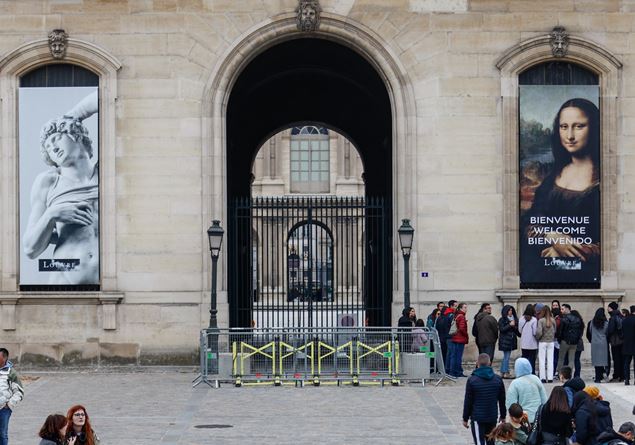
Seven minutes in total, in broad daylight, with a van equipped with a hoist and wearing yellow vests to pretend to be workers from the nearby construction sitetaking security by surprise and triggering panic but also curiosity about the completely unpredictable event among visitors: a sensational, incredible coup, studied down to the smallest detail, worthy of the best Hollywood screenplays, the one that took place at the Louvre in Paris, the largest and most visited museum in the world, in the Apollo Gallery, on the first floor, where some of the museum’s most valuable historical collections are kept. The gang of thieves, perhaps foreigners, managed to take away “eight objects of inestimable patrimonial value”.
Here’s what it is: a tiara from the parure of Queen Marie-Amélie and Queen Ortensia; a necklace of the sapphire set of Queens Marie-Amélie and Queen Hortense; earrings made with two stones from the sapphire set of Queen Marie-Amélie and Queen Hortense; an emerald necklace from Marie-Louise’s set; a pair of emerald earrings from Marie-Louise’s set; a brooch called a “relic brooch”; a large corset jewel of Empress Eugenie, wife of Napoleon III; a diadem also from Empress Eugenie, with 1354 diamonds and 56 emeralds, which is also the only jewel found so far, damaged, lost on the street outside the Louvre, during the frenetic and very rapid escape.
The robberies of works of art have often inspired cinema (from Lupine to Ocean’s twelve). Throughout history, there have been many sensational thefts of artistic goods of inestimable value. Among these, perhaps the most striking one because it still remains unsolved is the theft which occurred in 1990 at the Isabella Stewart-Gardner Museum in Boston, USA, a house-museum designed to house a collection of more than 2,500 works of European, Asian and American art. Here two men disguised as policemen managed to steal 13 works of art – canvases by Vermeer, Rembrandt, Manet, Degas – for a total value of around 500 million euros. Among these works, the “Concert” by Johannes Vermeer, painted around 1664, stolen together with the “Storm on the Sea of Galilee“, considered the most valuable stolen work of art in history. Even today there is a reward of 10 million dollars for anyone who provides information that can allow the stolen works to be traced.
Among other cases, the theft in 1969 of the Nativity by Caravaggiopainting worth around 20 million euros, stolen from the altar of the Oratory of San Lorenzo in Palermo. Another famous theft of works of art was that of painting The scream by Edvard Munch: the work was stolen (and found) twice within ten years. The first in 1994, when it was exhibited in the National Gallery in Oslo. She was found intact three months later. In 2004 it was stolen again, from the Munch-Museet, together with another painting, the Madonna. Two years later, in 2006, the Norwegian police found both paintings, which in 2008 were returned to display in the National Gallery in Oslo.
But the Louvre itself has a long history, despite itself, of thefts and attempted robberies. The most famous case is probably the theft of Mona Lisa by Leonardo da Vinci in 1911: a former employee, the Italian decorator Vincenzo Peruggia, hid in the museum and took the painting away, hiding it under his coat. The work was found two years later in Florence, where Peruggia had tried to sell it. That episode, with a happy ending, certainly contributed to increasing the notoriety of Vinci’s painting throughout the world.
(Photo Ansa: one of the entrances to the Louvre in Paris closed after the theft on 19 October)