
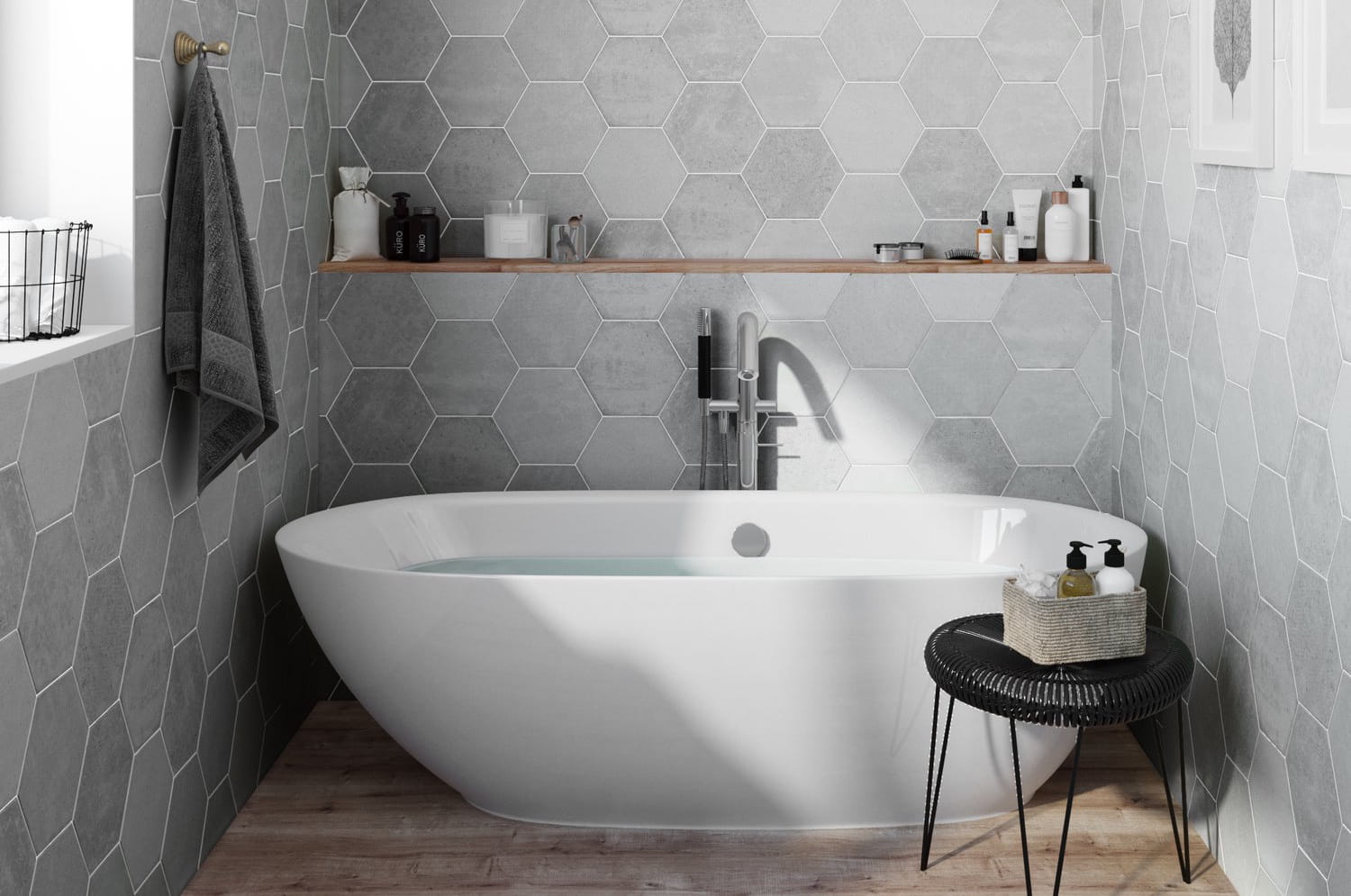




Both geometric and deliciously retro, hexagonal tiles are the star of our interiors. Vibrant colors, raw textures and revisited patterns: discover how this small six-sided tile reinvents the style of your technical pieces.
Long confined to terracotta country kitchens, it has a new look. Previously considered too traditional, it is coming back to the forefront thanks to its powerful graphic rendering which reconciles authenticity and contemporary design. And what about this new generation of hexagonal tiles, each more attractive than the last? Zoom in on these models which appeal equally well to bathroom than kitchenon the floor, on the wall and in a splashback.
In the kitchen, hexagonal tiles can be installed on the floor as well as on the wall! It will be ideal for adding a graphic decorative element to the splashback, for example. You can choose it in the same tones as the wall, or on the contrary, in a color that stands out or even with patterns.
On the floor, the hexagonal tiles won’t lack style either. Combined with parquet for a geometric look, it also looks great. Finally, special mention for its cement tile version with abstract and colorful designs, which are installed in a sophisticated but not uniform way. Wow result guaranteed.


On the bathroom floor, to cover the floor of a walk-in shower or to cover the walls around the bathtub, the hexagonal tiles will stand out. We also really like the patchwork effect in a shower with a mix of three shades or patterns that match. On the floor, it works best in its plain porcelain stoneware version, but you can also mix colors to create a graphic effect in black and white, for example.


In what other room can you dare to use hexagonal tiling?
If it is obvious that it easily finds its place in the bathroom, the kitchen or even the toilets, know that hexagonal tiles have real decorative power in other rooms of the house.
- L’entranceFor example ! Adopted in three different colors in size XXL, it creates the decor all by itself.
- Same in the corridor where it offers real dynamics to this often unexploited and little highlighted space.
- In the living roomit is discreet with a pretty pearly zellige appearance, on the wall or on the floor.
- While in the dining room it makes a splash in mineral shades and ultra-trendy patterns.


Less easy to install than rectangular or square tiles, hexagonal tiles require the same materials but more time. The reason is simple: six spacers are necessary to demarcate the joints between each tile instead of the usual four. Another constraint if you go for an unstructured installation: do not glue or dirty the part of the wall or floor that will not be tiled.
- To do this, glue the tile directly with less mortar to avoid excess around the edges.
- Gradually remove the overflowing glue using a sponge to avoid damaging the surface which will not be covered.
- Finally, the joints are made in the same way as during a classic installation.
- For difficult areas (like corners or upper rows), you can replace the trowel with a spatula to materialize them more easily.