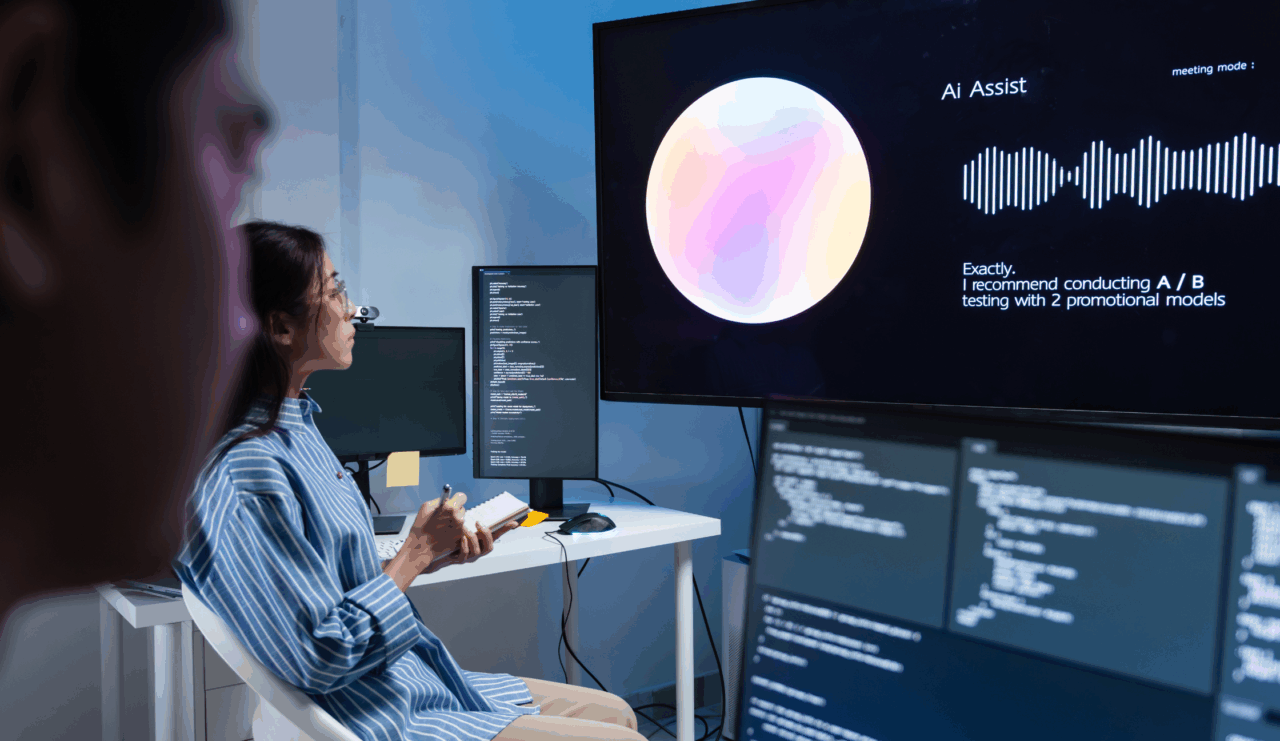






After several years of acceleration, generative artificial intelligence entered a maturity phase in 2026. Today, the spectacular announcements are giving way to a more strategic question, which has become central for companies and independents: which AI to choose, for what concrete uses, and with what impacts on work?
To answer this, this AI 2026 comparison analyzes the main solutions available, their strengths, their limits and their real professional uses.
Google with Gemini, OpenAI with ChatGPT or Microsoft with Copilot are no longer content with innovating. On the contrary, these actors create ecosystems integrated into everyday tools. Thus, the challenge is no longer to relay their promises, but to compare the main solutions according to their strengths, their limits and their real professional uses.
2026: AI is no longer a gadget, but a strategic choice
Previously reserved for tech teams or early adopters, generative AI is now used to:
-
write and analyze content,
-
automate certain tasks,
-
help with decision making,
-
improve individual and collective productivity.
However, this democratization brings a new challenge: the fragmentation of solutions. Each AI has its logic, its biases, its economic model and its preferred uses. So, understanding their differences becomes a real advantage for professionals.
Gemini (Google): the power of the ecosystem
With Gemini, Google is focusing on integration. Concretely, AI is gradually being deployed as a default assistant on Android and at the heart of Google Workspace (Docs, Gmail, Sheets).
Strengths
-
Good multimodal management (text, image, video, audio)
-
Smooth integration into Google tools
-
Powerful analysis of documents and data
Boundaries
-
Dependence on the Google ecosystem
-
Less flexible for creative uses
-
Arrival of advertising in responses: a point to watch out for
👉 So, Gemini is especially suitable for companies already in the Google universelooking for an integrated and practical assistant.
ChatGPT (OpenAI): conversational and creative AI
In 2026, ChatGPT remains a reference for editorial and creative uses. His strength is his reasoning ability, his adaptability and his personalization.
Strengths
-
Writing quality and structuring of ideas
-
Adaptation to different professions
-
Advanced customization tools (specialized GPTs)
Boundaries
-
More limited system integration
-
Requires usage skills (prompting)
-
Higher cost for large-scale deployment
👉 In practice, ChatGPT is particularly appreciated by freelancers, content creators, consultants and managers for writing and strategic thinking.
Microsoft Copilot: everyday professional AI
For its part, Copilot is designed for business productivity. Thanks to its integration into Word, Excel, Outlook or Teams, it acts as a discreet, efficiency-oriented assistant.
Strengths
Boundaries
-
Less creative than ChatGPT
-
Not very suitable for exploratory uses
-
Addiction to Microsoft 365
👉 So, Copilot is mainly designed for structured teams, such as HR, finance or administration.
Thanks to this AI 2026 comparison, professionals can quickly identify the tools best suited to their needs, while evaluating the advantages and limitations of each solution.
What about the other AIs? Between alternatives and digital sovereignty
At the same time, other players are gaining visibility. Meta AIintegrated into WhatsApp or Instagram, is mainly aimed at the general public and conversational uses. For their part, Claude, Mistral or other European AI attract attention for their promises in terms of ethics, sobriety or data sovereignty.
However, these solutions remain less visible, but they pose an important question for the years to come: should we depend solely on American giants?
Key issues for 2026
Beyond performance, several structuring questions arise:
-
platform dependence,
-
data protection,
-
the transparency of the models,
-
the place of advertising in the responses,
-
and the acquisition of AI skills as new professional capital.
In 2026, artificial intelligence is no longer a race for novelty, but a strategic competence. In other words, the issue is not to choose “the best AI“, but the one that truly corresponds to the uses, values and organization of work.
This comparison of AI in 2026 allows us to better understand which AI best adapts to different professional contexts and which skills to develop to use them effectively.
Thus, for businesses as well as for women actors of economic change, AI becomes a powerful tool. As long as you master it rather than endure it.