


Ghali and the opening ceremony of Milano Cortina 2026, what is happening? Like many public people Ghalione of the singers most loved by young people, has his own ideas. He expressed them on the Sanremo stage in 2024, arousing much debate for having expressed his support for the Palestinian cause, speaking of genocide. As soon as his participation among the artists was made known (others already known are Andrea Bocelli, Mariah Carey, Laura Pausini…) a fuss broke out at the Opening Ceremony of the Milan Cortina 2026 Olympic Games.
The casus belli
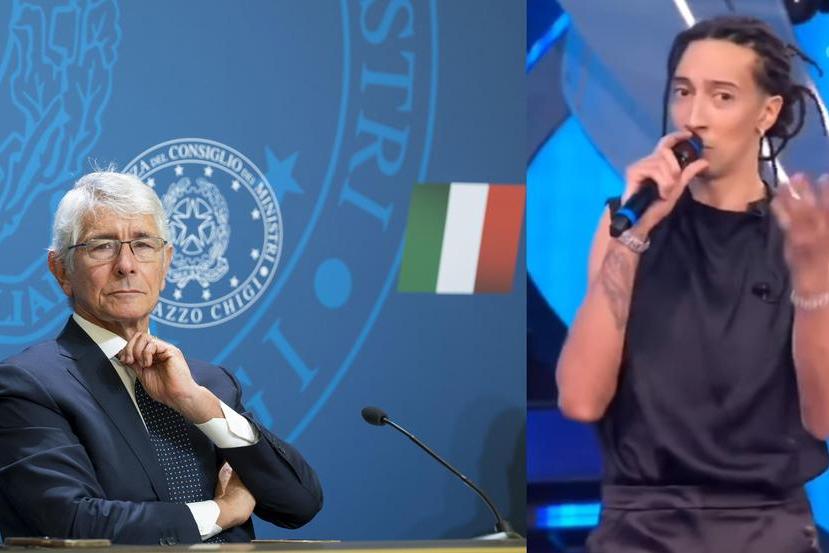
It all started from the words of the sports minister Andrea Abodi at the Prime Minister’s event on the sidelines of the presentation of the initiatives for Remembrance Day. In response to Noemi Di Segni, the president of the Ucei (Union of Italian Jewish Communities), who had just hoped that «Ghali has received some indications or guidelines», Abodi stated: «The choice of artists is also associated with the choice of performances, certainly on that stage, beyond the experience of each artist, there will be no misunderstandings about the ideal, cultural and even ethical direction». Then he added, prompted by a question: “It doesn’t cause me any embarrassment not to share Ghali’s thoughts, but I believe that a country must be able to withstand the impact of an artist who has expressed a thought that we don’t share, which will not be expressed on that stage.”
The reactions
Words that immediately sparked a political debate of the opposite nature: on the one hand the Five Star Movement he shouted about «Preventive censorship» regarding Ghali, on the other hand Alloy declared the presence of the Italian-Tunisian rapper at the Olympic opening ceremony “disconcerting”.
How it really works in the Olympics
A fuss that above all denotes a lack of knowledge of the specific context of the Olympic opening ceremony. Otherwise, some would know that it is not the minister who can “censor” Ghali because he has no right to do so, others would know that he would not even have been able, even if they didn’t like them, to have a peck in the list of guests. The Olympics and Paralympics are a particular and international place governed by rules and even by a Constitution, the Olympic Charter, which «establishes and recalls the Fundamental Principles and essential values of Olympism». And it binds with mutual rights and obligations «the three main components of the Olympic Movement, namely the International Olympic Committee, the International Federations and the National Olympic Committees, as well as the Organizing Committees of the Olympic Games, all required to respect the Olympic Charter». In Rule 50 paragraph 2, the Olympic Charter states: «No type of political, religious or racial propaganda demonstration is allowed in Olympic sites, competition venues or other areas.)
How Rule 50 was born
Previously considered implicit, the rule has been made explicit since 1974 and progressively evolved. Two facts triggered it.
The first with a very strong impact and peaceful: the protest on the podium of the 100 meter dash in Mexico City 1968 by Tommie Smith and John Carlos who went up to the podium to receive the gold and bronze medals respectively, barefoot and raising their black-gloved left fist in support of the blacks’ cause against racial segregation in the United States, the second, the very blond Australian, Peter Normanwho wore a rosette to support them and at the same time give a signal in his homeland against the discrimination of the aborigines.
The second extremely bloody, in Munich 1972, when a Palestinian commando took the Israeli building at the Olympic Village hostage, causing a massacre: 11 guest athletes, a policeman intervened and 5 terrorists dead, which also explains the sensitivity of the Israeli-Palestinian issue at the Games. The latter was the event that forced the Olympics from then on to leave behind, forever, a part of spontaneity, to deliver itself to an increasingly complex and economically burdensome security, which we cannot afford to underestimate.
Less strict limits after Tokyo
Rule 50.2 after Tokyo 2020 has loosened a bit, opening up spaces for free expression to athletes, in an increasingly smaller and increasingly complex world, dominated by private/public mixes. «The International Olympic Committee», writes Giorgio Sandulli, professor of Sport and political actors of the three-year course at the University of Genoa in an essay entitled Rule 50 of the Olympic Charter and the prohibition of propaganda to the test of modern society«he therefore found himself faced with the difficulty of preserving the, in reality increasingly evanescent, principle of neutrality of sport but also the natural desire to guarantee attention to sporting performance itself. As men of sport, the members of the IOC believe that – in the face of social objectives which may also be legitimate, but which remain personal and distinct – sport and specifically the Olympic event assumes and must represent universal and generally shared values, of which the IOC becomes a natural interpreter, in concrete terms, through the example of sharing the Olympic Village while respecting individual differences. In the search for an increasingly precarious balance, the IOC has highlighted the centrality of a few but basic principles typical of Olympic sport such as non-discrimination and equality; but at the same time it could not fail to take note of the increasingly acclaimed and affirmed freedom of expression”.
How it works now
Specifically in reiterating, even following a referendum in which the athletes commission expressed its opinion in favor of maintaining, the rule 50.2, the IOC has however restricted it to some particular contexts: the opening, closing and medal awarding ceremonies; during competitions on the competition fields, in the Olympic village. For the rest interviews and social media you are free to express yourself.
The Milan Cortina 2026 ceremony
It is difficult to imagine that the ban that applies to the athletes does not apply to the Organizing Committee, bound to the Olympic Charter, of which the Opening Ceremony is an expression. It is true that a guest is not part of the Olympic movement and therefore cannot be sanctioned, but since the Charter binds the Committee that calls him, it is quite predictable that the request to comply with the rules is part of the rules of engagement. Marco Balich, artistic director of the Opening Ceremony, explained very clearly the intention of sending a message of unity in a divided world by opening Milano Cortina 2026. It is difficult to imagine that the lineup and its contents do not reflect the intent.
Especially since the Opening Ceremony is not a mega Sanremo in which one takes the microphone and speaks off the cuff, but generally a “silent show” that must speak by showing a babel of languages, through image and music, while words are limited to protocol speeches.
Games and politics
What is certain, because this is also part of the rules of the Olympics, is that politics of any color, like everyone else, can criticize, but cannot interfere: it cannot dictate rules different from those that the Olympic Committee in its internationality and independence has given itself; nor in the guest list at the Ceremony in his messages if he doesn’t like them. Because this falls within the tasks of the Organizing Committee in its autonomy, so much so that the members of the Governments at the Olympics in the official ceremonies can only sit in the stands and watch but not participate in anything protocol, not even the award ceremony of the athletes.
If it is true, as it is true, that there are hypocrisies in Olympic unity, part of a real world in which violence knows no respite, and in the independence from politics of the Olympic world, given that the organization of the Games has always in a broad sense been intertwined with reason of state (history says so, from Berlin 1936 to the boycotts of 1976, 1980, 1984…) it is also It is true that the Ceremony is an official Olympic event in which the Protocol provides for the presence of all the actors of the Olympic movement as a whole, worldwide (2.2 billion viewers expected for the Milan-Cortina 2026 event). It would be a naive claim for guests to indulge in spontaneity in conflict with the Charter right there.