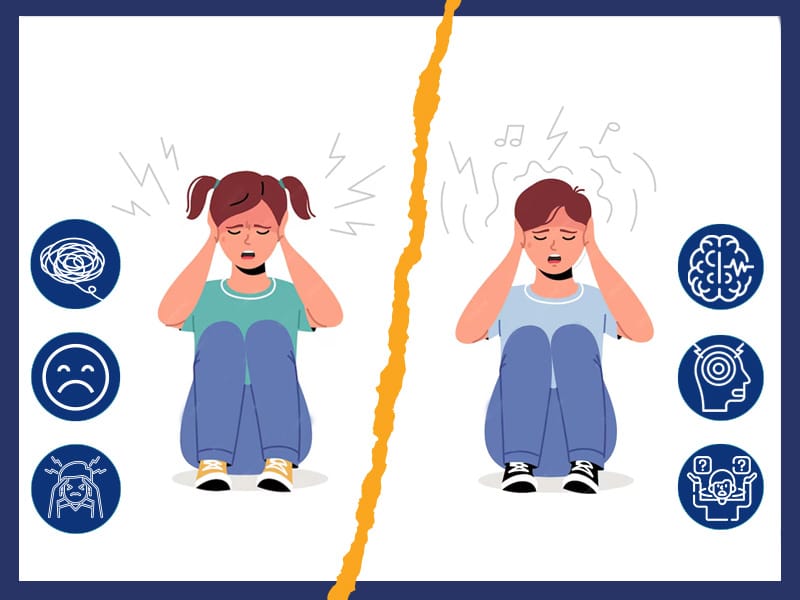
It’s always a surprise when that one promising student falls apart. Her grades are solid, teachers love her and she’s always the first to deliver assignments, but then you get a concerned call from parents about their daughter collapsing over something small and you wonder what went wrong.
Some might say it’s just an end-of-year slump, the result of pressure. According to CHADD, the national nonprofit that runs the CDC’s National Resource Center on ADHD, girls receive an ADHD diagnosis an average of five years later than boys. And even when a girl is struggling as much as the boy sitting next to her, it notes that parents and teachers are more likely to prioritize the disruptive boy for evaluation than the girl quietly burning herself out to keep up.
Because their neurodivergence is not as neurodivergent as a boy’s, many girls with ADHD are forced to go through school with little to no support and end up having to work as hard just to maintain their grades, which inevitably bears negative consequences for their mental health. I know this not only because I manage a school for neurodivergent children, but because, as a neurodivergent woman raising neurodivergent kids, I have to contend with these realities on a daily basis. As such, here are some things we all need to be more aware of.
The numbers don’t lie
According to the CDC’s most recent figures, about 15 percent of boys have been diagnosed with ADHD, compared with 8 percent of girls, roughly a two-to-one gap, yet almost no one who studies this believes that gap reflects how many girls actually have the condition. Girls are diagnosed on average about five years later than boys, and by some clinical estimates as many as half of girls with ADHD are never identified at all. Where a boy is often flagged around age seven, a comparable girl is closer to twelve, which in practice means she loses the years when early support does the most good.
Part of the reason has to do with how ADHD manifests in girls, who tend to have the inattentive presentation more often than the hyperactive one. A girl with ADHD will not be climbing the walls or throwing gum at the teacher’s hair; she’ll be the daydreamer who loses her homework, rereads the same paragraph five times, and works twice as long to turn in something that looks easy. Researchers have found that parents and teachers are more likely to refer a disruptive boy for evaluation than a compliant girl, even when the two are equally impaired. The diagnostic criteria did not help: they were drawn largely from studies of hyperactive boys qualify.
The toll
Girls with ADHD tend to internalize, so the condition often surfaces as worry or low mood rather than disruption, and that shapes what a clinician sees first. Federal figures show roughly four in ten children with ADHD also have anxiety, and close to three in four carry at least one other diagnosis. For many girls, the anxiety gets named and treated while the ADHD driving it stays invisible for years.
And like many others regarding mental health, hiding only makes it worse. The effort early adolescence. A girl will study how other kids behave and copy it, suppressing the urge to move as being a strong student. The research on the cost is consistent: higher camouflaging tracks with greater anxiety, depression, and lower quality of life. By June the reserves are gone, and the mask that is held through every class period tends to shatter the moment she feels safe, usually at home.
What parents can watch for, and what has to change
You know your daughter better than anyone, so watch for changes. After-school shutdowns where she can barely speak, tears or anger over things that never used to land that hard are signs that something is wrong. Also watch what she says about herself. A running loop of “I’m so stupid” tends to be a cry for help in disguise. None of it diagnoses anything, but the pattern is at least worth a conversation, first with her, then with a pediatrician or a psychologist who understands how ADHD presents in girls. Summer recovery rather than remediation, and it is a calm season to pursue an evaluation, away from the pressure of the school week.
The larger fix is not the burden of any individual family, but rather a recognition that there is a problem, and it is gendered. The diagnosed gap between girls and boys has already narrowed as awareness has grown, which tells you it was never mostly about biology. Until screening, teacher training, and diagnostic norms fully account for how ADHD shows up in girls, we will keep meeting them years late, after the anxiety has settled in and the confidence has worn down. What every one of these girls needs to hear, and what the system should be built to tell her sooner, is that she is not broken. She was simply never the child it was designed to see.
—
Sources
CDC ADHD prevalence by sex, boys 15 percent versus girls 8 percent | cdc.gov
Girls diagnosed roughly five years later, referral bias, and the 2013 criteria change | chadd.org
Co-occurring anxiety and other conditions among children with ADHD | cdc.gov
Camouflage in adolescent girls and its link to mental health | ncbi.nlm.nih.gov
Narrowing boys-to-girls diagnosis ratio as awareness grows | additudemag.com
——
About the Author
Beven Byrnes is the Executive Director of Bridges Middle School in Portland, Oregon, the state’s only middle school exclusively serving neurodivergent students, and is herself a neurodivergent woman and mother of four neurodivergent children. With 25 years of nonprofit leadership and 14 years at the helm of Bridges, she leads with a “heart-first” philosophy that prioritizes love and joy, building a community where students with learning differences gain the confidence to thrive. Bridges peers specialized expertise with individualized support, and its financial aid reaches over 35% of families.