
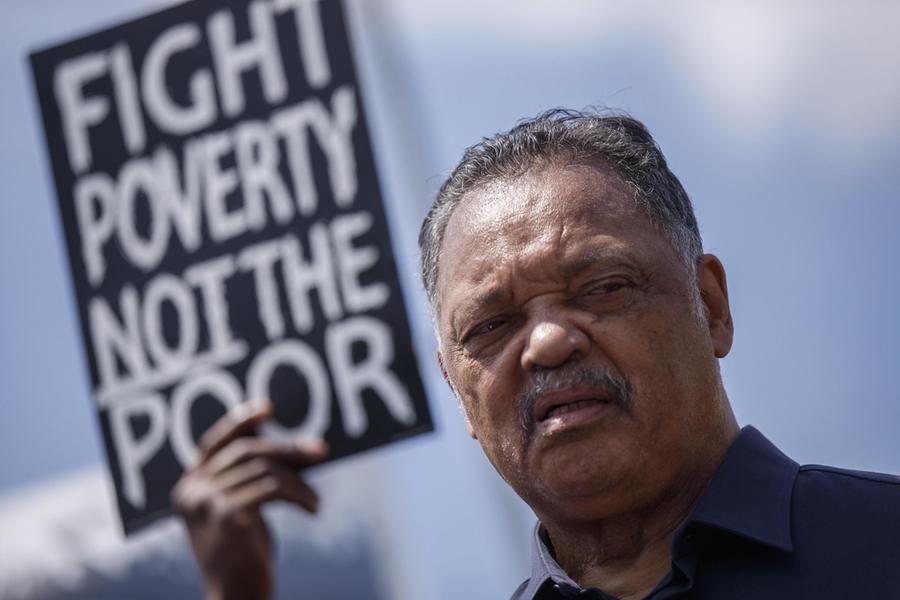




Jesse Jackson, who died on Tuesday at the age of 84, he was one of the most influential protagonists of the fight for civil rights in the United States. The children broke the news: «Our father was a leader who served the community, not just our family, but also of the oppressed, the voiceless and the marginalized throughout the world.”
His life was a constant journey of civil, political and spiritual commitment. It all began on July 17, 1960, when, at just 19 years old, Jackson entered with seven other companions into the municipal library of Greenville, South Carolina, then reserved for whites only. Arrested for this protest gesture, he began his extraordinary career as an activist for the rights of African Americans.
Ordained Baptist minister, Jackson participated since the 1960s in the 1965 Selma march together with Martin Luther King, and was appointed by King himself to lead the Operation Breadbasket organization in Chicago, dedicated to the social and economic redemption of the black community.
His public life was marked by decades of battles for the emancipation of minorities, but also by his role as an international mediator: was the protagonist of numerous negotiations for the release of prisoners and hostages in various world crises, receiving assignments from various governments thanks to his authority and image as a man of peace.
From 1971 to 1986 he drove Operation PUSH (People United to Save Humanity), then he founded the Rainbow Coalition, promoting social justice and economic opportunities for marginalized communities. However, there were moments of difficulty: in 2013 his son Jesse Jr. was convicted of improper use of campaign funds, and in 1999 Jackson admitted that he was the father of a daughter born from an extramarital affair.
On the political frontattempted to climb to the White House twice, in 1984 and 1988, without success. Yet, his influence was enormous: thanks to him over two million African Americans registered to vote, laying the foundations for the victory of Bill Clinton in 1992, jokingly defined as “the first black president of America”.
Jackson never stopped being active: he was a mediator for the release of prisoners in Iraq and Colombia, he negotiated with Fidel Castro the release of Cuban prisoners and with Slobodan Milosevic that of American soldiers. Even in old age he continued to support civil and political causes, as in the 2020 Democratic primaries, when he supported Bernie Sanders.
The last years of his life were marked by illness: in 2017 he was diagnosed with Parkinson’s disease, in recent times he moved around in a wheelchair and communicated only partially, until the worsening of the neurodegenerative disease which led to his death.
Jesse Jackson leaves an important legacy: that of a man who made faith and commitment to others the center of his life, fighting for dignity, justice and freedom for all.