





The “rarity” of this phenomenon is explained by the duration of the lunar cycle.
The night sky still has some nice surprises in store in 2026. It is preparing to offer us a remarkable astronomical spectacle, not seen for three years. This year we will witness the appearance of two distinct Full Moons in the same calendar month, a relatively rare phenomenon. This is a celestial opportunity not to be missed for all those curious and keen on astronomy.
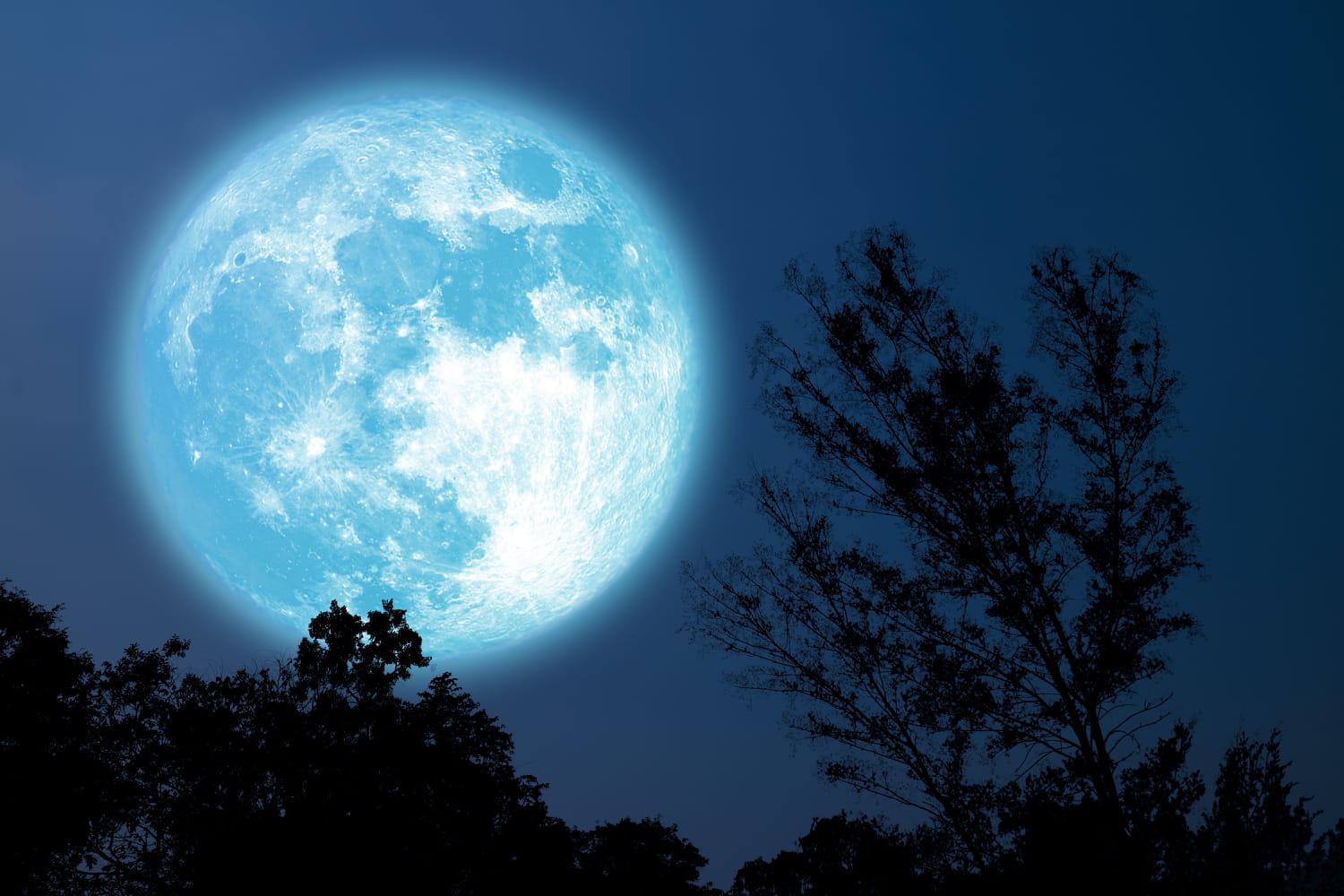
The “rarity” of this phenomenon is explained by the duration of the lunar cycle. The time between two successive Full Moons is approximately 29.5 days. This corresponds to the time required for the Moon to complete a complete lunar cycle. Since the majority of months last 30 or 31 days, it is exceptional for a Full Moon to occur early enough at the start of the month to allow enough time for a subsequent one to manifest before the month changes. This is why we generally only have one Full Moon per month. But not in 2026… This year, there will be two Full Moons in the same month and the second is called… Blue Moon.
A Blue Moon occurs on average only every 2 to 3 years, giving rise to the famous English expression: “Once in a Blue Moon” which can be translated in France as “once every 36th of the month”. For all knowledgeable astronomers or simple lovers of beautiful starry nights, the Blue Moon is a symbolic event appreciated by many people. It marks a rare overlap between the immutable cycles of our satellite and the chance of our calendar. The next time we can see two Full Moons in the month will be in May 2026: the first Full Moon (nicknamed the Flower Moon because it coincides with the period when Nature is in full floral explosion) will take place on May 1 at 7:23 p.m. and the second Full Moon (nicknamed the Blue Moon) will take place on May 31 at 10:45 a.m., according to the calendar of celestial events (Skycal) from NASA.
To fully enjoy this spectacle, it is advisable to move away from the city lights. The first hours of the night and those of dawn, when the Moon is low on the horizon, often allow us to see it with a slightly golden color and to perceive it larger, thanks to the lunar illusion. Contrary to what its poetic name might suggest, the Blue Moon has nothing to do with the color of our satellite. A blue moon is therefore not blue, but the same color as any other full moon. The Moon can only appear blue when the atmosphere is saturated with particles of very specific size (around one micron), such as smoke from large fires or fine volcanic ash (such as that emitted by the Krakatoa eruption in 1883). These particles disperse red lights, allowing mainly blue and green to pass through. This is a rare physical event, unrelated to the May 2026 calendar.
The most commonly accepted definition today is purely calendrical: the Blue Moon purely and simply indicates the second Full Moon occurring during the same calendar month. As a reminder, the Full Moon occurs when the moon appears as a complete circle in the sky. We perceive it as a circle because the entire face of the Moon facing the Earth is illuminated by the Sun’s rays.