






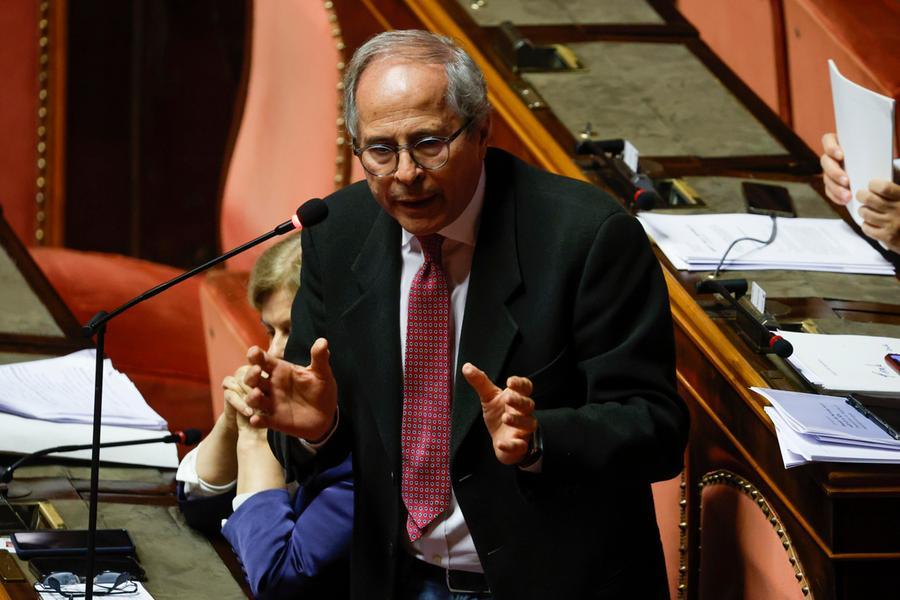
There are accusations that matter less for what they prove and more for what they reveal: a trust deficit. When Andrea Crisanti said in the Senate that, in many university competitions, “we already know” who will win, the question is not only whether this sentence is always valid; it’s understanding why it sounds plausible to so many people, inside and outside the academy.
In the same speech he also referred to an indicator of poor academic mobility (the so-called inbreeding), citing the order of magnitude of 80% for Italy compared to a European average of around 55%. Trust is the first infrastructure of public life; when it cracks, even formally correct procedures become socially suspect. The university lives on reputation – scientific, didactic, civil – and reputation is not an ornament: it is what makes a degree credible, a course desirable, a research authoritative. Generalizations hurt, but for this reason the signs of closure must be taken seriously. If the university appears closed, society ends up perceiving it as a separate body.
The diagnosis, however, cannot stop at morality. It has to go into mechanics. A key element is the “staff points” system, the currency with which the State measures the hiring capacity of universities. In simplified form: 1 organic point (PO) corresponds to the average cost of a full professor; an associate professor is worth 0.7 PO. In ministerial estimates, 1 PO is in the order of 116 thousand euros. It sounds like accounting; in reality it is applied philosophy, because it decides what is “possible” and what is “impossible” even before a commission sits down and reads the scientific works of the candidates.
Let’s take a simple example. A department, between retirements, turnover and budget constraints, has 0.3 OPs available. If he wanted to call an ordinary from outside, he would have to put 1 OP on the table: he cannot. But if there is already an internal associate in the same department, that teacher already weighs 0.7 OP in the budget. Progression to ordinary requires – in terms of marginal cost – only the differential: 1 − 0.7 = 0.3. With the same 0.3 PO that was not enough for an exterior, the interior becomes sustainable. Part of the “predictability” of competitions lies in this arithmetic: the prediction does not always derive from an unmentionable agreement; sometimes it comes from the fact that, if an outsider wins, the accounts are no longer sustainable.
This is where the most common misunderstanding lurks: confusing accounting rationality with proof of a “trick”. Defending an interior is not automatically a moral vice. The university is not just a marketplace for curriculum: it is a community of learning and research with obligations to students. Teaching continuity means courses that do not skip, laboratories that do not shut down, theses and internships that do not remain without guidance, doctoral students that do not lose the scientific reference, international and territorial relations that do not dissolve. In many disciplines the local “school” is a capital: it has methods, archives, infrastructures, projects, responsibilities. In that case, valorizing those who have already demonstrated that they can handle that load is not, in itself, a bad thing.
What to do, then? A truly reformist reform should start from a simple principle: don’t moralize people, design incentives. Separate internal progressions from external calls in an accounting (and financial) manner, allocating specific resources to mobility. Make not only the scientific criteria grid transparent ex ante, but also the sustainability framework of the tender: how many OPs are committed, for how long, and what alternatives are envisaged if an external party wins. Reward, in the financing and evaluation criteria, universities that attract from outside and practice mutual mobility; and make systematic the use of tools that increase procedural credibility (truly plural commissions, traceability of documents, clarity in motivation).
The philosophy here is concrete: a good institution does not ask for sanctity from individuals; constructs rules in which virtue is practicable. If we want more credible competitions, we must make it credible – and possible – to choose the best even when he is not “at home”. Only in this way will 0.3 return to being a number. And it will stop being the symbol of suspicion.
by Giuseppe Pignataro