



The Most Holy Name of Jesuswas always honored and venerated in the Church from the earliest times, but only in the 14th century did it begin to have liturgical worship. He was a great preacher and propagator of this cult the Franciscan Saint Bernardino of Siena (1380-1444) and continued by other brothers, especially by the blessed Alberto da Sarteano (1385-1450) and Bernardino da Feltre (1439-1494).
In 1530, Pope Clement VII authorized the Franciscan Order to recite the Office of the Most Holy Name of Jesus; and the celebration, now present in various locations, was extended to the entire Church by Pope Innocent XIII in 1721. The day of celebration varied between the first Sundays of January, remaining on January 2nd until the 1970s, when it was suppressed. Pope John Paul II restored the optional memory in the Roman liturgical calendar to January 3.
The Society of Jesus then took the three letters of the trigram of the Name of Jesus “invented” and designed by Saint Bernardino of Siena, as its emblem and became a supporter of worship and doctrine, dedicating to the SS. Name of Jesus his most beautiful and largest churches, built throughout the world. Among all, we remember the Church of the Gesù in Rome, the largest and most illustrious Jesuit church; there is in the vault the Triumph of the Name of Jesusfresco from 1679, the work of the Genoese Giovanni Battista Gaulli known as ‘il Baciccia’; where hundreds of figures move in a clear space with fast impetus, attracted by the central Name of Jesus.


What is the meaning of the name Jesus?
In all names of Jewish origin, particularly male ones, there is almost always an invocation to God, the eternal creator, from whom the Jewish people always drew strength in their troubled existence. The Messiah bore the name of Jesus during his earthly life, a name that was imposed on him by Saint Joseph after the angel of God said to him in a dream: “Joseph, son of David, do not be afraid to take Mary, your bride, with you, because what was conceived in her is the work of the Holy Spirit. She will give birth to a son and you will call him Jesus: in fact he will save his people from their sins” (Mt.1, 21-25).
Therefore the meaning of the name Jesus is that of savior; the evangelists, the Acts of the Apostles, the apostolic letters, cite extensively the meaning and power of the Name of Jesus, often stopping only at the term “Name” as God was indicated in the Old Testament. During the public life of Jesus, his disciples, appealing to his name, heal the sick, drive out demons and perform all sorts of wonders: Luke, 10, 17, “And the seventy-two returned full of joy, saying: Lord, even the demons submit to us in your name”; Matthew 7, 22, “…Lord, have we not prophesied in your name and cast out demons in your name and performed many wonders in your name?”. Acts 4, 12, “…There is no other name under heaven given among men in which we can have salvation”. By resurrecting Jesus and making him sit at his right hand, God “gave him the name that is above every name” (Eph. 1, 20-21); it is a “new name” (Rev. 3, 12) which is constantly united to that of God. This name finds its expression in the title of Lord, which suits the risen Jesus, as well as God the Father himself (Phil. 2, 10-11).
In fact, Christians had no difficulty in attributing to Jesus the most characteristic names that in Judaism were attributed to God. Acts 5, 41: “But they (the apostles) departed from the presence of the Sanhedrin, rejoicing at having been condemned to insult because of the Name”. The Christian faith consists in professing with the mouth and believing in the heart “that Jesus is the Lord, and that God raised him from the dead” and in invoking the name of the Lord to achieve salvation (Rom. 10, 9-13).
The first Christians, in fact, are those who recognize Jesus as Lord and designate themselves as those who invoke his name, it will always have a pre-eminent role in their lives: in the name of Jesus Christians will gather, they will welcome anyone who presents themselves in his name, they will give thanks to God in that name, they will behave in such a way that that name is glorified, they will also be willing to suffer for the name of the Lord. The sum expression of the presence of the Name of the Lord and of the entire SS. Trinity in Christian life is found in the sign of the cross, which introduces every prayer, devotion, celebration; and concludes the blessings and administration of the sacraments: “In the Name of the Father, of the Son and of the Holy Spirit”.

What is the trigram invented by Saint Benardin of Siena?
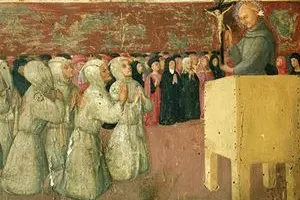
So that his preaching was not easily forgotten, Saint Bernardino with deep psychological intuition invented a brightly colored symbol that was placed in all public and private places, replacing the coats of arms and coats of arms of the various families and corporations who were often in conflict with each other. The trigram of the name of Jesus became a famous and widespread emblem everywhereon the façade of the Palazzo Pubblico of Siena stands out an enormous and solemn work by the Sienese goldsmith Tuccio di Sano and his son Pietro, but it can be found in every place where Bernardino and his disciples preached or stayed. Sometimes the trigram appeared on the banners that preceded Bernardino, when he arrived in a new city to preach and on the wooden tablets that the Franciscan saint placed on the altar, where he celebrated Mass before the awaited homily, and with the tablet at the end he blessed the faithful.
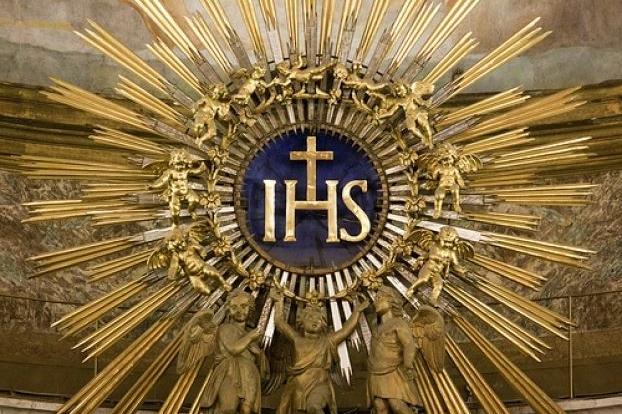
The trigram was designed by Bernardino himself, which is why it is considered patron saint of advertisers; the symbol consists in a radiant sun on a blue field, above are the letters IHS which are the first three of the name Jesus in Greek ΙΗΣΟΥΣ (Iesûs), but other explanations have also been given, such as the abbreviation of “In Hoc Signo (vinces)” the Constantinian motto, or of “Iesus Hominum Salvator”.
To each element of the symbol, Bernardino applied a meaning, the central sun is a clear allusion to Christ who gives life like the sun does, and suggests the idea of the radiating of Charity. The heat of the sun is diffused by the rays, and here are the twelve rays meandering like the twelve Apostles and then by eight direct rays which represent the beatitudes, the band surrounding the sun represents the happiness of the blessed which has no end, the light blue of the background is a symbol of faith, the gold of love.
Bernardino also lengthened the left shaft of the H, cutting it at the top to make a cross, in some cases the cross rests on the midline of the H. The mystical meaning of the meandering rays was expressed in a litany; 1st refuge for penitents; 2nd fighters’ banner; 3rd remedy for the sick; 4th comfort of the suffering; 5th honor of believers; 6th joy of preachers; 7th merit of the workers; 8th help of the defective; 9th sigh of the meditators; 10th suffrage of those praying; 11th taste of contemplators; 12th glory of the triumphant. The entire symbol is surrounded by an external circle with the Latin words taken from Saint Paul’s Letter to the Philippians: “In the Name of Jesus every knee should bow, whether of the heavenly beings or of the earthly ones or of the underworld”.
The Bernardinian trigram it was a great success, spreading throughout Europe, even Saint Joan of Arc wanted to embroider it on her banner and later it was also adopted by the Jesuits. Saint Bernardino said: “This is my intention, to renew and clarify the name of Jesus, as it was in the primitive Church”, explaining that, while the cross evoked the Passion of Christ, his Name recalled every aspect of his life, the poverty of the nativity scene, the modest carpenter’s shop, the penance in the desert, the miracles of divine charity, the suffering on Calvary, the triumph of the Resurrection and the Ascension.
In fact, Bernardino reiterated the devotion already present in Saint Paul and during the Middle Ages in some Doctors of the Church and in Saint Francis of Assisi. Furthermore, this devotion was practiced throughout the Sienese area, a few decades earlier by the Gesuati, a religious congregation founded in 1360 by the blessed Sienese Giovanni Colombini, dedicated to the care of the sick and so called because of their frequent repetition of the name of Jesus.