






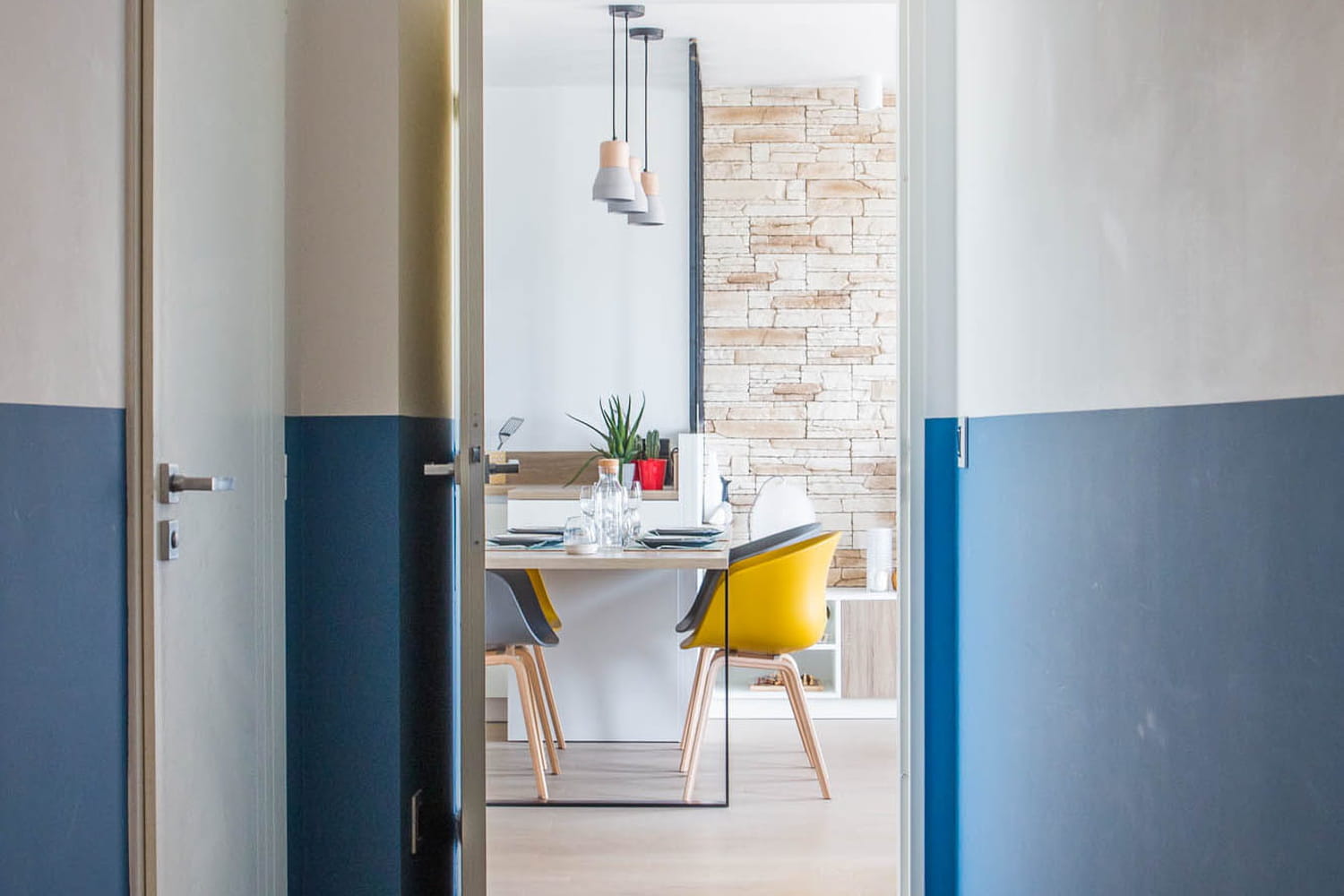
The hallway is often seen as a simple passage space, designed above all to be functional. However, it can become a real asset in an interior. With a few strokes of the roller and the right choice of color, this discreet space is easily transformed and gains character.
Long considered a simple place of passage, the corridor is often left aside in interior design. However, we circulate there several times a day, which makes it a space in its own right, capable of setting the tone from the moment you enter. As it is not a living room strictly speaking, it also allows you to dare to make more assertive choices and bring character to it without fear.
To avoid disappointment, however, it is better to pay particular attention to the choice of paint. A satin finish is generally preferable, as it resists rubbing better and is easier to clean. Conversely, matte paint, which is more fragile, tends to mark and reveal imperfections. In terms of colors, the possibilities are almost endless today, which leaves great freedom to express your style.
What color to choose in a dark hallway?
Be careful here with paints that are too dark which risk further darkening the room. In a hallway with few light sources, it is better to focus on small touches here and there to add relief. For example, we can play on contrastschoosing a light color for the walls and a darker one to make the doors stand out. The plinths can also be highlighted. In this case, we will paint them the same color as the doors, but if the corridor is not a closed space and leads to a living room, it is better to blend them into the wall so that they blend with the rest of the interior.
Opting for a very dark color can also be a bias if you want give real personality to your hallway. In this case, it will be necessary compensate with light inputand provide pendant lights, wall lights or even table lamps. The darker the decor, the more light is needed.
Create an impression of volume using color
In a narrow hallway or in a dark hallway, it is best to favor light shades so as not to accentuate the anxiety-provoking effect. Soft tones will more easily catch light, whether natural or artificial, making the room feel like it is breathing. Also pay attention to the patchwork side which tends to tighten the volumes. It is therefore better to limit yourself to two colors so as not to overload the atmosphere.
But in a corridor, there is another place that can be exploited: the ceiling! Often forgotten, the ceiling is nevertheless a decorative space that allows you to achieve things, especially in a small hallway where there is little wall space. As it is not directly at eye level, you can do very daring things, with strong colors or even patterns.
Dare to play with materials
It is not because a corridor is a small space that we cannot play with angles and volumes. We can thus combine the paint with a wall covering which will dress a wall or a corner of a wall, or even the ceiling. Today there is a wide range of wallpapers which allow you to create effects (bricks, wood, stone, etc.) and thus play with the architecture of the room. (Thanks to Stéphanie Rose-Tomasella, interior designer, www.designdinterieur.com, for her advice.)