
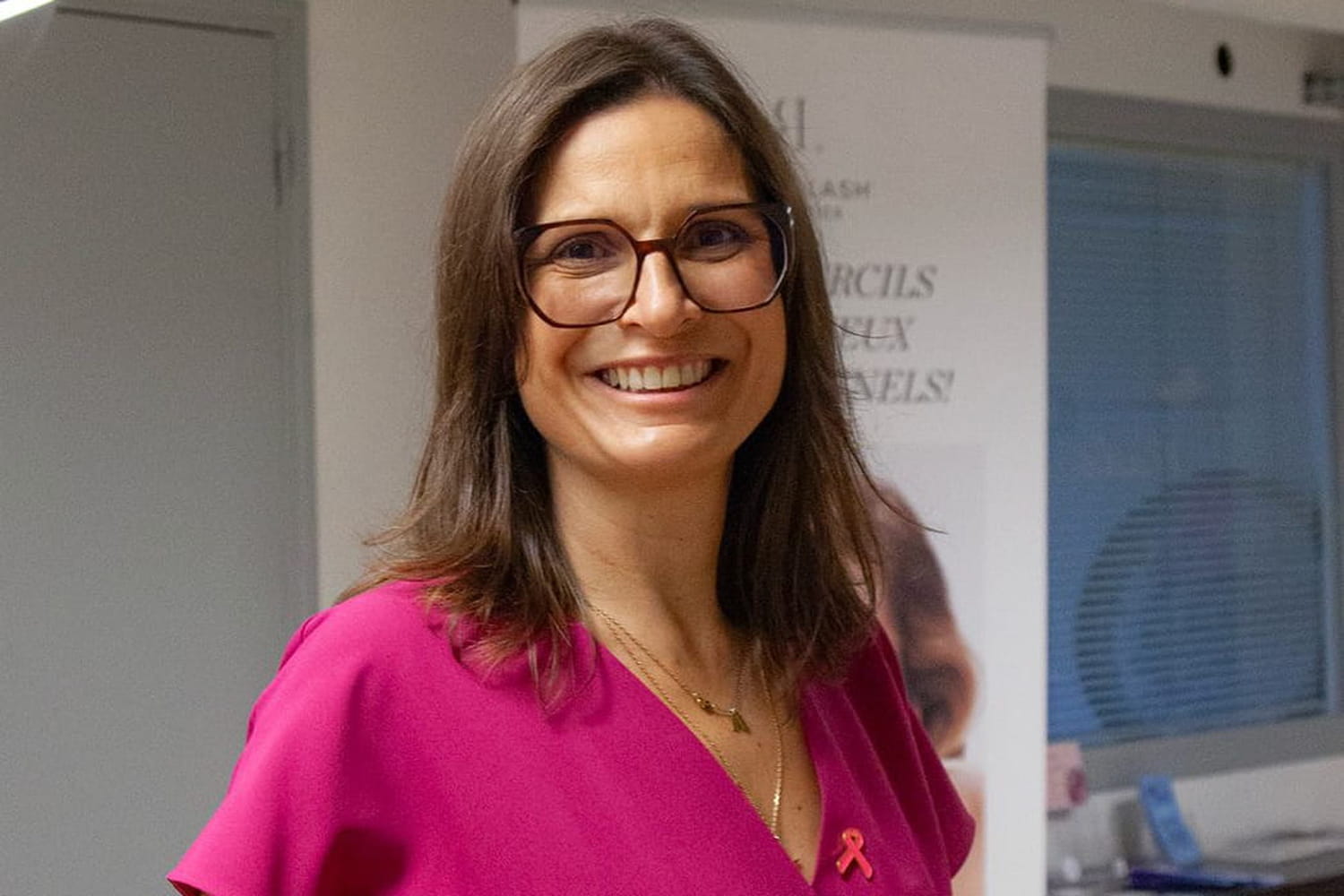



Sandie radically changed careers to become a caregiver. Today, she helps patients hospitalized in cancer and palliative care to release their emotions through touch.
On the occasion of February 4, World Cancer Day, we met Sandie Boulanger, somatotherapist. This young woman supports people hospitalized in oncology, palliative care and geriatrics with one goal: to soothe through touch. As she explains to us “when we are no longer able to communicate or connect with others, touch becomes fabulous.”
For Sandie, it all started in 2007. She was then a media planner in advertising and her daughter found herself hospitalized (unrelated to cancer). “I felt helpless. I tried to understand non-verbal functioning and to support my child as best as possible and these six trying months led me to think about the meaning of my life.” At the same time, one of his elderly friends is at the end of his life due to a brain tumor. “In the space of half a year, I spent a lot of time in hospitals and I discovered that I felt comfortable there and that I wanted to bring my presence and my help to the sick,” says Sandie. She left her job and joined a school to learn relaxation techniques such as sophrology before studying somatotherapy for two years. “Coming from the psychoanalytic trends of Wilhelm Reich and Carl Rogers, this mind-body therapy completely responded to my quest for connection. During the Covid pandemic, we realized how fundamental touch was. Thanks to it, it is possible to remove certain blockages and relieve pain and anxiety.”
“Touch helps manage pain and anxiety”
At the end of her training, Sandie began working as a somatotherapist in associations related to cancer and then at the Estrée clinic in Stains in Seine-Saint-Denis. “Touch is a sense that is little exploited in Western societies compared to other civilizations and I use it to manage pain and anxiety. These are not just touches: I first massage patients on the chest and stomach where I listen to the breathing and where I feel the muscular tensions. Thanks to this contact a place of great security is created. We regain self-confidence and speech but also the emotions are freed.”
Convinced by the numerous benefits of this method, Sandie Boulanger presented it to the National Assembly in 2024, before the Cancer study group, at the invitation of its co-president, Sandrine Josso, deputy for Loire-Atlantique. “My project was received very favorably. This allowed me to obtain a full-time job in the Antony hospital where I am now considered as a supportive care professional in the same way as the others. On the other hand, I have broadened my field of expertise: I devote most of my time to relieving patients in the cancer and palliative care departments but I also work in geriatric orthopedic surgery because operations are sometimes necessary. the cause of great confusion”, says Sandie.
“Somatotherapy helps reduce the amount of anxiolytics”
“Somatotherapy soothes patients to allow them to recover better but also to reduce the quantity of anxiolytics. I also work in the intensive care unit to relieve intubated people. During the coma phases, I take care of their body, I talk to them and, when they wake up, they perceive an invisible link between us”, notes Sandie who emphasizes the importance of massage for the elderly. “These are often people who are never touched again outside of nursing care because their skin and their smell are no longer the same. Touch brings them back to a form of joy and gives them the feeling of existing again.” Sandie also supports relatives of patients and caregivers: “I offer them a space where they can, by relaxing the body, bring out the emotions linked to difficult events and create new emotional gardening tools. Caregivers, patients or loved ones: everyone is part of the care chain. I am therefore keen to create a real human dynamic. This is the reason why I created an association called Le coeur sur le care, with an oncologist and an executive from the hospital’s oncology department whose aim is to raise funds to be able to develop supportive care.
Regularly confronted with death and illness, Sandie manages to maintain a certain form of emotional management. “JI am touched and I verbalize it. By being able to name, I don’t collapse, but what’s more, the other person realizes how important he or she is.”. Passionate about her job, Sandie would like it to become more popular. “Care is truly considered in an integrative way in our country. Treatments are no longer just technical and we realize that the link is fundamental. Numerous studies show that when there is a bond of trust, there is better follow-up of treatments, a reduction in anxiety and pain. Contact is a philosophy of living that allows you to know how to give but also receive!”