
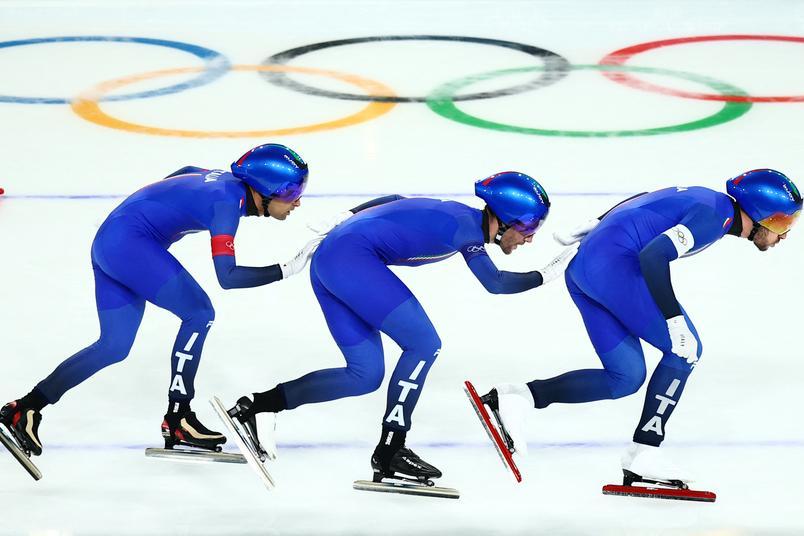



Miracle in Milan as it was a miracle in Turin twenty years ago, a ring of ice in the house, when there is one, produces gold. This time they bring it Davide Ghiotto, Michele Malfatti and Andrea Giovannini who ride on the ice in a toy train like the legendary Japanese bullet train.

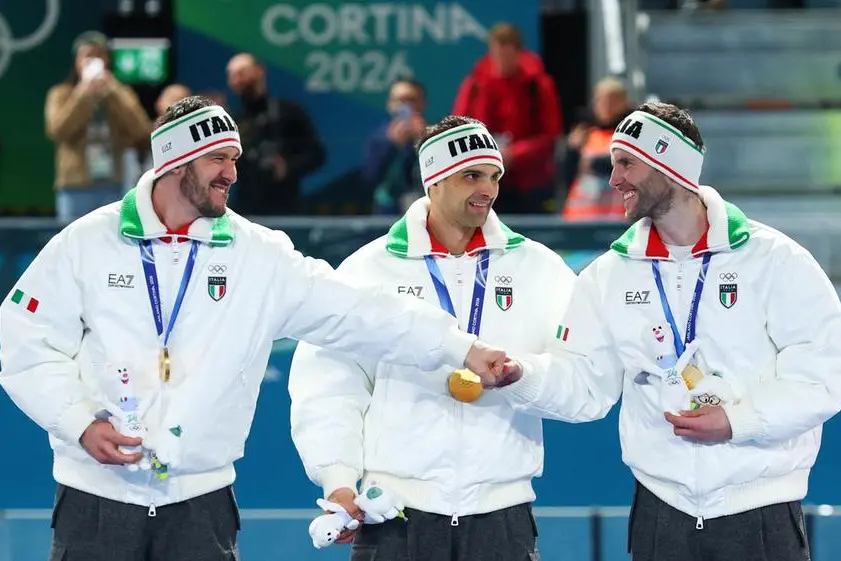
First Francesca Lollobrigida twice, now them. Or rather gold. Another. This pavilion at Rho Fiera, 13 N, to be precise, the last one at the end of the subway, dedicated to speed on the ice, which will be called Ice Park only until the last of the 17 days of the Games and never again, he alone gave away a third of the nine collected so far between snow and ice at Milano Cortina 2026: three golds, plus Riccardo Lorello’s bronze, in the 5000 meters. Lorello is from Rho, he grew up ten minutes from this track that never existed.
Even in Turin the Oval lived for the Games only, resurrected for the short time of the Universiade and finally converted into an exhibition building. The ice coils are still there but the ice has no longer formed. The Ice Park in Milan will suffer the same fate. Perhaps this is right for the country, it is a niche sport, but for those who live in the niche on a daily basis it is always time to migrate.
If it is true that the pursuit, a team competition, gives the measure of the health of the movement, the success density of the long track ice is very high, because the speed movement is small, it is worth about a tenth of figure skating which represents the bulk of the discipline.
When under the giant screen in Cesana Pariol where Zoeggeler ran the third heat of the Olympic luge, in 2006 Dutch colleagues came to ask what movement was behind Enrico Fabris who seemed to have appeared out of nowhere to raid gold, silver and bronze daisies. We put the number at around 80 members in total on the long track, they understood 80 thousand thinking of their home.
Today, speed on the Italian ice includes short track, because many young people do both, and the long track has a thousand members in total, many started on wheels and then landed on the ice to pursue the Olympic dream that was closed to wheels.
The athletes of Olympic interest, in the long track speed, do not reach 20: but due to the size of this movement there are “a lot of people to train with”, copyright Michele Malfatti.
When he and Davide Ghiotto started we could count on one hand. If the short track, that thing where you do it at the door, can be practiced in a common ice rink on the same artistic and dance rink, the long track requires something else that isn’t available in Italy: you train outdoors season permitting in Baselga di Pinè (Trentino). No indoor track to guarantee this level.
THEn terms of daily life for those like these three athletes, from the Guardia Finanza Sports Group, skating is work, it means 250 days away from home. And then it also explains why, whether you are a mother or a father, the first thought with gold around your neck goes to a child.
If Lollobrigida’s son hadn’t seen his mother for a week, Ghiotto’s eldest son: «He hadn’t seen his father for a hundred days. In the rest of the time it’s about being a family with your teammates.”say the golden men of the pursuit, where harmony is necessary because if one breaks away from the train everyone loses: «on the track in the individual races you are also adversaries and having strong ones among your teammates helps you prepare better, because in training you measure yourself, but even if there are tensions on the track, once training is over, you go back to being people, united by the need to feel united away from home: «A pat on the back and we start again».
To those who ask him how he absorbed the individual disappointments that after the 10,000 wood had led him to think about retiring Davide Ghiotto, the philosopher (with a degree in Kant) speaks of: «Comrades who put up with him and supported him». On the inspiration received from Francesca Lollobrigida: «If she, who had had a season without results, had achieved two golds, we too had to try. Giovannini explains that he mimicked the celebration of NBA star Steve Curry in Paris 2024, whose resistance to pressure he had admired: «I was very tense, not having had any other races before, I thank the team psychologist who helped me dominate them». Malfatti shouts: “I love you” to the woman he has to leave at home too often. There are many thanks in the words of these champions that almost no one will recognize on the street tomorrow. Not Italy at least, even if they were already European and world champions.
Like those who came from nothing 20 years before them (Matteo Anesi, Enrico Fabris, Ippolito Sanfratello, Stefano Donagrandi all remaining in the microcosm of the ice), Ghiotto, Giovannini, Malfatti today in the semi-final – before eating up the Americans – they have caused displeasure to the many Dutchmen fully equipped in orange who populate the stands of the Milanese track, like the one in Turin 20 years ago: who knows how the little girl with the blonde braid, Dutch flags on her cheeks and an orange heart-shaped glitter glued to her chin took it. You will probably remember these three ice migrants dressed in blue when you grow up. Because in his house this going in circles is almost as important as Steve Curry’s NBA.