






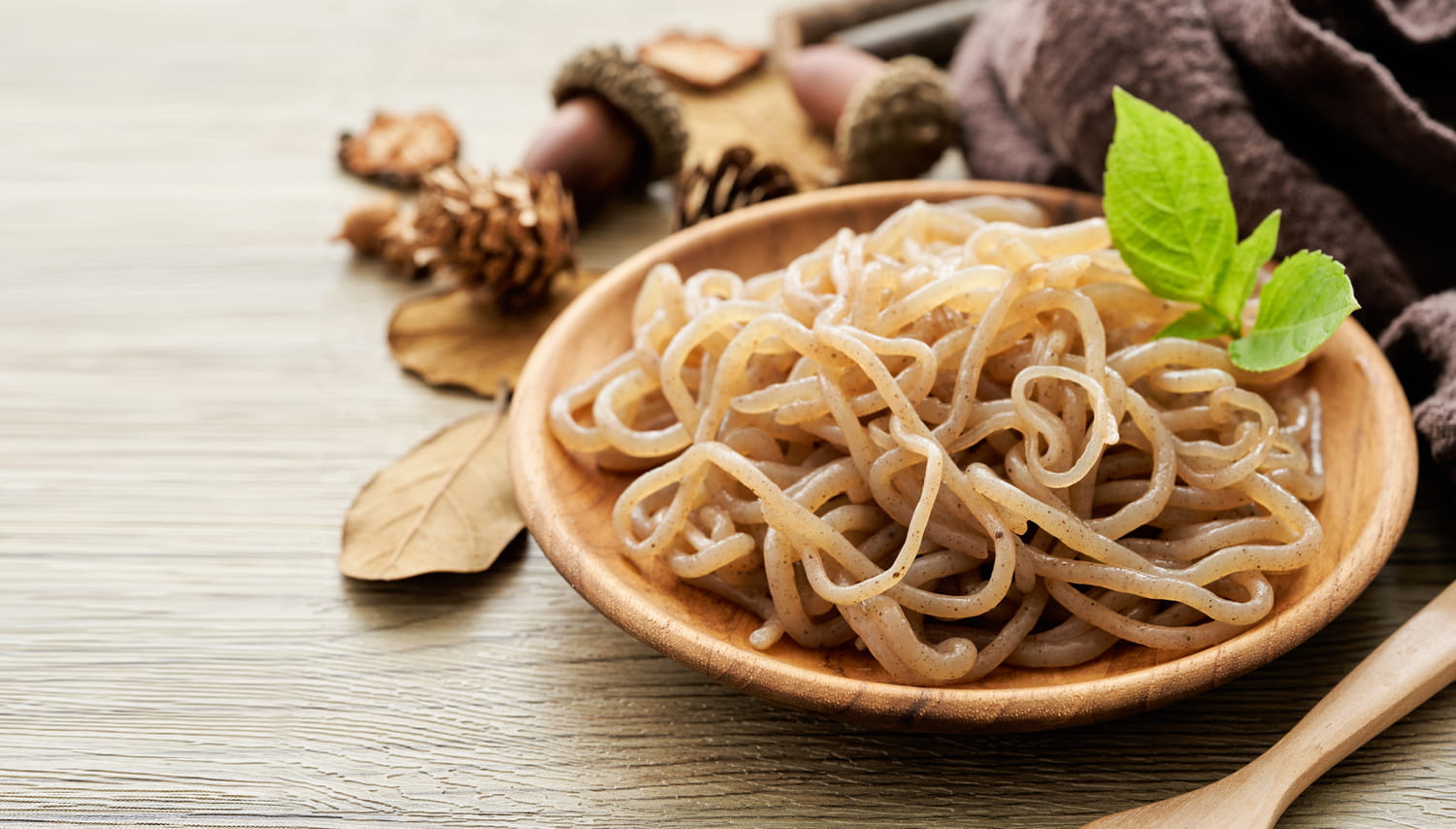
Originally from Asia, konjac is a tuber eaten in the form of pasta to lose weight, lower cholesterol or improve transit. But it can have side effects. Update with the nutritionist.
Coming from Asia, konjac has become an essential food over the 2000s for those looking to lose weight. It is also known for lowering cholesterol and reducing blood sugar, but be careful not to neglect its richness in fiber… The opinion of Dr Alexandra Dalu, nutritionist.
What is konjac?
Konjac is a perennial plant, which grows from a very large spherical tuberous rhizome. Native to the tropical and subtropical forests of Southeast Asia, it grows naturally in Vietnam, China, Indonesia, Korea and Japan. Its enormous tuber (up to 80 cm in circumference) is reduced to a fine white powder, a basic ingredient of Asian cuisine, then transformed into blocks or vermicelli. Konjac can be used in paste (noodles, vermicelli, spaghetti, etc.), in rice, in sachets (powder) or in capsules. “You should be wary of culinary preparations and look carefully at the labels to check if salt is added. Naturally, konjac is bland in taste and translucent. A processed preparation loses the benefits of the plant” warns Dr. Dalu.
What are the health benefits of konjac?
Konjac contains a fiber, the glucomannan. It’s an ingredient zero calories, and gluten-free. “He created a feeling of mechanical satiety, like a big balloon that inflates” explains Dr Alexandra Dalu, nutritionist. He can help with weight loss “but it is not a miracle solution over time“. Konjac can also accompany periods of fasting. “A plate of konjac spaghetti in the evening allows you to last until midday the next day. Konjac can compensate for the day after a party or be taken as a detox cure“. Konjac is also a prebiotic, “it feeds the probiotic, the good microbe in our second brain, the intestine” reminds the doctor. Finally, konjac can be a natural alternative to enema. “Fiber is a natural process of colon cleansing recalls Dr. Dalu.
Why does konjac help you lose weight?
Konjac contains a fiber, glucomannan, which is the source of its satiating power. “It is a plant that swells on contact with water, so when you consume it the stomach fills and creates a feeling of mechanical satiety, like a large balloon that inflates.” explains Dr. Dalu. “This will send a message of satiety to the receptors of the volume of the stomach which is full, which themselves will send a message to the brain saying I am no longer/not hungry“Konjac is used to reduce the quantities one eats.”It is recommended to take your konjac sachet half an hour before the main meal.“, specifies the doctor. “It’s a little help but it’s not the treatment for weight gain.” she recalls.
Does konjac reduce cholesterol?
“Like all fibers, konjac slows the absorption of fat and sugar into the blood” reminds Dr. Dalu. “If the patient suffers from blood sugar problems or high cholesterol, konjac can help during a rich meal. Fiber will limit fat and sugar intake.” “However, konjac does not constitute a treatment for cholesterol.” “You should absolutely avoid taking it at the same time as your cholesterol treatment, so as not to cancel out the effects of the medications.” warns the expert.
Does konjac help with diabetes?
Konjac mechanically reduces fat absorption. “It is a natural alternative to counteract a spike in blood sugar but it is not a treatment for diabetes. recalls Dr. Dalu. “Be careful if a diabetic consumes konjac at the same time as taking their treatment, it will be poorly absorbed by the body” warns the expert.
Constipation: is konjac a laxative?
Konjac has benefits for transit. “If you have constipation problems, konjac is ideal. It is interesting to carry out a small cure of konjac sachets, rather in the evening“reveals our expert.”It is more effective than psyllium or Chia” she adds. Konjac can promote transit for people lacking fiber. “For a person who consumes very little fruit and vegetables, eating konjac three times a week and drinking plenty of water can help transit even if it is not a panacea.” advises Dr. Dalu.
What are the dangers of konjac?
Since konjac is essentially made of fiber, it should not be consumed at the same time as medications or vitamins. “It should be consumed 3 or 4 hours apart from meals.” specifies Dr. Dalu. “If you eat it when you take your treatment, it will end up in the toilet because it will be caught by the fibers” adds our expert. “Konjac is also contraindicated for people who have gastric problems, a very long intestine and who have had intestinal obstruction“.”Konjac contains no antioxidants or vitamins, it has empty calories. You must therefore vary your diet and not eat mainly this food.“warns the doctor.
Thanks to Dr. Alexanda Dalu, nutritionist. Author of the book “The 100 preconceived ideas that prevent you from being well“, Leduc.s editions.