
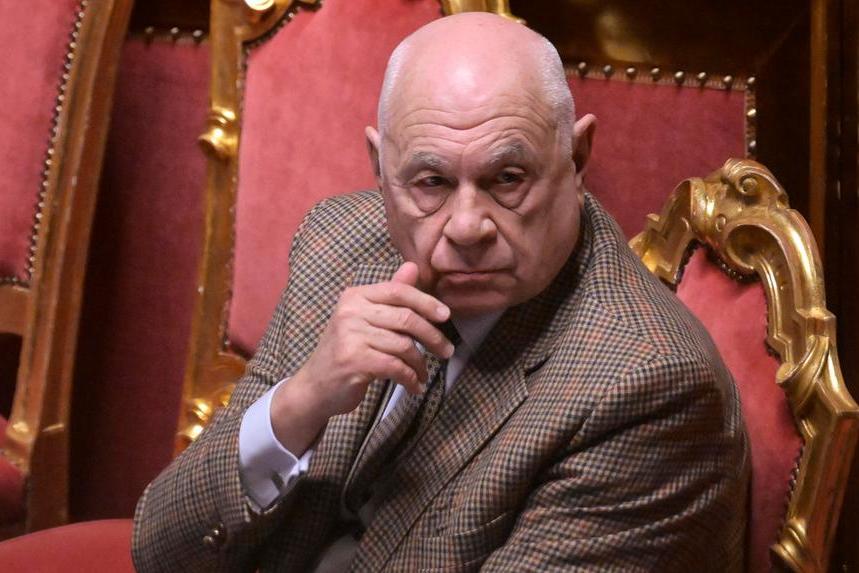



There is a moment in Italian public life when political debates and questions of principle turn into skirmishes, skirmishes into duels, duels into brawls. This is what is happening around the referendum on justice. Nicola Gratteri had ignited the dust with a napalm declaration: “the suspects, the accused, the deviant freemasonry” are voting yes to the referendum on the separation of careers. The supporters of the reform did not turn the other cheek, on the contrary, they took matters further. Justice Minister Carlo Nordio responded to the Naples prosecutor’s attack: “There is a paramafia mechanism behind the choice of members of the CSM.” Not at all regretful, the two promise to carry on to the bitter end. And there’s still a month to go until the consultation date. «I will say one a day», promised the Keeper of the Seals. And indeed.
The Ministry of Justice has written to the National Association of Magistrates inviting it to consider whether to disclose the financiers of the “It’s Right to Say No” Committee, promoted by the ANM. A formal letter, sent by the head of cabinet Giusi Bartolozzi and addressed to the president Cesare Parodi. The pretext is a question from Forza Italia MP Enrico Costa. The content is simple: transparency. But with a tail of poison.
Costa, already on 8 January, had publicly raised a doubt: if the ANM promotes a committee for the No and that committee collects contributions from private citizens, isn’t a link – political and formal – created between serving magistrates and financiers? What if a magistrate found himself in front of one of those financiers in the courtroom? Should he abstain for reasons of expediency? It is a question that does not accuse, but insinuates. And in politics the insinuation is often more devastating than the accusation.
The Keeper of the Seals collected the doubt and transformed it into an official request: to evaluate «with a view to full transparency» the opportunity to disclose any funding received by the Committee. Not an order, but an invitation. However, in times of exposed nerves, even invitations sound like ultimatums.
Parodi’s response was laconic and, we would say, predictable. The Committee, he wrote, is promoted by the ANM but is legally autonomous. Donations are permitted to private citizens, excluding those who hold political positions. Everything – including the statute – would be published on the Committee’s website. As for the names of the donors, making them public would mean exposing the data of private citizens, with possible privacy protection problems. If details are needed, he concluded, we must contact the representatives of the Committee.
It is a clear defensive line: the ANM does not manage those funds, does not know them in detail and cannot disclose them. But the issue has now moved beyond the technical scope. It has become political.
The opposition reacted as if a dangerous threshold had been crossed. Debora Serracchiani spoke of a “very serious act”, even evoking the ghost of the “proscription lists”. Peppe De Cristofaro defined the request as “intimidation”, arguing that the Committee must answer to its supporters and not to the government. According to this reading, the letter from Via Arenula would be yet another chapter in the clash between the executive and the judiciary.
On the opposite front, Maurizio Gasparri chose an ironic tone: why on earth should the ANM have hidden financiers? «Do they have something to hide? I don’t think so,” he said, publicly inviting Parodi to make all financing public, as political parties do. It’s the old rule: if you ask someone for transparency, that someone cannot avoid transparency.
Meanwhile, another question lit a second fire. Fratelli d’Italia senator Salvo Sallemi asked the minister to clarify how many magistrates registered with the currents sit in the CSM or hold managerial and semi-managerial positions in judicial offices. Parodi had indicated that the members of the currents were approximately 2,100 out of 9,200. But, observes Sallemi, it is not enough to know how many there are: we need to know where they are. It is the question of careers, appointments, levers of command.
Thus the referendum, which should be a confrontation between ideas, is becoming the ground for a broader showdown. On the one hand, politics demands to know who finances whom and who thinks how. On the other hand, the judiciary claims autonomy and denounces pressure. In the middle, a disoriented country witnessing yet another duel between state powers.
The truth is that transparency is a precious commodity, but it can turn into a weapon if used as a cudgel. And the defense of autonomy is sacrosanct, but it risks appearing corporate if it closes in like a hedgehog. In Italy, when it comes to justice, the debate rarely remains sober but becomes belligerent. It immediately becomes a clash, and the clash slides into mutual distrust. So, in the end, having sheathed the foils, and even the sabers, we get to work on the clubs.