





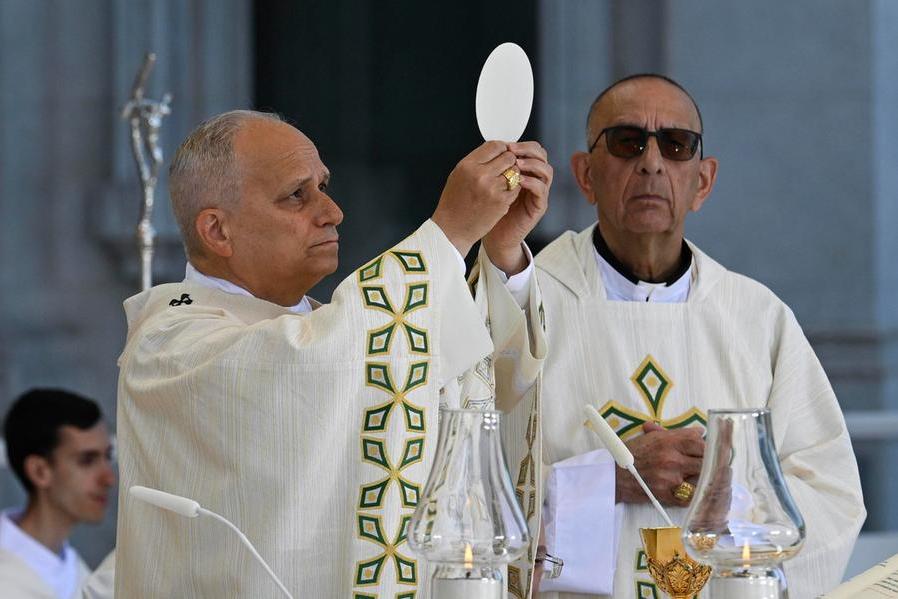
“No one can kneel before the Lord and despise his brother.” Pope Leo speaks to Spain, speaks to Europe, speaks to the world. On the day in which the Church remembers Corpus Domini, it asks to rediscover the centrality of the Eucharist, the traditions linked to the celebration, but not as an external form. The Corpus Christi procession reminds us that the Risen Lord “is alive and still passes among us, who becomes bread for our hunger for life and visits the corners of our hearts and our history, even the darkest ones”.
Madrid has been embellished with floral carpets, flower petals, altars in the streets. Over one million two hundred thousand people participate in the mass. The Pontiff recalls that these traditions “have shaped the piety, art, music, architecture and life of the Spanish people for centuries and, even today, express and manifest the spiritual feeling of this country also through beauty”.
Leo reiterates that «in the Eucharistic celebration Christ gives himself as food, the procession says that He does not remain closed in the temple but, rather, comes out to meet us. Jesus walks the streets, crosses the squares, visits our neighborhoods, inhabits the places of our daily liveslike the nearby God who walks with his people, like the Lord of history, consolation for the weak, light for families, hope for the most fragile, peace for those who suffer. The Christ who passes through the streets in the monstrance is the same one who identifies himself with the poor, the sick, the lonely and the rejected.”
And with the monstrance, the invitation is to bring ourselves out too. «Away from selfishness, from indifference, from a comfortable and private faithto respond to his invitation to conversion, to change our gaze, welcoming his presence which changes us and makes us builders of a new world”.
That’s why the Corpus Christi processions, far from being a legacy of the past, become an invitation for today «for our personal life, for our relationships, for society, for the construction of the future. From this perspective we must understand the invitation to “remember” that we heard in the first reading: “Remember the whole journey that the Lord, your God, made you travel in these forty years in the desert”, remember how when you were hungry he fed you with manna; it is a question of “remembering” precisely so as not to forget who the Lord is, so as not to fall into the temptation of relying on other idols and feeding on bread that does not satisfy.”
The mandate for Spain is therefore that it continues to spread its religiosity, to ensure that it «is not a museum of the past to be visited, but a school of faith from which to draw even today. A school that teaches us to kneel before God and before others». A school, which «teaches us the gratuitousness of love that becomes a gift, so that it circulates among us and breaks the chains of all selfishness; a school from which we learn that God is real presence and we too are called to be present in the situations and challenges of society, not to run away, to commit ourselves personally to the construction of the common good”.
Finally remember San Manuel González, the Spanish bishop known as «the bishop of the abandoned tabernacles»because he dedicated himself to spreading love for the Eucharist and for others starting from the care for an abandoned tabernacle in Palomares del Rio. «His life reminds us that the Eucharist cannot be honored only in large celebrations or occasionally, but also in the silent faithfulness of those who accompany the Lord when he seems forgotten and in a humble and discreet friendship that is nourished day by day». And with him he also remembers Saint John of the Cross imprisoned in Toledo, in very harsh conditions, just before Corpus Domini in 1578. «He recognizes from the night of that prison the hidden presence of the Lord, from which flows a light that never fades and a life that never ends. Eucharistic Jesus is “that eternal hidden source”: a source that flows and quenches thirst but without dazzling, without imposing itself with external power, without presenting itself in a spectacular way.” It is therefore necessary to open ourselves to the Lord so that He may quench the dryness of our hearts, to then go out onto the paths of life and history and bring this current of fresh water, a current of love, peace, justice and joy among the people. Let us drink again from this Eucharistic source, which does not close us in a private devotion but sends us to water our brothers, families, the poor, those who suffer, those who have lost hope. Eucharistic grace transforms us, but also makes us protagonists of the transformation of history and a sign of hope for those we meet.”