



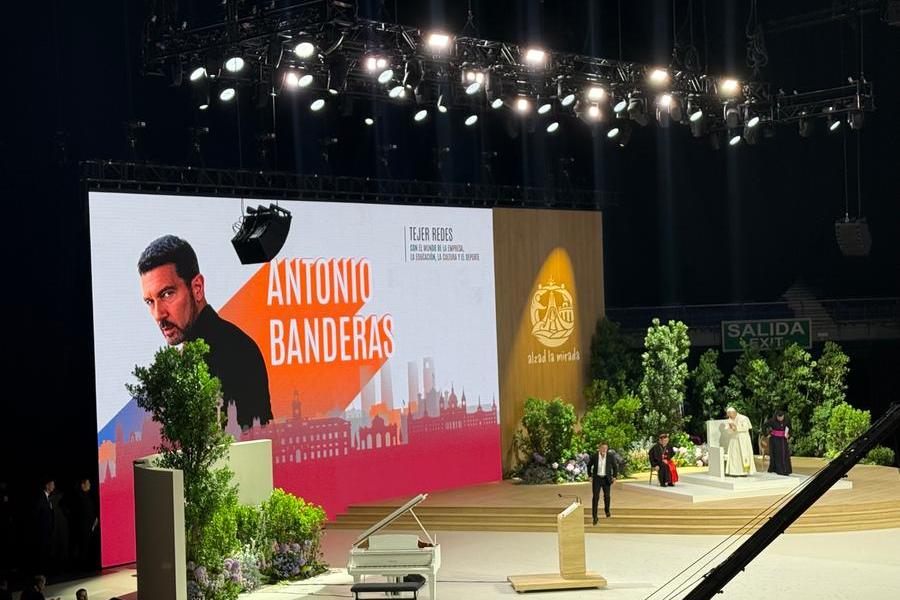
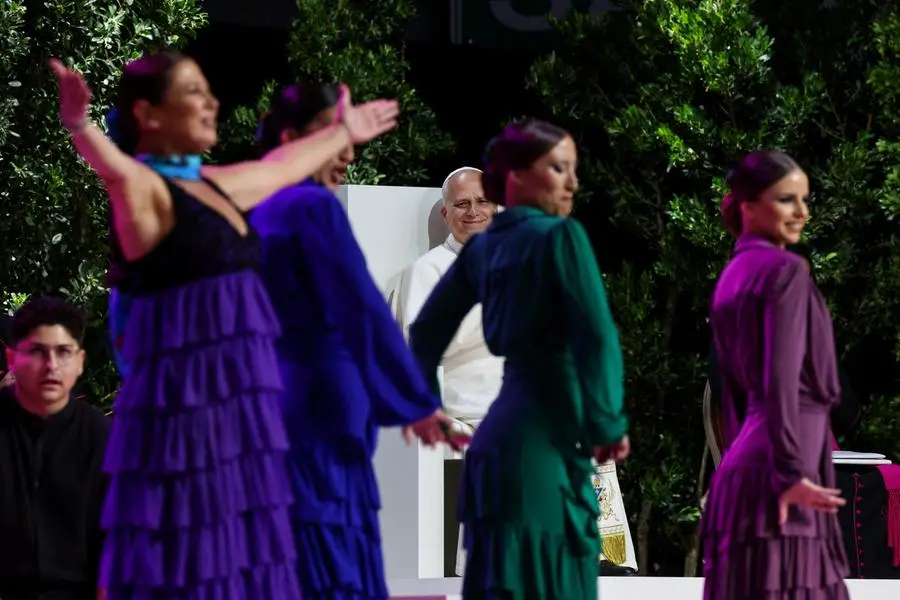
Flamenco dominates the stage. At the Movistar arena, which usually hosts concerts, cultural events and, more frequently, basketball games, 17 thousand people await the Pope. The rhythm of the castanets alternates with the words as everyone takes their seats. The dialogue begins between Leo XIV and the world of the arts, economy and sport. The first to speak is Antonio Banderas.

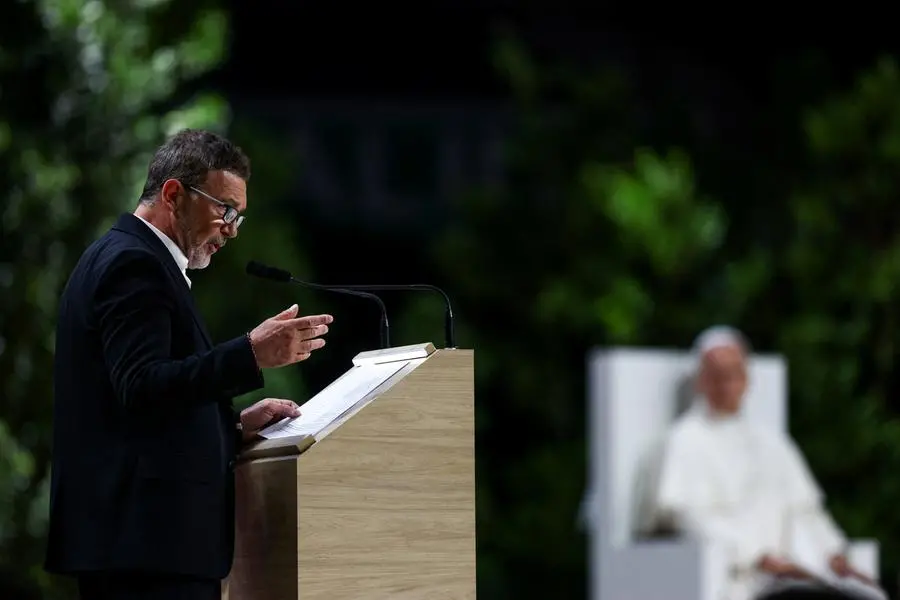
He talks about his experience going back in time, «to the Holy Week celebrations in my beloved Malaga, in the sixties of the last century». His questions about God, his mother’s faith, the “humble and good people of my city, who every year went out, and still go out, in the streets of their neighborhood carrying on their shoulders the statues that help them to search for themselves while they search for God. And they do so by leaving the self behind, to cling to the we… from us they pass to theirs, from theirs to everyone, to everyone in the world, from the world to the universe, from the universe to God, and then returning to earth realizing that God can be in every particle, in every molecule of every drop of water, of every sea, of every rose petal, of every heartbeat, of every sigh.” Banderas calls for dialogue, indicates art as an alternative to violence and as a help in recovering the depth of the soul in a world “that runs and fragments”. And he talks about his latest theater show, Godspell, which in «Spanish is “El hechizo de Dios”, (God’s spell)», confessing that he was the first to be «a victim of God’s spell».
Among the testimonies also that of the rector of the Complutense University, José María Coello de Portugal, who underlines the great inclusive importance of educationand its contribution «to building a peaceful society and improving a coexistence frequently threatened by a sterile climate of conflict that sometimes permeates our societies of the 21st century». And again Antonio Garamendi, a Spanish entrepreneur, current president of the Spanish Confederation of Business Organizations (Ceoe) and Ángela Lopez de Miguel, president of the Spanish Confederation of Small and Medium-Sized Enterprises (Cepyme) reflect on artificial intelligenceadvanced automation and global interconnection that “are redefining the way we produce, work and compete” and on the importance of social dialogue.
Teresa Perales and Carolina Marín speak for the world of sport. Both awarded the Princess of Asturias Award for sporthave distinguished themselves, one as the most decorated Spanish athlete in the Paralympic Games having won, in swimming, 28 medals and holding the record in the 100 meters freestyle, the other, is the only non-Asian athlete to have won an Olympic gold medal in badminton. They reflect on sport as a source of resilience and self-discipline. And they wish the Pope “good luck in life!”.
Leone responds by recalling that the place where they find themselves hosts “the deepest emotions of the human being: joy and admiration, enthusiasm and hope, as well as sadness and frustration”.
He talks about the beauty of Spain, «visible in its cities, in its streets and monuments, in its squares and gardens, in its universities and churches, in its music, painting and dance, in its gastronomy. Here you can also perceive the soul of the generations who transformed the landscape and gave it its own face, and this reveals to us in every trait the intelligence and will that reside in the human soul.”
Looking at what has been built so far, the Pontiff asks himself what “are we leaving for the future and, consequently, what type of community are we building?”.
And if it is true that society has a great capacity to produce, innovate and communicate; “However, it seems that we still need to learn to guard the soul of what it generates. Otherwise, we run the risk of being media savvy and effective at production, but uncertain about why, for what purpose, with whom and for whom we produce. In this context, the Church, aware of both its successes and its errors throughout history, wishes to remain in dialogue with the contemporary world.”
He quotes Paul VI who recalled that the Church “is an expert in humanity” and, therefore, for this very reason “it is not disinterested in anything truly human”. So the question is What does it mean to be truly human? The Church shares with humility but also with firmness what it has discovered in the experience of faith: that Jesus Christ answers the great questions about human life and its fullness, already in this world and up to its culmination in eternity”. Because of this the person always remains at the center of his action. For this reason it cannot be disinterested in culture, and must ask itself what we are sowing, what we are cultivating, what values we are preserving, what we are causing to die.
«To answer these questions, there is a need of a social dialogue that we could compare to the art of weaving networks, which implies meeting, listening, dialogue and respect”.
He asks us to pay attention, in every area, to the language used, «written, oral and, in the digital environment, also that of images; Why communication is never neutral. Every expression communicates, transmits; it can hurt or heal, destroy expectations or open new horizons, sow division or reawaken hope in the possibility of building something genuinely human together». Dialogue between culture and work, with a “university that does not turn its back on the world of work nor renounce the truth”, but also with an “entrepreneurial activity that does not consider the employee as a simple factor in the equation of its own interests”, with an art that “does not have the elite as its sole purpose”, with a “sport that is not reduced to entertainment or transformed into mere business”, with a “technological progress that takes into account the elderly, the poor and those who have no voice”.
On the part of the Church, dialogue starts from “a Christian vision of life, which starts from the awareness that the Creator has woven the human being with threads of love” which is why human dignity is inalienable.
And then “weaving networks means creating together” and also “serving in a selfless way”.
Remember that «men and women moved by faith have built hospitals and schools, created solidarity initiatives and spoken with a language that ennobles people. For this reason it is legitimate to honestly ask ourselves whether the world – and in particular Europe – would have forged its own identity without the spiritual imprint that has permeated its history. This is not a provocation, but an invitation to reflect on whether eternity, which broke into time and space through the incarnation of Jesus Christ, can be reconciled with everyday life.”
Leone wonders if «it is really possible to believe that Europe – which we love so much – would be the same without the imprint of faith” and why we should fear that “eternity permeates everyday life”. He makes his predecessors’ cry his own: «Don’t be afraid! Open the doors wide to Christ! Jesus Christ takes nothing from us and gives us everything”. And he asks «out loud: who is excluded despite their virtues and abilities? We cannot ignore that the condition of the poor represents a cry that, in the history of humanity, constantly challenges our lives, our societies, political and economic systems, and the Church”.
He takes up his recent encyclical Magnifica humanitas to underline that «the Church, an expert in humanity, even if it sometimes goes against the grain, insists on the fact that “economic and institutional structures are fair only to the extent that they serve the integral development of the person and favor the responsible participation of all”».
And, finally, it turns its attention to the world of sport. «Let’s think», he says, «of how many of us have learned respect for the opponent on a playing field rather than listening to a speech. How many athletes teach us to lose without hating, to win without humiliating or to get up after falling.” He repeats the words of John Paul II who said about sport: «In these times, in which unfortunately various forms of violence and therefore hatred tend nefariously to tear the fabric of social solidarity, you (athletes) contribute, for your part, to giving a luminous testimony of cohesion, of peace, of union, in a word of “knowing how to be together”». Underlining that “these expressions are more current and appropriate than when they first resonated”, he invites everyone to “be new threads for weave new networks that harmonize all areas of life, to weave a renewed society in which time is imbued with eternity, culture preserves memory and encourages dialogue, education promotes the search for truth with a critical spirit, art arouses amazement and generates noble emotions, business recognizes the dignity of the person and work continues to be an engine of hope». New threads that know how to follow “the advice of Saint Paul: “Rejoice with those who rejoice; weep with those who weep. Have the same feelings towards one another; do not harbor desires for greatness; turn instead to what is humble. Do not consider yourselves wise. Do not repay anyone evil for evil. Try to do good before all men. If possible, as far as it depends on you, live in peace with everyone”. Because”, concludes the Pope, “in all of this what is at stake is that, in the future, our magnificent humanity continues to shine”.