





by Lorenza Ceccarini
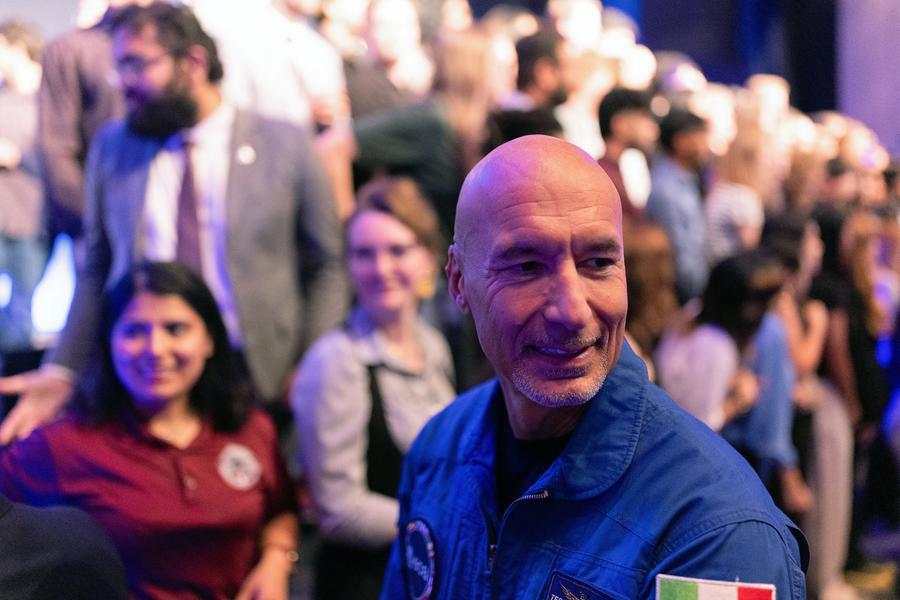
If we imagined the soil of the Moon immersed in the darkness that distinguishes it, as we have been accustomed to doing since the first images of the moon landing fifty years ago, we could ideally see an Italian flag waving. THE’astronaut Luca Parmitano joins, as a pilot, the Mission Artemis III.
NASA’s announcement seems to resonate, in our country, almost as the conclusion of an intricate global history, full of anxieties of primacy and secret military plans, which from the era of the Cold War and the space race, played between the United States and the Soviet Union, leads us back to the most current and shared technological achievements and to the ever closer knowledge of the cosmic environments that have shaped our human and earthly beings. You don’t go near the Moon with one of our pilots to demonstrate that you are more powerful than others, but because a man, a European, was able to demonstrate that Italy is capable of expressing such excellence as to be able to sit on the command post to guide the universe to self-discovery. Competence and experience, acquired in his 366 days spent in space during long-duration missionsVolare and Beyond, on the International Space Station, are the requirements that allowed the astronaut to reach the level of preparation necessary to complete the long-awaited challenge: Artemis III will push beyond the usual limits of operations performed by spacecraft in orbit.
The objective of the exploration that will see our astronaut as protagonist is clear: to learn to move further and further into space. Along with NASA astronaut Commander Randy Bresnik and NASA astronauts Frank Rubio and Andre Douglas as landing specialists, Parmitano, who trained as a test pilot at EPNER, the French flight testing school, and was selected by the Italian Air Force in 2007, it will have to test complex and delicate rendezvous and docking operations to evolve the technologies in view of future trips to the Solar System.

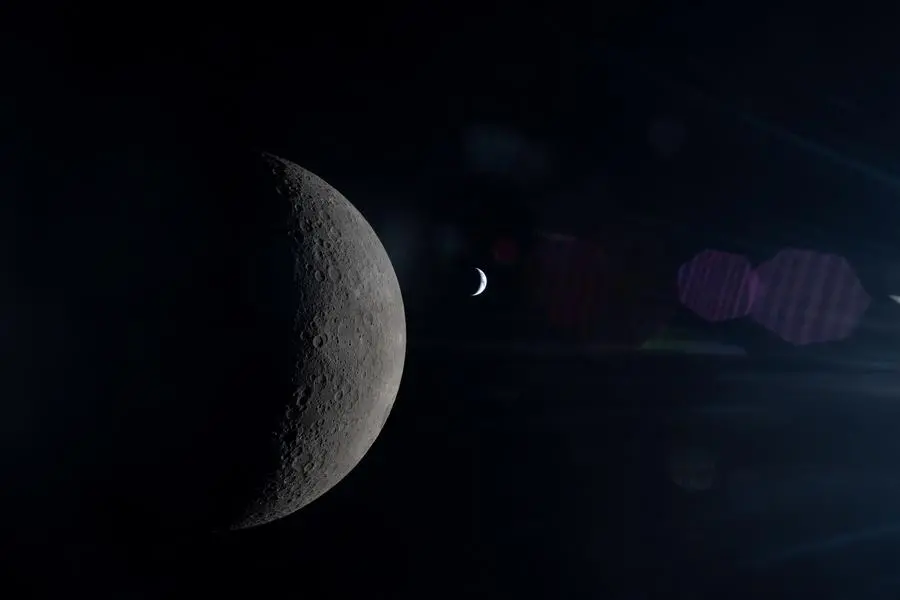
The Moon and Earth in a shot from the Artemis II mission.
(via REUTERS)
Born in Paternò in 1976, he is married with two daughters. He loves weight lifting, swimming, cycling and running. He graduated in Political Science with a thesis in International Law, then graduated from the Italian Aeronautical Academy of Pozzuoli and obtained a Master’s degree in Experimental Flight Engineering from the Higher Institute of Aeronautics and Space (ISAE) in Toulouse. “As a test pilot,” he commented after NASA’s announcement, “this is truly a dream mission, as we will be able to help test systems and develop procedures so that future crews can go further and ultimately return humanity to the Moon.” «At the same time, ESA’s European Service Module (ESM)» – underlined Josef Aschbacher, Director General of ESA – «will once again provide the fundamental capabilities that power Orion, demonstrating Europe’s enduring role at the very heart of the Artemis programme».
Before any other thought, Luca Parmitano wanted to thank his country as his “launch base”. What, we ask him, is the meaning of that very first reference to Italy? «I am very pleased that many people understood my metaphor which came to mind in an absolutely spontaneous way» – he tells us – «and which I then tried to collect in a single image. As far as I’m concerned, I have been living abroad for professional reasons for more than twenty years now, but I have never stopped being Italian, I have never stopped wearing the Italian flag on my left shoulder, I have never forgotten my origins, I continue to have a great sense of responsibility and gratitude towards a country that raised me, educated me, both in basic education and in professional education and I am grateful for the opportunities that have been given to me by Italy. Opportunities that other European countries envy us. I come from the ranks of the Air Force, which trained me first as a fighter pilot and then as an experimental pilot” – he tells us – «and this is the professional background that pushed NASA to choose me as a pilot for this mission. I joined ESA thanks to my work and professional experiences. The Italian Space Agency allowed me to put into practice my first space experience in 2013 with the mission Fly. This sense of debt and gratitude towards my country is with me and accompanies me. Clearly, none of this would have happened without the bridging role of the European Space Agency and I wanted to thank ESA which allows me to be an astronaut today for the bridging, cooperating and bridging role. It is an example for the whole world: twenty-five countries including twenty-three member states that collaborate together for the common good. Italy” – he recalls – is one of the founding countries of the European Space Agency and this is an incredible source of pride for all of us Italians. This is why I wanted to say that, if the launch base is Italy, which gave me the professional foundations to be where I am, Europe is certainly the structure, the ramp, the launch tower that allows astronauts to approach the spaceship. The fuel, I said in a very emotional way, is represented by my family.”