




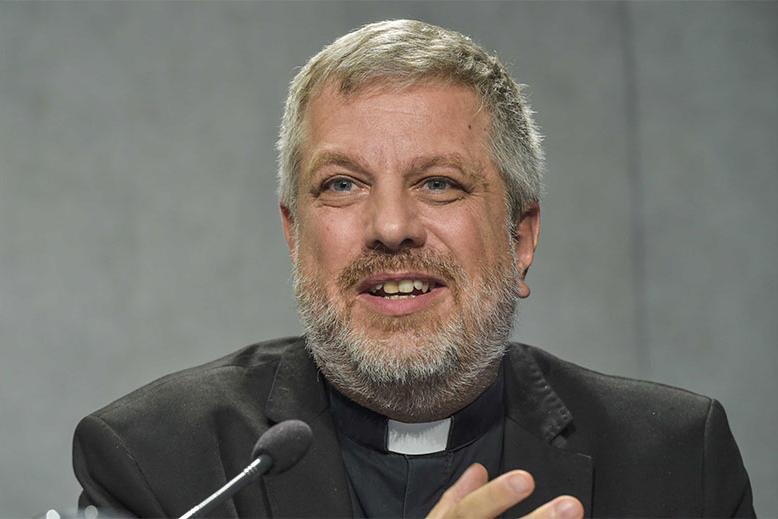
«Just as Laudato si’ was not a green encyclical, this is not an encyclical on artificial intelligence». Father Giacomo Costa, general secretary of the Synod of Bishops and former director of Social Updates, immediately underlines that «the Magnifica Humanitas concerns the way in which the Church interprets the great transformationsthe rerum novarum, that is, the new things in history in the light of the Gospel, accompanying humanity in delicate phases. Every era has its “new things” and, therefore, the question always arises how to preserve the dignity of the human being with respect to these innovations”.
What social implications does this encyclical have?
«A first point to reflect on concerns the question of candies. Artificial intelligence is not just a tool that is used, that helps, that facilitates tasks, but it is a system made up of infrastructures, data, computing capacity, platforms, economic interests, geopolitical strategies. All these things make us understand that technologies are not neutral, but convey culture and bring with them moral architecture. The power to decide on this architecture is often concentrated in the hands of a few private actors who impact people’s lives much more than many states. Some fundamental conditions of social participation – that is, what we see or not, what is rewarded and highlighted and what remains invisible – they are mediated by systems that escape democratic control. The question to be asked then is not whether artificial intelligence works or not, but who it serves, who governs it, who benefits from it, who pays the cost, whether it increases freedom or produces new dependencies. And then there is a second consideration.”
Which?
«It’s about work. Here the link with Rerum Novarum is truly strong. At the end of the nineteenth century the issue was the dignity of the worker. This demand continues today, but takes on new forms: automation, the algorithms that organize work, digital surveillance, the replacement of some tasks, the precarization of professions. Then there is also the invisible work that makes this whole digital economy possible. There are people who label and live in harsh conditions paid very little. And then there are the issues of rare earths, mines, data centers, energy consumption. Digital seems light, clean, weightless, but has a resource-consuming body. This body depends on human labor and produces social and environmental impacts. From the perspective of integral ecology, we are asked to look at this entire supply chain and ask ourselves whether this innovation is good only because it is efficient or whether it also promotes dignity, justice, participation, sustainability, worthy human work. We need to discuss this.”
And then there is the issue of peace.
«This is a point on which the encyclical has a great impact. Artificial intelligence makes war more impersonal and shifts responsibility away from the concrete faces of war victims. Conflicts are normalized and rearmament appears as the only possible realism. Peace, the encyclical says, is not naivety, but is political, diplomatic, educational and spiritual work. It is an even deeper realism because it takes into account the victims, the people and the future of the people. The question of peace is then linked to the question of truth and democracy. A democratic society does not live only on formal procedures, but on trust, credible words, shared facts. If everything becomes manipulable – as can be done with artificial intelligence – the common ground on which the political community can discuss is lost. Artificial intelligence can multiply the power and verisimilitude of things that are decidedly false. For the encyclical, truth is not just an individual virtue, but a common good, a condition of coexistence.”
What is the Church’s task in this context?
«The Church is called to accompany this time without fear and without naivety. That is, without condemnation or allowing ourselves to be fascinated by novelty. It must help us discern and listen to the concrete lives of people, of parents who don’t know how to relate to their children in this digital world, of teachers who see the way of studying changing, of workers who fear being replaced, of young people who seek authentic relationships, of the elderly who risk being excluded, of the poor who pay the costs of innovation. There are two challenges for our communities. The first is that of education which does not just mean saying that artificial intelligence should not be used to copy.”
What does it mean to educate then?
«Making the effort of thinking, of comparing, of making mistakes, of searching. It is not enough to receive an automatic summary from AI, we need to be trained to go through shared processes. There is also a huge responsibility when it comes to communicating. Faced with increasingly aggressive, polarized, fragmented communication, we need to have spaces in which we learn another quality of speech. Words capable of truth, of respect, which do not fuel opposition. This disarming of words is truly a first step in building peace. And then the other pastoral implication concerns synodality.”
What does synodality have to do with artificial intelligence?
«There is a very beautiful image that guides the entire encyclical, that of Babel, a grandiose, powerful, but uniform and therefore inhuman city, born from a desire to dominate. And then there is Jerusalem being rebuilt with the contribution of many. Everyone does a section of the wall and no one does it all alone. The reconstruction of the city goes together with the reconstruction of ties. Faced with digital transformation, the Church cannot and does not want to respond only with experts and documents, but needs community processes of discernment in which all skills, experiences, different generations and above all the most vulnerable people are brought into play. The Magnifica Humanitas calls us, as a Church, not to just add a few meetings on artificial intelligence to our diocesan programs, but to go deeper. The point is to make Christian communities places where the human, this magnificent human, is preserved in his fragility, in his weakness, in his relationships. We must continue to keep places open where we think and learn criteria of truth. Places where fragility is not a failure, where there are possible spaces of communion in which we take on the responsibility of hope. The question then is not what the next developments of artificial intelligence will be, but what we men and women will become within this change. We will be more efficient, perhaps faster, more connected. But will we be more human? Will we be more capable of justice, care, freedom, truth and peace? The encyclical, I repeat, without fear or fascination, sets a criterion for navigating this future. And the criterion is that progress must be measured on the dignity of people, especially the most fragile ones, on the ability to cherish the faces of every person, without exception. This is the most concrete form of the Church’s mission and everyone’s social responsibility.”
At a time when we are witnessing the disintegration of international law and the weakness of large multilateral institutions, is it possible to protect humanity?
«The Pope wants neither to engage in politics in the strict sense nor to remove the responsibility of all those who are on the ground. He wants to help ask questions, hoping that whoever is responsible will be able to address them in a concrete way. We cannot think of dealing with situations without a multilateral relationship in which we grow together. Recent history shows the failures of the many attempts to resolve situations unilaterally and violently. Certain, the path indicated by the encyclical may seem longer, but we know that the longest paths are those that actually build something lasting and not just the semblance of solutions. In this, as a Church, we must have the courage to get involved. In this non-violent perspective, in this perspective for peace we cannot only speak, but we must do. We must show credibility by building a capacity for coexistence even in the differences and divisions that inhabit the community.”
What is the responsibility of the Catholic press?
«As a Christian community we have the challenge of build, demonstrate and experience another way of communicating. Realistically we have to take into account costs, times and methods. But we need to invest in the taste of something different. We have seen in the synodal journey how the conversation in the Spirit has spread throughout the world from the North Pole to South Africa. I think this is a sign of the desire for a quality in our way of speaking and communicating that is totally different from that of the speed of artificial intelligence. There is an ability to listen to each other, to establish bonds, relationships and, together, to identify what gives life, what promotes the human. We may have different visions, but starting from our faith we can build a different quality of conversation. I think our press should listen deeply to this desire. I believe that it is a desire not only of Christian communities but of many others who want a different quality of relationships, of our way of speaking. We must be aware that communication is constructed in a polarized manner and try to identify the manipulations, the shortcuts that invite us to divisive, confrontational and violent thinking. It is important to listen to the desire, which exists, for a quality in communication that goes elsewhere. This is the challenge: not to think based on those criteria that seem dominant, but to have a type of communication that manages to accompany communities that help people grow in a different way.”