





By becoming mothers, it is a reality that everyone accepts: the baby becomes the center of attention, while they take “second place”. Several mothers tell us about this painful exclusion, which many feel without daring to name it. Anh-Chi Ton, midwife, observes her every day.
It’s a natural phenomenon, but it can have consequences that we still don’t talk about enough: after a birth, attention shifts almost entirely to the child. The questions, the looks, the concerns naturally focus on this little being. The mother fades into the background. We worry about the baby’s sleep, his weight, his crying. We more easily forget to ask how the one who has just given life is doing. Little by little, a shift takes place. The woman is no longer perceived as a whole person, with her emotions, her needs, her fragilities. It becomes a function: the one that nourishes, that protects, that organizes. A pillar that is both essential and paradoxically secondary.
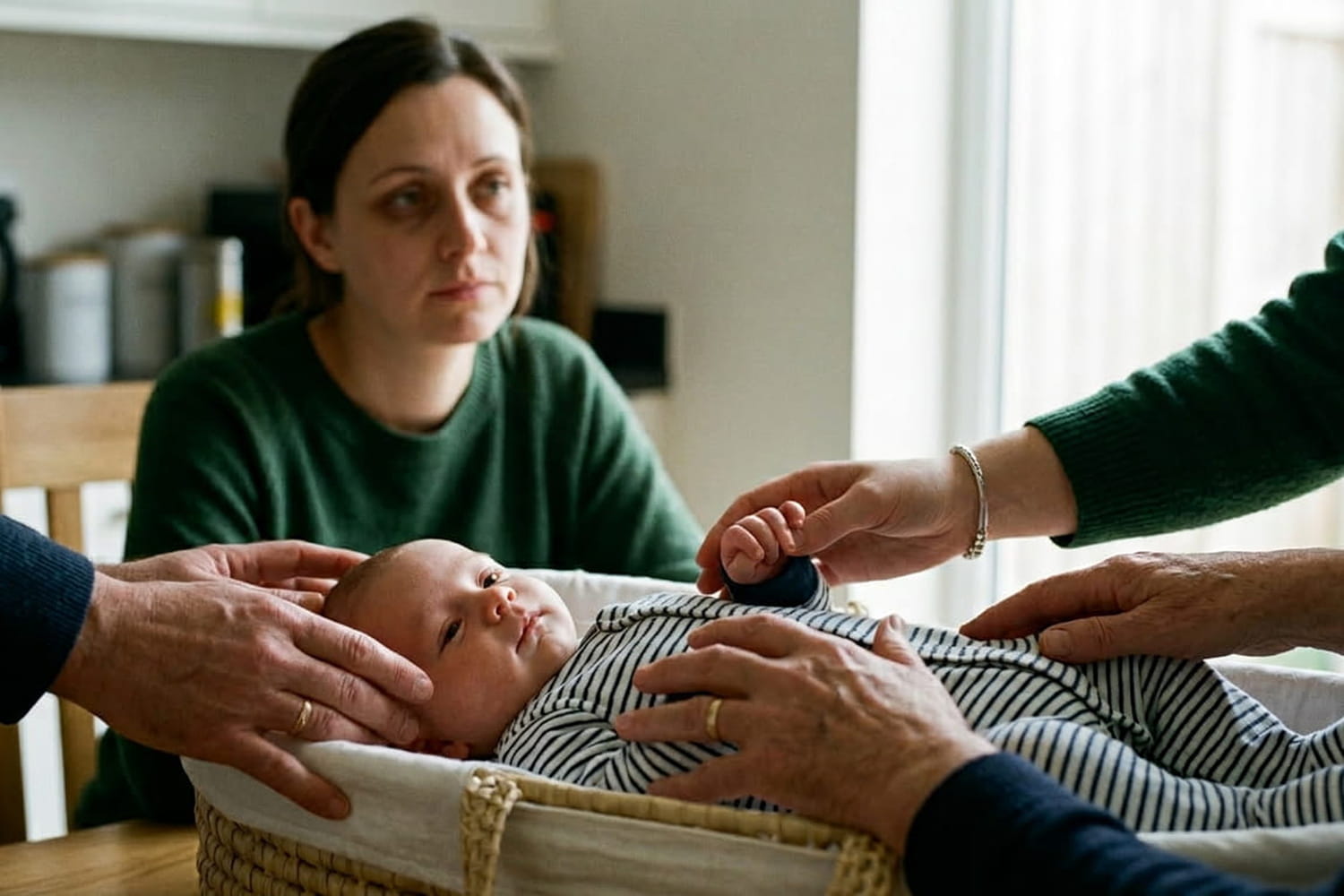
We notice it almost everywhere, both in humorous and dramatic situations. On social networks, hundreds of videos show it: friends, uncles and aunts or even grandparents, who jostle the young parents to go straight to see the baby. Subtext: “I came to visit him, not you.”. And this phenomenon is felt all the more for mothers, because society has always demanded that they be entirely devoted and step aside for the benefit of their children. This is where what some call “maternal invisibility” comes into play: not a sudden disappearance, but an almost silent erasure of the woman, in favor of her role as mother.
Of course, each woman will experience the experience differently, but many mothers report this sidelining in the first months, or even the first years of the child. Anh-Chi Ton, a private midwife in Paris, regularly notices this with her patients: “I’ve heard it enough times to tell me that these are not isolated cases, there is a reality. They don’t all verbalize it, but many tell me that they feel neglected. Basically, ‘Everyone wants to see the baby, and I don’t care’. It’s as much the entourage as sometimes even the spouse”she explains to us. Often, grandparents are the first to participate (unintentionally, of course) in this invisibility. This is what Jessica, mother of a little girl, feels: “I find it normal to step aside for my child, because it is my choice. But above all I notice that I take second place with my own mother. She never came to spend a weekend at my house, which she has done regularly since she became a grandmother. I think she loves my daughter more than me now!”she tells us in a bittersweet tone.
And Jessica isn’t the only one. On the Reddit forum, a young woman says that her motherhood has “made truly invisible” in the eyes of his family. Her mother, in particular, only has eyes for her adorable twins… to the point that she feels totally forgotten. “I feel selfish for feeling this way, but I would like to be recognized as a person and not just an accessory to my babies.” Anh-Chi Ton has noticed this feeling of guilt all too often in her patients. This is why she decided to address the subject in advance in her childbirth preparation classes: “I talk about it because if they feel it, they will tell themselves that they are not alone. It takes the drama out of things, because what comes up the most is this guilt. They all told me: ‘I’m horrible for saying that, it’s normal that people love the baby’. It’s important to talk about it because it’s still a taboo subject. And the feeling of isolation, of thinking that you are the only one in this situation, is for me the number one factor in postpartum depression.” In France, according to Health Insurance figures, 10 to 20% of mothers are affected by postpartum depression. And if it is not necessarily the cause, maternal invisibility can be an aggravating circumstance.
Another symptom of this erasure: the “nostalgia for pregnancy. For Charlotte, mother of a 3-year-old boy, this is what was “the most blatant.” That is to say the contrast between pregnancy, where the mother-to-be is the center of attention, and post-partum, where the baby suddenly takes up all the space : “When I was pregnant, everyone took care of me. People asked me if I was sleeping well, if I needed anything… However, I’m even more tired now, but no one cares! Charlotte tells us about having experienced childbirth “quite traumatic”which did not happen as we had explained to him during the preparation courses: “It was hard for me and I felt like I had no right to complain, since the baby was fine and that was the most important thing.” Anh-Chi Ton also heard this minimization of the young mother’s feelings a lot.
To avoid participating in this maternal invisibility, the midwife therefore recommends that those around them forget “the vague sentences like ‘The baby is fine so everything is fine’ or ‘It’s fine, there’s worse’ because that never brings relief”. The only solution: finally put words to this widely shared but still unspeakable feeling, so that young mothers finally feel heard.