



The Olympians will not argue tonight: Alberto Tomba and Deborah Compagnoni in Milan, Sofia Goggia in Cortina, it is difficult to get them to agree more than thiswith the names that have honored the snows of home most in history. After much controversy during the relay, no mistakes under the Olympic rings exploded in a shower of gold. The stadium understood and appreciated it, Sofia above all, who lost her place as standard bearer due to injury four years ago, was entitled to compensation. The other two are the imperishable symbol of the Winter Olympics for Italy, as is Gustav Thöni, who passed the flame to Sofia. A little less applause for him, a shame, but perhaps it was just a question of age: many of those present were not born, but there are no captions at the stadium. We must grasp it quickly, knowing that much will escape, that suggestions and emotions will remain.
Leonardo’s geometric knots which inspired the double brazier of Milano Cortina 2026, for example, are important, they are a signature, almost: knots, or “constraints”, Vinci. They slip into many works, into many pages. Six of these sheets sleep in the Ambrosiana Library, one of the oldest if not the oldest libraries open to the public in the world. Citing them in the brazier was an elegant way of evoking a story of depth without being didactic or obvious: with Leonardo, from the smooth and carbonated Mona Lisa, to the train invented in All we can do is cry falling into the already seen is a moment. Even though it was strange at a certain point to see the torch enter the stadium and then, passing through the hands of the volleyball stars, walk away to light up elsewhere.
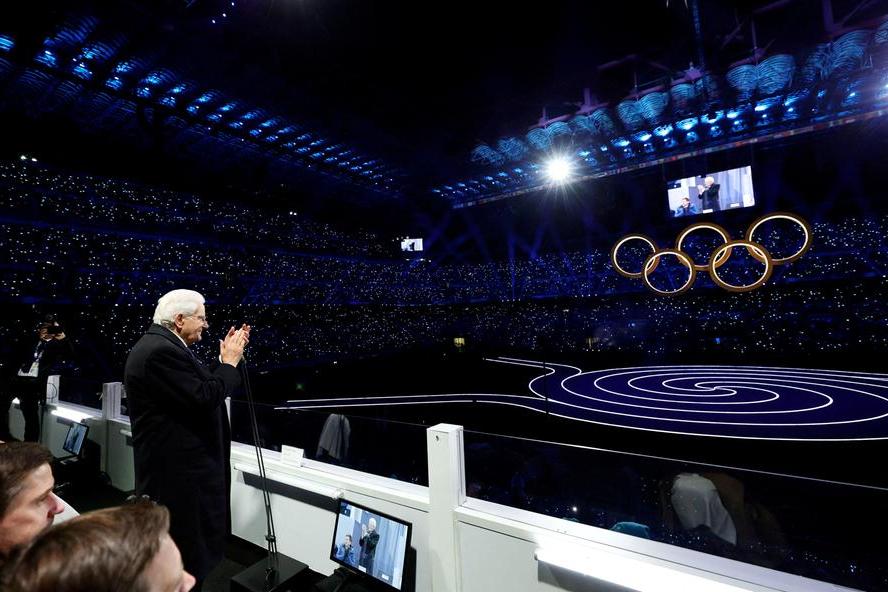
Once upon a time there were colored cards, white raincoats to pretend snowflakes. They are no longer there. At San Siro Milano Cortina 2026 the public’s contribution was a riot of lights that changed color according to needs. Poetically white at the beginning, golden as the hoops went up, certainly the most spectacular moment inside the stadium. Very colorful while Mace on the podium, transformed into DJ console, struggled to fill the void of the delegations dedicated to snow sports, all obviously far from Milan. The difficulty of the widespread Olympic parade was taken into account, which only the television expedient managed (perhaps) on the occasion of the ceremony to re-aggregate in its sidereal distances.
Seen from the stadium, where Milan and Cortina remained divided apart from the screens, the parade functioned as a litmus test of sporting “biodiversity”: Canada, the great country of ice and snow half here and half there, China and Korea dominating the ice all in Milan walking in the spiral of the stadium, where before seeing a flesh and blood standard-bearer behind the silver divas who gave their names to the Nations, we had to wait for Amenia, those who came first all to Curtain.
Marco Balich promised to make San Siro sing and in some ways he kept it, but perhaps not where he expected: the audience didn’t follow Mariah Caray’s “Volare” so much, dressed up in the white stole of a 1950s diva, as Laura Pausini and the second stanza of Mameli’s anthem, to the point where she changes the rhythm: before that wasn’t possible due to the pop arrangement which some may not like but which the stadium seems to have appreciated. Very institutional instead Nobody sleeps by Bocelli, perhaps a quote from the counterpart, given due proportions, by Luciano Pavarotti in Turin 2006. Leopardi/Favino’s ratings are also very high, with the reading of the infinite. Other rhymes compared to those to which the Meazza curves are accustomed, at their last event of this magnitude, which could not miss Beppe Bergomi and Franco Baresi, who entered together first with the torch.
The outside temperature, around 9.30pm, began to give a light breeze to the Italian flag on the flagpole, to make the audience suffer in the stands (the wind of the flag-raising was fake), and to freeze choreographers and singers from then on, especially the women forced to wear evening dresses, but at least it graced a little at the beginning on the one hand the Winged Love which, in a very elegant choreography, celebrated Canova and his classicism, and of the other the exposed navel of the homage to Raffaella Carrà, to which the stadium responded by dancing.
But it was in front of the march of the living Italian flag that advanced as it would have done in a Giorgio Armani fashion show that an emotional silence fell on the San Siro before the photo of the recently deceased Milanese designer who gave so much to Italian sport and who lastly designed the uniforms of the flag bearers appeared on the screen in black and white, even if perhaps many in the stands didn’t know it because there’s no one to tell them. But they got it. And in this case, the Milan Cortina 2026 Ceremony has kept its promise of immediacy, transmitting emotions like a great theater of music, dance and mime, something vibrates even where there are no caption words: wavelengths that carry light, colors, sounds, at the cost of some falls into kitsch, like the three poor Rossini, Puccini and Verdi reduced to carnival masks.
However, seen from afar, the three tubes of red, yellow and blue, primary colors from which all the colors in the world are born, were effective in their ironic naïveté: the fabrics coming down from afar looked like pure color dripping.
If Israel and the United States received some boos, President Sergio Mattarella received thunderous applause from the moment he appeared, smiling, in the video of the tram with Valentino Rossi. The speech by IOC President Kirsty Coventry was much applauded, and rightly sowho spoke to the athletes with the authentic feeling of someone who knows what it feels like to have been there. An authenticity that was felt from the stands. Who knows if Ghali understood from the center of the stage that he had been the protagonist of the most poetic moment of all, when the children invoked peace by forming a white dove in the center of the stage, replacing the traditional flight of the pigeons?
While the Italian parade shouting “bravo bravossimo” to the rhythm of a rock Barber of Seville gave the Olympics back its soul, the amount of lightness that something called the Games should never lose.