

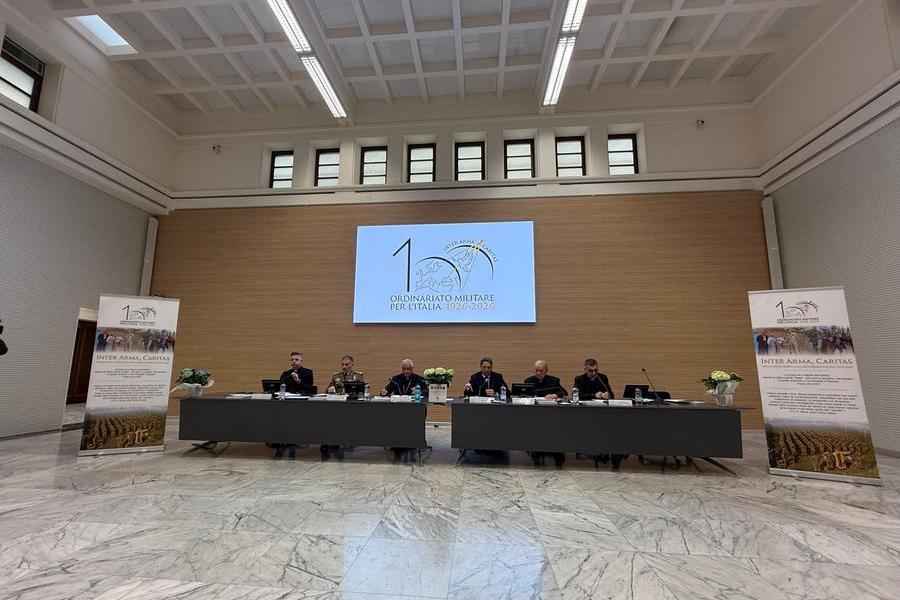


The military ordinariate turns 100 years old. And it celebrates them with a week of events, prayers and reflections. With the meeting, on March 5th, with the President of the Republic Sergio Mattarella and, on the 7th, with Pope Leo. But also with the prayer vigil for peace which will be held on March 3 in St. Peter’s Basilica. Because, the military ordinary immediately underlines, Monsignor Gian Franco Saba, the task of the chaplains is, as Pope Leo explained, to act to bring an unarmed and disarming peace.
«Even in places marked by fatigue the Church is called to announce the Gospel of hope and peace», and she does so by remembering that “war is always bad.” Chaplains act as “artisans of peace who refine the weapon of charity”. Precisely for this reason, “Inter Arma, Caritas”because “the centenary is not intended to be a self-celebration, but an occasion of memory, discernment and gratitude” to remember the mission of building bridges to bring “consolation, hope and moral conscience in military contexts, especially in the most difficult and risky ones”.
Furthermore, among chaplains and soldiers, General of the Army Giovanni Maria Iannucci, operational commander of the Joint Forces Summit (Covi) specified“there is a profound complementarity because both are united by the vocation and spirit of service for the common good, peace and stability”. Furthermore, the general underlined, «the presence of the chaplain is of fundamental importance in a complex world. And the uniform is also essential because it is a sign of sharing and integration, it allows the chaplain to enter into full harmony with the soldiers, understand their life and feelings. This increases the effectiveness of the ministry.”
The general also recalled the tribute given by the military chaplains who, in the First World War, had 93 deaths and 185 in the second war, not counting those who remained missing in the Russian Campaign.
Today there are 152 chaplains, of which 8 in missions abroad, in Kuwait, Niger, Lebanon and Somalia, Kosovo, Bulgaria and Hungary. A small number which makes the service very demanding and tiring. This is why training is essential. «It is a crucial challenge, recalled Monsignor Saba, «it must be accurate and continuous to prepare them for a demanding “peer-to-peer” service, which requires psychological and spiritual balance and the ability for interdisciplinary dialogue». Furthermore, in many contexts they find themselves in contact with other cultures and religions. «Interreligious collaboration is a consolidated reality in international missions, where chaplains regularly interact with leaders of other confessions, contributing to dialogue and peace».
And vocations are also born among the military. Like that of Don Giuseppe Balducci, in charge of social communications of the Military Ordinariate for Italy, son of a Navy officer, ordained 12 years ago after a past spent in anti-terrorism.
The chaplains are also joined by the nuns who, within the ordinariate, carry on the tireless prayer for peace, through Eucharistic adoration and contemplation.