





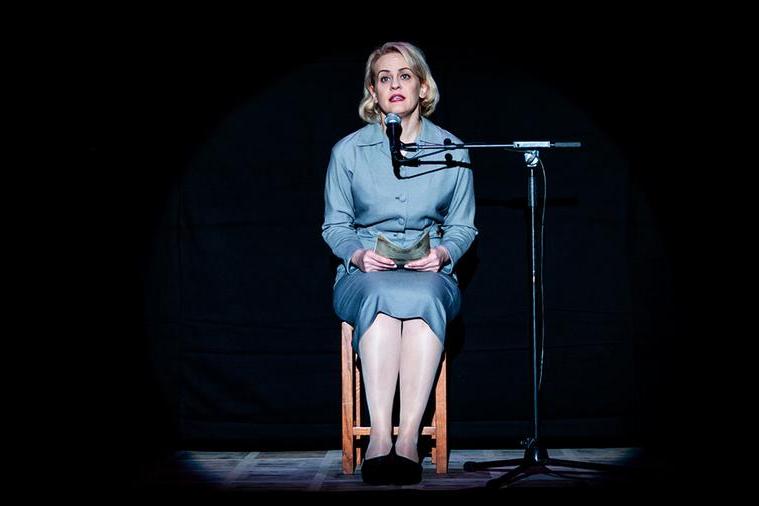
Mary Stuart is a simple woman. His is a simple story. It has nothing to do with the pomp and velvet of the legendary British queen. His “noble title” is a bitter irony inherited from his father, the “King of Savoy”, earned precisely because of the extreme poverty in which he found himself. Maria Stuarda is an Italian woman, born in the first twenty years of the twentieth century. He does not have laid tables nor did he receive a high-class French education. His is a genealogy of effort and silence. She marries Michele, an “ugly but good” man who is envied by everyone.
World War II arrives and Michele disappears into the infinite white of the Russian steppe. Left alone, Maria must learn to fight hunger. A fortuitous event opens the doors of a shoe factory to her. And from here the text by Nicoletta Verna, My name is Maria Sturda, at the Parenti Theater until 8 March, it opens out like a fan onto an existence that takes up the parable of the most beloved cinematographic and literary characters of the second half of the twentieth century. But it does so through a brilliant dramaturgical structure that eschews any victimization. In dialogue with Marina Notaro’s saxophone, Marina Rocco begins a visceral listening to the text, taking on the role of Mary with a millimetric interpretation. Its strength lies in rendering an extraordinarily dense word while maintaining a façade of extreme, almost naive simplicity. The actress explores and gathers the weight of each syllable, bringing the audience into the story with disarming naturalness.

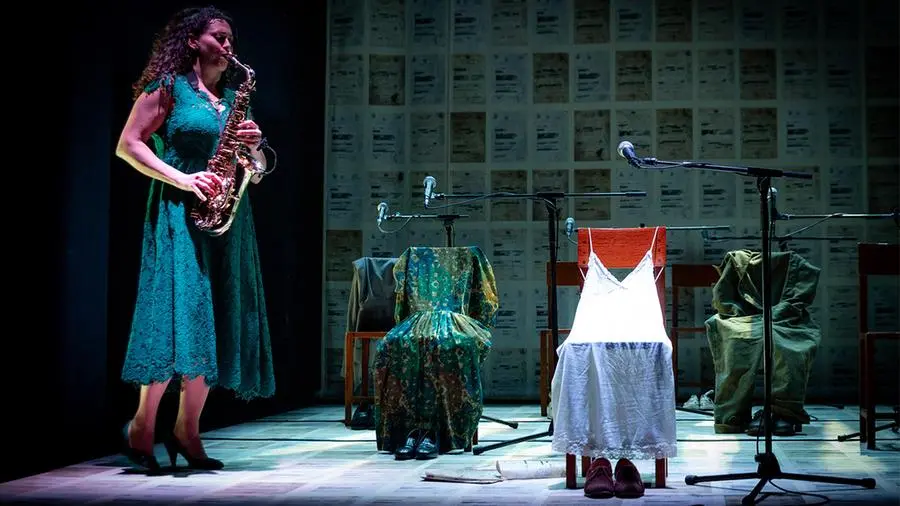
Marina Notaro on saxophone.
Here lies all the power of the text: Mary Stuart does not propose philosophical reflections or draw moral conclusions. It limits itself to providing an objective account of the events, leaving it up to the facts themselves, when all is said and done, to force reflection. This truth, which the protagonist fears might be judged as a purely subjective vision, becomes a universal reality precisely because of its honesty. Direction, sounds and lights support this symphony orchestra of elements that undermines the prejudices with which we are used to reading history.
Mary Stuart was not a queen. She was a simple woman, yet her story remains carved out of the chaos of abstract reflections, imposing itself with the specific weight of the crudest reality. There is no space for the evanescence of concepts when the word becomes flesh, work and survival. The strength of this project created by Andrée Ruth Shammah it lies precisely in its tangible scope, a substance that does not dissolve because it is bitten by the truth of the facts. It is the story of too many women who, yesterday and today, have faced and face endemic and silent violence: a world where the executioners do not die, but the victims remain dead even though they are still alive.