











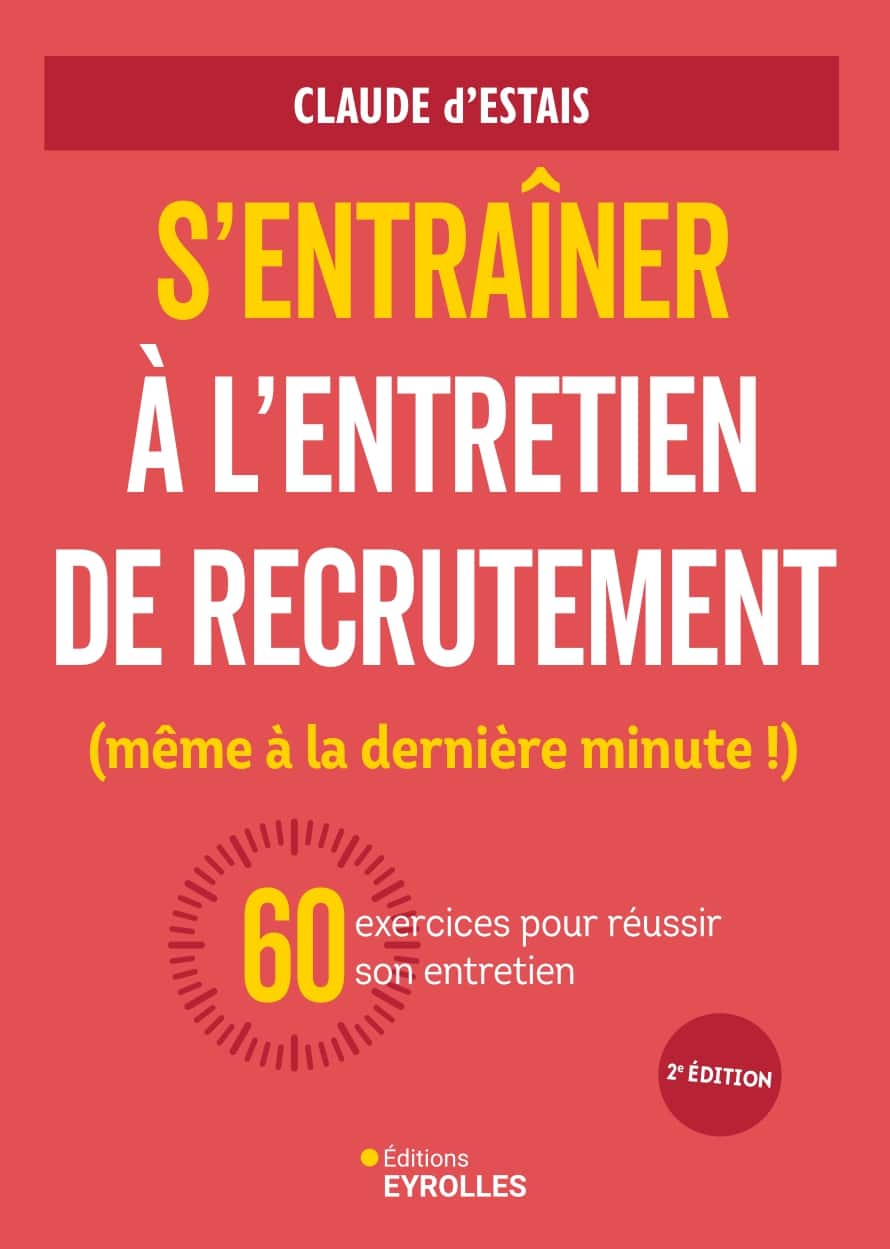
Succeeding in a recruitment interview is neither a matter of improvisation nor chance. Preparation, alignment, stress management, gender bias: in this in-depth interview, Claude d’Estais, professional support expert and author of “ Practice for the recruitment interview… even at the last minute » (new enriched edition 2026 Editions Eyrolles), provides a detailed and concrete reading of this high-stakes exercise. She shares pragmatic tools and essential keys to understanding, in particular for women who wish to take responsibility for their journey, position themselves accurately and convince without justifying themselves.
You affirm that a recruitment interview is never an exercise in improvisation. Why do you think preparation remains the absolute key to making a difference?
Claude d’Estais: Training and preparing before a recruitment interview is fundamental. It’s about putting yourself in battle order: identifying your strengths, your assets, but also your weaknesses, in order to construct a clear, structured and precise speech… therefore impactful.
With my clients, I often use the metaphor of organizing a cupboard to illustrate this preparation work. I explain to them: “ We will sort your wardrobe together: sweaters, blouses, pants, skirts and dresses. We will fold and store them carefully, by categories and colors. You will thus have a clear vision of what you have, your strengths, and what you may be lacking. »
This work allows you to produce a sharp and impactful speech, adapted to a large number of interview questions. You can then go and get, without hesitation, the “ turquoise blue sweater » perfectly adjusted to the question asked, without disorganizing your entire wardrobe. And if a question calls for an answer that you hadn’t anticipated, you can “ improvise serenely » by intelligently combining what you already have.
To those who believe that preparation harms naturalness, I respond that actors are all the more natural on stage when they have learned and rehearsed their lines.
Finally, solid preparation makes stress management considerably easier. Training and applying procedures is the daily life of units like the GIGN: when they intervene in extreme situations, they can provide the best responses precisely because they have prepared in advance.
You place alignment as the first factor of success in an interview. How does being clear with yourself actually change the recruiter’s perception?
Claude d’Estais: Being aligned means knowing who you are, what you want, what you don’t want and what you bring. This inner clarity is immediately felt during the interview: the speech is fluid, coherent, structured. The recruiter then perceives a credible, readable and reliable candidate, capable of clearly positioning herself. Alignment is reassuring, because it gives the feeling of a person aware of their value and their place.
Conversely, a lack of alignment often results in unclear or contradictory answers, which create doubt in the recruiter’s mind.
You remind us that recruiting is above all a risky act for the company. How can candidates integrate this reality to adjust their posture during interviews?
Claude d’Estais: It is useful to remind candidates, who are often stressed, that their interlocutor is frequently just as stressed. Recruitment represents a significant cost for a company and a real loss of earnings in the event of failure.
Furthermore, knowing how to recruit, build and develop a team has become a key management skill, directly integrated into the evaluation of managers’ performance.
In this context, it is essential for a candidate to reassure the recruiter, not only about her ability to succeed in the role, but also about her ability to integrate into the team and share the company’s values.
Many women still approach the interview as an exercise in justifying their career path. Why can this posture be detrimental to them, and how can we get out of it?
Claude d’Estais: If women are more likely than men to justify their career path, it is often because they believe that certain choices – maternity, parental leave, retraining – do not correspond to the company’s expectations.
However, these choices can also reflect an ability to decide, to commit, to assume one’s priorities, and to deeply respect the value of work. Wanting to justify yourself at all costs can, conversely, be seen as an admission of weakness.
My advice is simple: make your choices, without trying to justify them excessively. As the saying goes, “ who justifies himself, accuses himself “.
In your experience, what are the most common biases that women face in recruitment interviews today?
Claude d’Estais: The most frequent biases still concern the supposed availability of women, absences linked to maternity or the ability to reconcile professional and personal life.
A more subtle bias also concerns the perception of ambition. When a man clearly expresses his goals, he is often seen as a driving force. When a woman adopts the same posture, she may be judged too demanding or, paradoxically, lack ambition if she is more measured.
You devote part of your book to questions of a discriminatory nature. How can a candidate answer it without putting herself in difficulty or giving up her limits?

Claude d’Estais: Despite current legislation, certain questions relating to their age, family situation or maternity continue to be asked in interviews to women. When faced with this type of question, it is important not to be mistaken about your recruiter’s intention. Often, it can happen to make “ small talk » that recruiters ask questions without realizing their potentially discriminatory nature. In this case, the primary intention is not to discriminate.
That being said, any information given may be used. It is therefore essential to weigh your response. When faced with a clearly discriminatory question, it is best to answer it in a direct and very concise manner, without going into personal details, in order to quickly refocus the exchange on the professional field, without adopting a defensive posture.
You give a central place to stress management. Can we really transform stress into a performance lever during an interview?
Claude d’Estais: Stress is an adaptation reaction to a situation perceived as threatening. In moderate doses, it mobilizes our resources and stimulates our intellectual abilities.
When it becomes excessive, the body “coward” certain non-vital functions: digestion, language, gestures, etc. These manifestations (sweaty hands, stuttering, tense smile) are unpleasant and amplify stress.
Hence the importance, again, of preparation. Good preparation allows you to transform stress into a real performance lever. This stress then becomes a driving force, comparable to the stage fright of great actors before going on stage: essential to being not good, but very good in interviews.
You talk about silence as a strategic tool that is often underestimated. How can silence become a form of power in the exchange with the recruiter?
Claude d’Estais: Silence is a powerful tool. In our culture, it is socially difficult to cut people off. Leaving silence allows the recruiter to intervene naturally, express his expectations and guide the exchange.
An interactive interview creates a positive climate and encourages the recruiter’s involvement in your application. Silence, used well, also highlights your words. As in music, a speech without silences quickly becomes inaudible.
You invite the candidates to work on their “gray areas“Why is it risky to ignore them, even when you feel experienced and legitimate?
Claude d’Estais: Your gray areas are often points on which we are not completely aligned with ourselves: geographical mobility, professional/personal life balance, real ambitions…
Each individual has their own gray areas. Not working on them means taking the risk that they arise uncontrolled in an interview, creating a perceptible dissonance for the recruiter. Under stress, the unconscious can very effectively sabotage the message we wish to convey.
For the recruiter, it is a dissonant note which immediately generates the following questions:
- Why is this candidate talking to me about this subject?
- How does this answer relate to my question and the thread of our interview?
- Why did this candidate just say the exact opposite of what she told me a few minutes ago?
- Why does this candidate express behavior with her gestures that is completely contradictory to what she is saying?
Your unconscious under stress has the capacity to very effectively torpedo the messages you are sending. Managing your unconscious well so that it stays in its place is not a question of legitimacy, but of working on yourself. High-stakes situations are typically those where your control abilities work less well… And therefore they are perfect opportunities for your unconscious to manifest!
If you had to give just one piece of advice to a woman who is hesitant about taking on an ambitious position, what would it be?
Claude d’Estais: My advice would be to never ask yourself what is missing to be fully successful in a position. The important thing is to identify the many assets you can build on and use them.


