





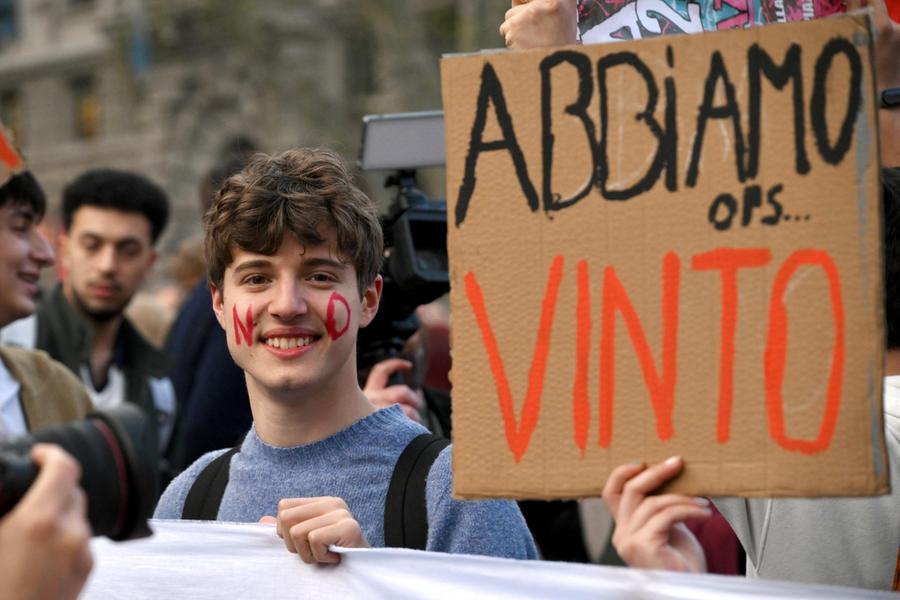
In the aftermath of the referendum on justice, the headline that occupied the pages of the newspapers the most, after the referendum result, was the one on young people. 61% of young people aged between 18 and 34 voted No. With Andrea Bonanomi, Associate professor of Social Statistics for the Catholic Faculty of Psychology and researcher for the Youth Observatory of the Toniolo Institute, let’s try to understand what this data tells us and what signal it gives to politics.
Professor, which generation are we talking about?
«Generation Z ranging from 18 to 30 years old, of networks and digital natives».
What politically distinguishes these young people from previous generations?
«They are much more liquid, fluid, non-partisan. The term ideology is not part of their vocabulary nor of their way of doing politics. They have a more value-based approach and membership is based on themes, campaigns and problems, not ideological and rigid as it was for previous generations.”


It was young people, to a large extent, who contributed to rejecting the reform. What relationship is there between this generation and the Constitution born in 1947?
«It’s a very strong relationship. They are young people who grew up in enormous uncertainty: born after September 11, 2001, they have gone through the financial recession, the environmental crisis, the pandemic and now the season of wars. For them the Constitution exists and is solid, their grandparents made it for which they have great respect and the idea of touching it without knowing how was really too much. That “don’t touch our grandparents” was a message against parents and the damage they are doing in politics. The other decisive aspect is that the only solid political figure recognized by young people is Mattarella who has made the Constitution his own and cites it on every occasion.”
The Constitution as a still current instrument for the protection of rights?
«Yes, especially for a generation that makes rights and the environment the cornerstones of its commitment».
How much influence have social networks had on the formation of young people’s opinion?
«This generation no longer gets information through traditional channels, paper newspapers or TV. The Internet is their channel. They experience social media as a space for the formation of ideas, they have a more critical approach than ours, they distinguish what is true from what is false. They use them not to absorb an idea, but to build it. There are pages that have millions of views. And then there’s the world of podcasts. They use the tool to ask themselves questions, with a decidedly better attitude than boomers.”
This is why the “constitutional spirit” seems to have overcome the typical polarization of social media: is it a sign of political maturity?
«They certainly didn’t appreciate that on a matter as important as the Constitution, the founding pact of our country, there was polarization in the form of “fans”. The stadium atmosphere – as they call it – on such a sacred and important topic was not liked. The Constitution cannot be touched for young people.”
Then there is the decisive weight of associations and live meetings. Face-to-face meetings helped understand complex questions better than online debates.
«After the Pandemic, political participation has many facets: it is not just being part of a party or going to vote. But it means talking about it, joining campaigns, being part of associations and volunteering “in person”. This is a generation that went to high school in Dad: for them it is the opportunity to experiment and get their hands dirty and see the results quickly. So they have immediate knowledge of what they are doing. A characteristic of this generation is not to persevere if they don’t see results immediately. There they know they can make a difference. Furthermore, they talked about it a lot at school, addressing the issues, the technical aspects, specifically addressing the topic much more than the adults who were polarized to the right or left, for or against the Government”.
Can we talk about a return to participation “from below”?
«For them, participation is much more horizontal, unstructured. It’s a wave that has already started since the European elections. They don’t go to vote in political elections because they see them as far away, they are far from the parties but not from politics. In local elections the data tells us that they do not vote less than adults, in the European elections approximately 2% more than adults voted. They go to vote if they know they are making a difference.”
What relationship do young people have with politics. Of trust, distrust or disillusionment?
«With the Youth Report of the Toniolo Institute we have been working on the condition of youth for more than 15 years. What we notice is that it is not true that there is no interest or that it is weak. It’s like an ember that needs to be fed, otherwise it goes out. But it doesn’t take much to rekindle it and the Referendum showed us this. They start out with enthusiasm but the lack of spaces for participation, the lack of a political offer that speaks to them and about them and all this becomes mistrust, disenchantment and disillusionment. But they are born enthusiastic. Certainly the structure of the Italian parties makes them feel distant. Even if the data towards the parties is constantly growing: in 2025 31% said they had trust, in 2012 it was only 8%. To the question “Without parties is there democracy?” more than 60% say no. They recognize that they are fundamental but the offer we have in Italy does not represent or involve them.”
What value do they give to the vote?
«They go if they understand that voting can make a difference, otherwise they don’t go. And this referendum without a quorum is proof of this. They have not internalized the idea of voting as a duty, for them it is more of a right. When this right allows them to have their say and makes a difference then they go to vote.”
A look at the future. Could this youth protagonism also have effects in the next elections?
«No, politics must be good at keeping the flame alive. Indeed, the mistake you must not make is to think that you have recovered the young people.”
What are the main political demands of the new generations today?
«Rights, foreign policy (and how much the war that surrounds us undermines people’s rights), the environmental issue that has moved generations in recent years starting from Fridays for Future, an exercise in collective participation of young people that has not been valorised. Finally, work which is their great concern.”
What should politics do to permanently involve young people?
«When a young person approaches a party, don’t make them do leafleting for ten years but enhance them in the skills in which they make the difference: the environmental issue, technologies. Approaching them not as young people – now we are talking about youth quotas in parties but it would still mean treating them as an endangered breed – but valuing them because they are competent”.
Finally, if this referendum tells us something about young Italians, what is the most important message that politics should grasp?
«That if young people want – and they want it – they will make a difference and they will be there. They’re not on the couch, lying down. They demonstrated participation and conscious voting. They clearly told us “we are here and we know what we are talking about”. They gave a very strong message. The high turnout among young people was the best result of this referendum.”