
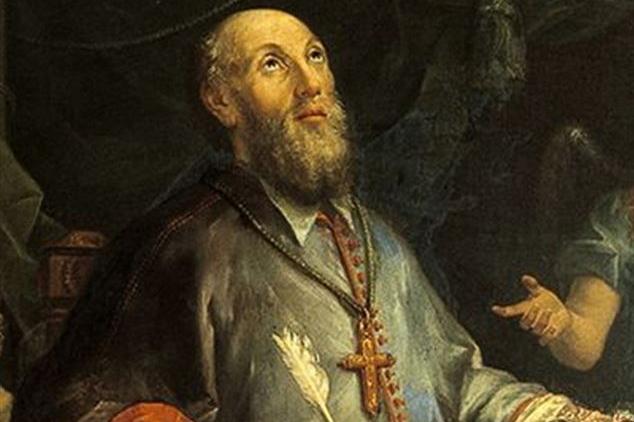




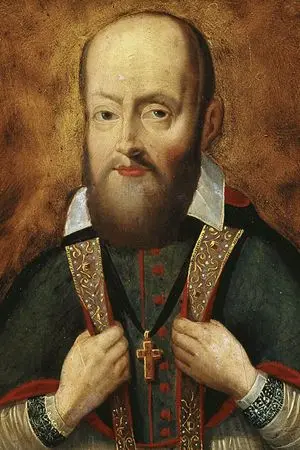
Children’s lives often go in the opposite direction to what their fathers expect. This was also the case for François (Francis) de Sales (the castle, in Savoy, where he was born on 21 August 1567). From an early age, his father saw before him – gifted with uncommon intelligence and character – a brilliant career in the world, destined to revive his fortunes and give new prestige to the noble Boisy family. Francesco was educated in the best boarding schools in France (La Roche, Annecy, Paris); receives a solid education in the humanities; he studied law at the University of Padua, famous throughout Europe – as well as for medicine – also for legal subjects. He stayed in the Venetian city for three years (1588-1591), dedicating himself profitably to study, but also cultivating the religious vocation that had blossomed for some time and which progressed under the guidance of the Jesuit Antonio Possevino. After obtaining his degree in law (1591), Francesco returns home. Here a long internal battle awaits him: on the one hand, the ambitions of his father (who would like him to be a lawyer and senator, and who also chooses for him the very young noblewoman who should marry him); on the other, his only true aspiration: that of “being of the Church” and of serving it to win souls for God. He manages to resist every pressure and overcomes every flattery in order to give his life the expected turning point, becoming a priest. This happened in 1593. Appointed archpriest of the cathedral chapter of Geneva, Francis immediately demonstrated qualities of zeal and charity, of diplomacy and balance, which would accompany him throughout his life and of which he would give exemplary proof in the difficult apostolic mission (1594-1598) in Chablais, by then conquered by Calvinism.
His fame spreads, and we really need to insist that he accept the proposal to become auxiliary bishop of Geneva: nomination ratified by Clement VIII in 1599. The sad events that Francis was about to experience from 1598 to 1602 (the death of his father, economic difficulties, diplomatic conflicts, the invasion of Savoy by the French) did not weaken his commitment, nor did the spiritual fruits of his activity diminish. Indeed, they increased when, upon the death of Monsignor de Granier, bishop of Geneva, he was destined to succeed him (1602). Her love of God, her simplicity and her sweetness conquered hearts: starting with that of Baroness Giovanna Francesca Fremyot de Chantal (1572-1641), an exceptional figure of woman and religious (she was canonized in 1767), co-founder with Francis of the Order of the Visitation of Saint Mary. Tireless in preaching, in catechesis, in the administration of the sacraments, in pastoral visits, Francis, fortunately, does not even fail to trace the lines of his priestly spirituality. Thus was born Philothea or Introduction to the devout life (1609), his first and fundamental ascetic work, which will also have great editorial success and, a few years later, the Teotimo or Treatise on the Love of God (1616). The spirit of true religious devotion, as Francis understands it, is summarized here: not an external manifestation, nor a rigid practice, as was the custom in those times, but rather a constant improvement of oneself in perfect union with God and in the exercise of the theological virtues.

Founder of the Visitation Sisters
These inspiring principles guide the Visitation of Saint Mary, the institute of monastic life for women, without the obligation of seclusion, founded in Annecy in 1610. In fact, Francis wants the institute to renounce any excessive form of bodily austerity (thus also opening up to people with weak health), to be rather a school of prayer, contemplation and “asceticism of the heart” (mortification, purification, penance, humility, gentleness, patience): an internal training ground also necessary to prepare for the external service of the apostolate and charity. In this way, the Visitation Sisters, Visitandines, could be completely of God without being detached from the world.
The foundation of a Visitation monastery in Lyon, at the request of the archbishop Monsignor de Marquemont (1616), however, will represent a turning point in the life of the small diocesan congregation and will be the prelude to its transformation into a religious order (1618).
Until the last of his days, Francis offered a clear testimony of what it means to love God and brothers. He died in Lyon on 28 December 1622. He was canonized in 1665; later, he was also awarded the title of Doctor of the Church (1877).
In 1923 Pius XI proclaimed him the patron saint of journalists
Ordained on 18 December 1593, he was sent to the Chablais region, dominated by Calvinism, and dedicated himself above all to preaching, choosing not polemical opposition, but the method of dialogue.
To meet the many he could not reach with his preachingdevised the system of publishing and having “posters” posted in public places, composed in an agile and highly effective style. This intuition, which bore such notable fruits as to determine the collapse of the Calvinist “stronghold”, earned St. Francis the title of being indicated, in 1923 by Pius XI, as the patron saint of Catholic journalists and writers.