
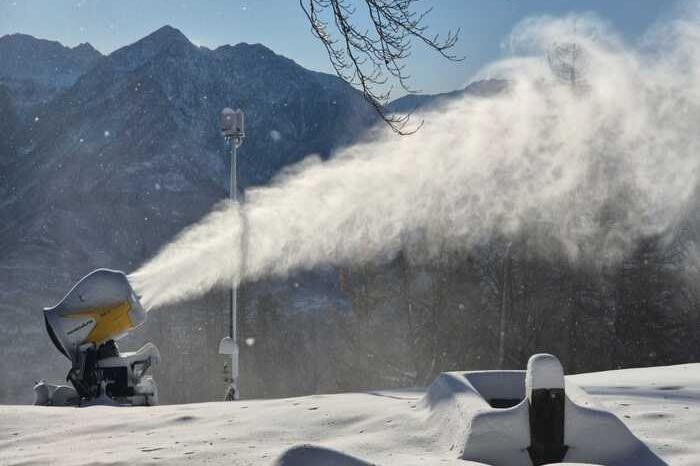



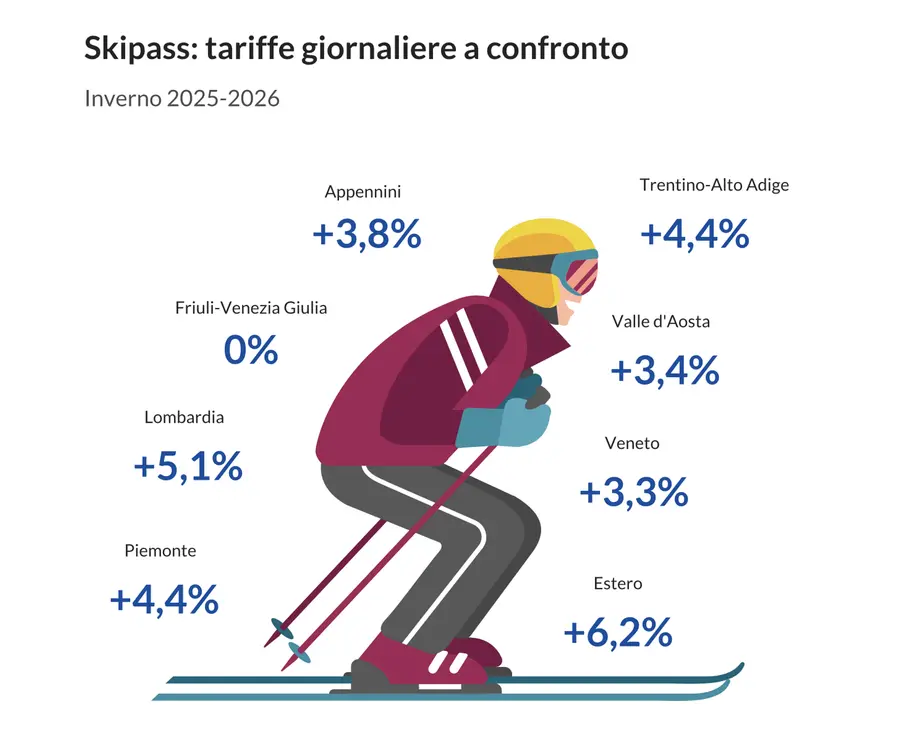
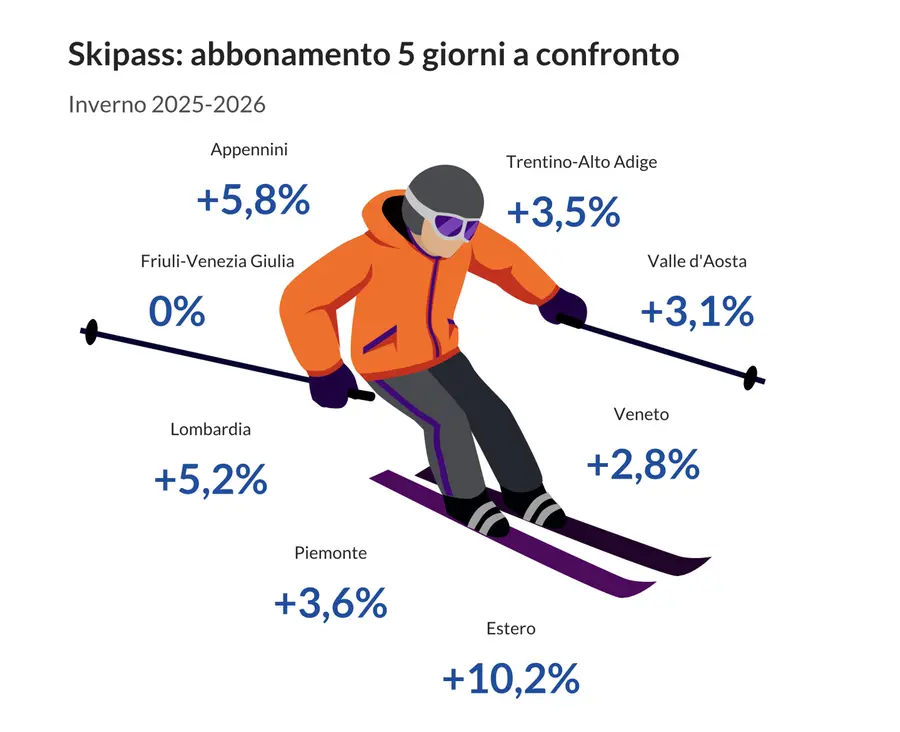
In 2025-2026 the prices for a day of skiing will rise again. According to the Altroconsumo survey, based on 44 Italian ski resorts – with some comparisons with ski resorts across the border – the daily ski pass recorded an average increase of +4% compared to last year; the five-day pass increased by +4.4%.
The result is a rather high bill for those who want to put on skis: in some of the most popular resorts, the cost for three adults (ski pass only) can reach up to 260 euros per day; and for those who choose top locations, the figures fly even higher.

From Livigno to Cortina, a wide (and growing) gap
In the Lombardy area, the Livigno district records one of the strongest increases: the daily ski pass for adults goes from 65 to around 71-72 euros (varies depending on the period), equal to an increase of more than 10%. In the North-East, Cortina d’Ampezzo – which has always been a popular destination for skiers – sees the daily ski pass stand at around 80 euros, in line with the high average for 2025-26. In the large areas of the Dolomites and Trentino-Alto Adige, prices remain among the highest in the country: in some cases the ski pass costs up to 86 euros per day.
Those aiming for a ski week – with a multi-day ski pass – discover that the savings compared to five “single” day tickets are often marginal: according to the survey, the five-day ticket is only worth on average just over 40 euros compared to five single day tickets. This is why – say many experts – skiing increasingly risks becoming an exclusive activity, accessible only to wealthy sections of the population.
It’s not just a question of prices: the tourist profile is changing
The increase in ski pass prices is not an isolated phenomenon. Behind it there is a deeper transformation of Alpine tourism. As Gianni Battaiola, president of Federalberghi Trentino and Trentino Marketing, recently observed – which we will analyze in more detail in the next issue of Famiglia Cristiana – winter tourism in mountain resorts is changing: They are no longer building “tourist resorts” like forty years ago, but places where people live all year round, with a mix of residents and “temporary visitors”. Global mobility, flights, international interest: skiing is no longer a domestic sport, but a destination for tourists from all over the world. For this clientele, often international, high standards of comfort and services are expected – but producing “quality” has a cost, which inevitably ends up on the consumer.
The result is an increasingly demanding tourist offer – refuges with panoramic lounges or glass and steel architecture, high-quality cuisine, extra services – but also a progressive increase in prices, which makes the winter mountains an increasingly less democratic experience.
The consequences: fewer families, more elite tourism – and mountains at risk of exclusion
The impact of these increases is destined to be felt above all on families and the middle classes. If a day of skiing for three adults can cost 260 euros for ski passes alone, not to mention accommodation, transport, equipment rental and cost of living at altitude, the budget for a ski holiday becomes very burdensome.
This doesn’t just mean fewer visitors: it means a change in the type of tourism. More and more “elite holidays”, with less space for those seeking the mountains as a family escape or an opportunity for simple socializing.
Furthermore, the mountain – already fragile in terms of environment, services, social balance – risks losing part of its popular identity. The facilities become infrastructures for exclusive tourism, the mountains for a few, and the local community can feel expropriated.
We need a balanced vision of the future
The crossroads is clear: either the winter mountains remain a common good, accessible to many, or it risks turning into a luxury for the few. To avoid it, courageous choices are needed.
Alongside “ski” tourism, it is essential to enhance winter as a season of excursions, snowshoeing, immersive experiences in nature – an offer capable of attracting people even without groomed slopes, without “top of the range” ski passes.
But we also need conscious policies: accessible prices, diversification of the offer, attention to residents, and respect for the environment and local communities.
In the next issue of Famiglia Cristiana we will open an investigation into the future of the mountains in winter. Because today we can no longer call them tourists: they are temporary citizens.
As underlined by Gianni Battaiola – a key figure in Alpine tourism – for decades the mountain has no longer been a place for “passing” holidays, but a context in continuous transformation. «We don’t build a tourist resort, we build a place where people live well. If those who live there are happy, then those who arrive can also find a beautiful, welcoming, balanced area to return to.”
What changes, first of all, is mobility: snow has become global. Today the international presence in the Alps has grown dramatically — and in Trentino, for example, the ratio between foreigners and Italians is now 60-40. They come from East and West: Asians, Americans, Brazilians. Americans even buy entire destinations in Switzerland. Climate change accelerates the transformation: shorter seasons, less predictable snow. This is how alternative offers to skiing are born: walking, snowshoeing, wellness. But, as Battaiola warns, a winter without skis makes the mountains sad. Snow remains central to the economic life of the territories.
The crux – concludes Battaiola – lies in balance. «There is no overtourism. There is bad management, bad flow management.” We need sustainable attendance numbers, shared rules, a pact between residents and “temporary citizens”. We need variety: not just Italian weekends, nor an excessive foreign presence. We need to diversify to find the right balance.
The challenge that awaits the mountain is only one: connecting the territory to the tourist. Make those who arrive feel like temporary citizens. Because only in this way does emotion become respect, and tourism becomes the future.
Infographics: Altroconsumo.